Ayyan Mani and Oja Mani’s marriage
Serious MenAyyan Mani and Oja Mani’s marriage is shaped by bereavement, poverty, and the shrinking possibilities of family life in the BDD Chawl. Ayyan brings Oja into a home left empty by the deaths of his parents and brothers, but his initial hopes for the marriage are marked by a calculating view of her youth. Years later, as desire gives way to detachment and disagreement over their son’s upbringing, both remain bound to a family life Ayyan once imagined love could transform but cannot simply escape.
Origins and the Chawl Home
By the time Oja enters Ayyan’s life, his three brothers have died within eighteen months, followed by his father and mother. He is twenty-seven and she is seventeen. He has ushered her into his home while calculating that she will remain young after his own potency begins to fade: an expectation that makes the marriage’s starting point less a meeting of equals than an arrangement imagined around his future needs.
Their first night exposes the fear inside that arrangement. On the conjugal mattress, among funereal roses left by neighbours and friends, Ayyan discovers that Oja has carefully cut her arms and legs with a Topaz blade without damaging her veins. She has done it to provide a reason to be left alone, and to avoid being undressed by a stranger. This memory later becomes one Ayyan summons when he feels trapped by family life: the wedding that began with his possession of a bride also began with her attempt to protect herself from him.
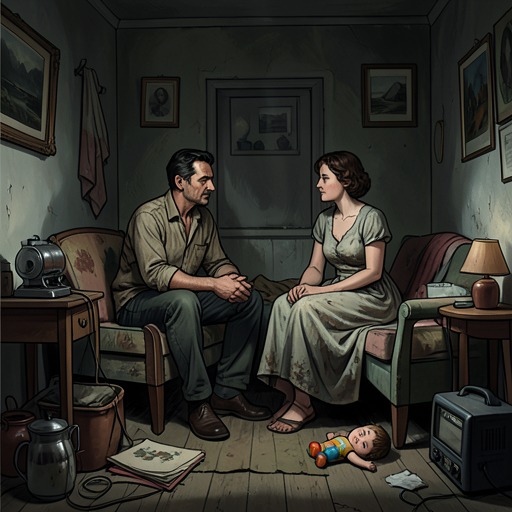
The physical setting allows little privacy or room for change. Their home is fifteen feet long and ten feet wide, with a central patch of cleared stone floor, a television, washing machine, cupboard, and a rudimentary kitchen beside a tiny bathroom. The larger corridor is lined with open doors and occupied by neighbours; Ayyan’s sense of Oja being trapped with him is inseparable from the surrounding crowding. The young woman who once spoke in giggles and sang in the mornings seems, to him, to have absorbed the darkness of the chawl.
Intimacy, Detachment, and Care
Ayyan’s recollection of the newlyweds carrying empty travel bags to cheap lodges makes their circumstances visible by contrast. Other couples seek a private bed for a day; he says he never had to do that, because he and Oja lived together in the crowded family home. The detail is not simply about their lack of money: it sets privacy, romance, and ordinary marital pleasure against a dwelling where more than a dozen people may share a room and newlyweds sleep on illegal wooden lofts above their families.
Over time, Ayyan experiences Oja’s response to sex as a change he cannot reverse. Her face, once animated by moans and coyness, becomes blank and distant; he imagines ways to provoke a reaction, then abandons those private games and accepts her detached love as he accepts her cups of tea. The fantasies he invents do not restore intimacy. Instead, her unresponsive gaze frightens him because he reads it as evidence that the woman he loves is stranded in a dull life because of him.
That recognition coexists with fantasies of solitary freedom. Ayyan imagines leaving family life to sleep beneath open skies and expect nothing from anyone, but concludes that a bachelor’s freedom is like that of a stray dog. He returns in memory to Oja’s frightened arrival as a bride, not because the past resolves their present estrangement, but because it renews his sense of obligation and attachment. When they are intimate, the distance between them remains: even during sex, Oja turns her attention to checking on Adi.
One morning, while Adi is bathing, Ayyan tells Oja that, for their son’s sake, they must stop seeking their own pleasures. She accepts the decision with a nod while watching the milk boil. On the walk to school, Ayyan keeps returning to that small, domestic image and interprets it as a sign of his own decline. The moment is both practical and painful: their son reorganizes their private life, while the ease with which Oja accepts the proposal confirms for Ayyan how far their intimacy has already receded.
Faith, Their Son, and Competing Hopes
Their disagreements over religion reveal different ways of imagining what Adi needs. Oja repeatedly brings home a Ganesha idol; Ayyan rolls it in newspaper and says he will throw it away, as he has before. He insists that they are Buddhists, recalling Ambedkar’s rejection of a religion that had treated them cruelly. Oja, by contrast, wants to claim the Hindu gods as hers, take Adi to a temple, and have festivals at home. Her desire is not only doctrinal: she wants their son to know the gods familiar to other boys and to grow up with a cultural world she feels their household lacks.
Ayyan does not simply dismiss that wish. He regards the epics as products of Brahmin propaganda, yet recognizes that they are also stories through which Adi might encounter moral complexity: virtuous characters choosing wrongly, sympathetic demons, and gods behaving badly. He wants his son to learn morals, patriotism, and the stories themselves, while imagining that at twenty Adi might have enough intelligence to abandon them. His response leaves the couple’s disagreement unresolved, but shows that he can privately concede the value of what Oja wants even as he resists the religious terms in which she asks for it.
The conflict sharpens when Oja links Adi’s hearing impairment to the absence of gods, and presses her wrists to her eyes as she weeps. Ayyan shouts for her to stop. Her grief and explanation meet his anger rather than agreement, exposing how the boy’s disability has become a painful point of interpretation within their marriage. Elsewhere, when Adi removes his hearing aid during his parents’ argument and shuts his right ear, their dispute is registered in the child’s body as well as in their words.
They also occupy different positions in the secret game through which Ayyan manufactures Adi’s reputation as a prodigy. At first, Adi mentions his pact with his father to Oja, but she dismisses it as ordinary father-and-son talk. As teachers begin summoning the parents, she worries about the disruptions yet becomes excited by the prospect of a genius. She says she wants Adi to be normal, tells others about his brilliance, and tries to ward off the evil eye with fire and black powder on his cheek. Her mixed response makes her neither a knowing architect of Ayyan’s scheme nor merely its opponent: she is a mother who fears for her child and hopes that the attention surrounding him might mean something for him.
A Shared Family Under Public Attention
Ayyan recognizes that Oja might not tolerate the pact, and that her opposition could cost Adi the status he is beginning to enjoy at school. Adi, in turn, comes to understand why their game must remain secret: he likes being considered extraordinary rather than being defined as handicapped. The deception therefore places a concealed boundary inside the marriage. Ayyan and his son share a plan from which Oja is initially excluded, even as the public story of Adi’s brilliance begins to draw her in through pride and hope.
When Adi’s supposed achievement appears in The Times of India, residents of the chawl gather around Ayyan’s newspaper and ask what the boy has done. Ayyan explains prime numbers to them; they regard him with affection and respect as the genius’s father. The recognition enlarges the family’s standing in the neighbourhood, but its foundation remains a story Ayyan has invented. Oja’s earlier wish for Adi to be known as other boys are, and her excitement at his apparent brilliance, sit uneasily beside the secret that he and Ayyan have kept from her.
The marriage does not reach a neat resolution. Ayyan continues to feel responsible for Oja’s confinement and attached to her, while their sexual life has cooled and their religious arguments remain unsettled. Their son’s growing reputation brings public attention into a home still defined by limited space and material constraint. What holds the relationship together is not a restored early romance, but the persistent, imperfect work of sharing a household and worrying over Adi—even when Ayyan’s plans, Oja’s hopes, and their beliefs pull them in different directions.