Ayyan’s Press Conference Exposes Institute Remarks
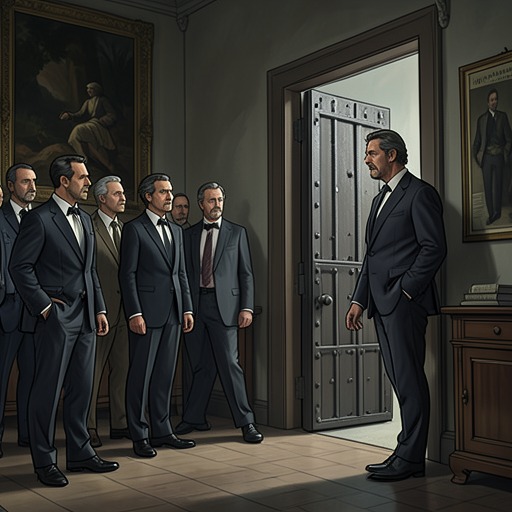
Serious MenAyyan Mani’s press conference transforms the public story of his son’s supposed genius into an indictment of the Institute of Theory and Research. With Minister S. Waman beside him and journalists packed into the minister’s office, Ayyan announces that Adi Mani will not pursue admission to the Institute, then reveals that he has recordings of private conversations among its scientists. The announcement joins two kinds of exposure: the boy’s carefully constructed public identity and the prejudice concealed behind the Institute’s claims to intellectual authority.
Setting and Stakes
The conference takes place after Adi has become a national media sensation. Newspapers and television channels have circulated accounts of the Dalit boy’s extraordinary abilities, while Sister Chastity has repeatedly described his remarkable state of mind. The story has gathered force beyond its factual basis: parents who saw a quiz recount it with inaccuracies, and the country appears captivated by the idea of a genius who is the son of a clerk and grandson of a sweeper. Ayyan, once able to manage the tale as a private game between father and son, now faces a public narrative with its own momentum.
The press conference is staged amid an audience of journalists, photographers and television crews. Ayyan sits behind a table crowded with microphones, Waman at his side. When Waman gives him the microphone, he tells the gathering that his own speech will make sense only after they have heard Ayyan. The minister’s introduction lends the clerk’s testimony political weight, while the crowded room and the cameras promise to carry it well beyond the room.
The Withdrawal from the Institute
Ayyan first addresses Adi’s future, although the boy is not present. He explains that Adi applied to the postgraduate mathematics course at the Institute of Theory and Research, took the Joint Entrance Test and passed. Only the interview remains, but Ayyan declares that his son will not attend it or join the Institute. He gives two reasons: Adi should finish school like other boys, and letting him sit the entrance examination was a mistake.
The decision unsettles the audience only briefly. Ayyan’s refusal is not simply a retreat from the opportunity that the family’s public story seems to promise. He is also rejecting the institution as a destination for his son. The distinction matters: the supposed prodigy has been presented as evidence of an opening for a Dalit child, but Ayyan now argues that neither the boy’s schooling nor the Institute’s culture makes that admission a straightforward good. His announcement interrupts the triumphant story just as it reaches the threshold of institutional recognition.
A Clerk’s Evidence
Ayyan then identifies his own position in the Institute. He has worked there for fifteen years, beginning as an office boy and rising to clerk. He describes Arvind Acharya as a great man who has been shamed, whose life has been destroyed and who has almost gone mad. Ayyan says that the public does not know what actually happened inside the Institute, but that he does. He has a CD containing a recording that, he says, will explain the events; he also has another recording that is more shocking. The Institute, he warns, is a frightening place for his son to enter.
The disclosure changes the meaning of Ayyan’s presence. He is not speaking as an outside observer or as a scientist, but as a long-serving employee who has listened, recorded and waited for a moment when his testimony might be taken seriously. He explains that, as a clerk, he expected no one to believe him before this day. The press conference therefore gives his recordings a public platform that his position within the institution had not afforded him. His personal account of Adi’s educational future becomes inseparable from the evidence he says he has kept.
The Recordings and the Institute’s Crisis
The recordings’ impact is visible inside the Institute as the news spreads. The astronomers gather around a television, watching channels play the voices of men in the room and their disparaging views about the intellectual capacities of Dalits and women. Commentators, including a conspicuous number of female reporters and presenters, mock the kind of men running Indian science. The private conversation between Oparna Goshmaulik and Arvind Acharya is no longer the focus of the broadcasts. The released remarks instead make the scientists’ own language a public spectacle.
The disclosures expose the Institute to two different fears. The Oparna recording could clear Acharya and make his return seem imminent; Jana Nambodri had earlier suggested attacking the recording’s credibility, but has now fallen silent. At the same time, the astronomers fear violent public retaliation if Dalits feel slighted. Police vans stand guard at the gates, yet their presence does little to reassure the staff. Protest has already begun within the grounds: the Institute peons have stopped work, left taps running and clogged toilets with broken cutlery. Ayyan’s press conference thus lands in an institution already losing control of both its public reputation and its daily operations.
Caste, Performance and Public Consequence
The press conference’s force is grounded in a longer history of caste exclusion. In an earlier conversation, Sister Chastity tells Ayyan that Brahmins still use a degrading private name for Dalits, despite using a more acceptable term in public. Ayyan answers by contrasting centuries of accumulated Brahmin privilege with his own childhood as the son of a sweeper in a one-room home. That contrast gives the conference’s public language of opportunity a sharper edge: the celebrated boy’s achievement is being made to stand for a group whose access to education and respect remains unequal.
Ayyan’s public intervention also follows his private construction of Adi’s genius persona. He had drawn his son into a secret pact, supplying questions for him to ask in class; Adi came to enjoy being regarded as extraordinary rather than merely labelled special because of his partial deafness. Ayyan then arranged a fictitious news item about the boy. When a photograph showed Adi wearing a hearing aid on his good ear, the detail passed unnoticed, helping the performance appear credible. At the press conference, however, Ayyan uses the attention generated by that fabrication to speak about a real institution and its real remarks. The final irony comes when Nambodri later asks which ear Adi cannot hear with, and Ayyan calmly answers that both are deaf, adding that Adi likes to wear only one hearing aid at a time. The boundary between exposure and deception remains unsettled: Ayyan has manufactured a public image, but the recordings turn the audience’s attention toward prejudice that the Institute’s own members had spoken aloud.