BDD Chawl
Serious MenBDD Chawl is a sprawling residential complex of old, deteriorating buildings where tens of thousands of people live in cramped conditions. It is both Ayyan Mani’s birthplace and the setting of a close-knit but divided community: a place marked by shared routines and memories, yet also by poverty, social competition, and a contested prospect of redevelopment.
Setting and History
The complex comprises 120 identical three-storey buildings, containing about ten thousand one-room homes. More than eighty thousand people live there. Its exterior bears the effects of age and weather: the paint has long disappeared, clothes hang from the small, dark windows, and parts of the walls and even roofs sometimes fall, particularly during the heavy August rains. The scale of the complex does not translate into spaciousness; residents share small homes with extended families, sometimes gathering several generations and many relatives under one roof.
The British built the chawls more than eight decades ago as housing for people without homes, in what the narrative presents as a belated act of conscience. But the buildings were so poorly designed that street dwellers refused to move in. For them, exchanging life outdoors for a small, dark room along a long corridor was no improvement. The unoccupied homes were instead turned into cells for freedom fighters. A place that had failed as a refuge and served as a prison later became home to a vast population, carrying these layers of abandonment, confinement, and ordinary residence in its history.
Neighborhood Life
Life in BDD Chawl unfolds amid a dense public world. Residents gather around the buildings and on their walkways; the neighborhood’s young people talk and practice English, while boys’ playful wrestling can tip into a quarrel. The buildings hold people through the changing fortunes of family life, including new unions and deaths. The resulting closeness is not simply comfort: families have little room to separate, and the everyday community is shaped by both mutual familiarity and material constraint.
The men’s lives make that constraint especially visible. Joblessness and drinking are common enough to be familiar sights, and being sober and employed is treated as an exceptional achievement. Older mothers have lost sons before those sons reached thirty, yet remain capable of laughing together. The neighborhood is not presented as a single mood of deprivation: grief, humor, youthful hope, and routine coexist in its crowded spaces. Its inhabitants form a community through proximity and shared experience, though that closeness does not erase the limits and frustrations of their circumstances.
Ayyan Mani and the Chawl
Ayyan was born on a floor in BDD Chawl thirty-nine years before the events described. He lives in Block Number Forty-One, reached by steep colonial stairways, and still returns home with affection. To the local men, his shared childhood makes him a familiar figure, and his relative success has made him something of a legend. He laughs with them, lends money, and joins their conversations on the terrace about cricket, property developers, and public figures.
Yet his warmth does not amount to belonging without reservation. Ayyan has deliberately separated himself, in his own thinking, from the world in which he grew up; he believes he had to reject it in order to imagine a way out. He notices the resentment of old friends who feel he has left them behind, and takes that resentment as reassurance. His view of male fellowship is similarly skeptical: joking, shared memories, and generosity do not overcome the rivalry he sees beneath them. The chawl is therefore both the home he loves and the social world he feels compelled to outgrow.
The Redevelopment Dispute
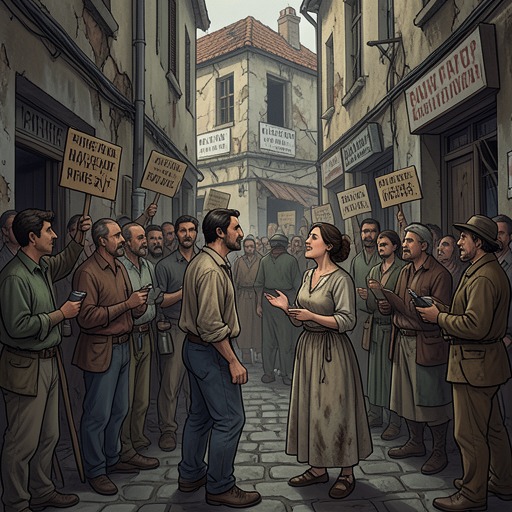
The complex’s extensive property attracts builders, who periodically send agents to persuade residents to sell their flats. One such negotiation takes place at night on the tar-coated terrace, before more than a hundred men and a few women. The agents sit at the center of the gathering, while residents voice competing expectations and anxieties. Ayyan has seen similar meetings and expects this one to produce no agreement.
The residents disagree about when and on what terms to sell. Some believe delay could bring a better price; residents who need money quickly favor selling, while their urgency strengthens the resolve of those who prefer to wait. Others fear they would not manage in the promised high-rises. One woman worries that apartment living would require keeping the doors shut, while another resident insists that the forty families on the ground floor should receive neighboring flats because they have lived as one family for decades. Ayyan wants to sell, but knows the competing claims make an immediate resolution unlikely. The dispute turns redevelopment into more than a question of buildings: it threatens established patterns of proximity while offering a possible way to leave deteriorating housing.
Narrative Significance
BDD Chawl is not merely a backdrop to Ayyan’s life. Its physical crowding gives material form to the social conditions he seeks to escape, while his continued attachment to home complicates any simple account of departure. His neighbors’ memories of him and their resentment of his advancement keep him connected to the community even as he judges its bonds competitive and its circumstances restrictive.
The redevelopment meeting makes the same tension visible at a collective scale. Residents share a place and a long history, but those shared ties do not produce a single position: the need for money, hopes for a better return, fear of unfamiliar apartments, and loyalty to long-standing neighbors pull in different directions. BDD Chawl’s significance lies in this unresolved combination of home and confinement, solidarity and rivalry, inherited hardship and imagined escape.