Free Will and Determinism
Serious MenFree Will and Determinism is both a scientific question and a private conviction for Arvind Acharya. Libet’s experiments offer him a way to describe action as predetermined rather than freely chosen, while a childhood vision of a circus performer’s death gives that argument an intimate, troubling precedent. The novel connects these ideas without settling whether Arvind Acharya witnessed the future, encountered coincidence, or found in the theory a language for events he cannot otherwise explain.
Physics, Purpose, and the Problem of Choice
In a private conversation with Oparna Goshmaulik, Arvind Acharya confesses that he believes physics is stalled and must change. He objects to treating particle bombardment in an expensive collider as sufficient, arguing instead that physics should make room for life and consciousness as part of what science investigates. The claim is not presented as a developed alternative theory; the scene emphasizes how difficult he finds it to express an idea that seems clear in his mind. He also recognizes the professional risk of voicing it publicly, since such a position could be dismissed as the talk of a scientist who has lost his reason.
His larger intuition is that the universe has a plot or purpose, though he cannot say what that purpose is. This belief sits beside, rather than simply resolving, his interest in determinism. If events are fixed in advance, the universe may resemble a film whose scenes unfold according to an established order; yet Arvind Acharya’s sense of a plot also suggests an intelligible design behind that order. The narrative keeps the distinction unsettled: purpose does not necessarily mean that human beings choose their actions, and inevitability does not explain why the universe should have a purpose at all.
Libet’s Experiment and Predetermined Action
Arvind Acharya introduces Libet’s work as a challenge to the ordinary sense that a person consciously decides to act. In the account he gives Oparna Goshmaulik, Libet attached electrodes to volunteers’ scalps and asked them to carry out simple actions, such as lifting a finger or pressing a button. Measurements, as Arvind Acharya describes them, showed neural activity beginning before the volunteers believed they had consciously decided to move. He takes this sequence to imply that the feeling of choosing may arrive after the process that produces the action has already begun.
From that small experimental setup, Arvind Acharya draws a far-reaching possibility: if the conscious decision follows the brain’s initiating activity, actions might be inevitable rather than freely chosen. The implication expands beyond a finger or a button to every event on Earth, from a turn of the head to a dog’s bark or a falling flower. His comparison to a scene in a film makes the idea vivid while also exposing its severity: human beings may experience themselves as choosing, even if the sequence has already been set.
Oparna Goshmaulik knows enough about Libet to question the conclusion. She recalls his association with physiology at the University of California and challenges the claim that experiments could prove free will nonexistent. She also raises a practical objection: Libet’s equipment may have been primitive, leaving room for error. Arvind Acharya has heard such objections before, but his certainty comes from more than the experiment as an isolated piece of evidence. He had briefly worked with Libet for a few weeks and helped with the experiments. That personal connection gives his account the weight of memory, though the novel does not present it as a conclusive answer to Oparna Goshmaulik’s scientific doubts.
The Circus Vision in Childhood
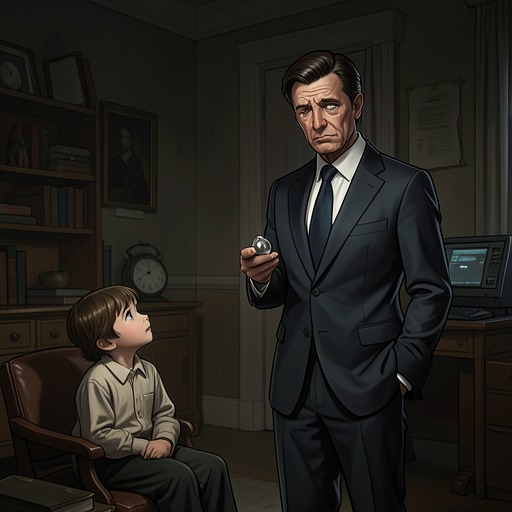
The deepest source of Arvind Acharya’s conviction is an episode from when he was about nine. His family was walking to a circus about a kilometre from home after their car failed to start. As they travelled, his mother shared groundnuts with him. His mind suddenly went blank, and he saw a dwarf in a red T-shirt and white shorts riding an elephant, a blue bird flying overhead, and the dwarf being trampled. He told his mother what he had seen; she smiled and ruffled his hair, treating the warning as something not to fear.
At the circus, the family sat in reserved front seats. Arvind Acharya watched for the scene he believed he already knew. An elephant entered with a dwarf in a red T-shirt and shorts. A small blue bird flew above the audience, passed over the dwarf, and escaped through a hole in the roof. Then the dwarf fell. The elephant remained calm as it stepped on his chest, and he died. The sequence corresponded to the vision in its distinctive details, but the book gives no independent explanation for how Arvind Acharya knew what would happen.
The death turned the family outing into a scene of panic. The crowd tried to escape, and Arvind Acharya remembered his mother looking at him in fright. At home she told his father what their son had said; his father believed neither of them, and the incident was eventually forgotten. Arvind Acharya says that his mind never went blank in the same way again and that he never saw the future another time. The episode is therefore singular, not evidence of a continuing ability. Its importance lies in the way it left him changed and in the unresolved gap between a strikingly specific foreknowledge and the disbelief that followed.
Private Memory and the Meaning of Fate
The circus story shifts determinism from an abstract problem into the history of a person’s life. Arvind Acharya does not describe the dwarf’s death as a general demonstration that all events are predetermined; rather, he recounts one experience that has remained with him. Its force is emotional as well as evidentiary: the child knew what was coming, sought safety between his parents, and then watched the predicted death take place. The account gives the theory a personal origin without proving that the theory is true.
Oparna Goshmaulik’s response is divided. Her first impulse is to reject the argument, but she notices the way Arvind Acharya looks toward the ceiling as he recalls Libet and, later, tells his childhood story. She tries to be understanding toward a man she loves, even while retaining her scientific objection. This response matters because the ideas are disclosed in an intimate, private setting, not delivered as a public scientific claim. The conversation reveals both what Arvind Acharya has concealed and the distance between his conviction and what another person can verify.
When Oparna Goshmaulik agrees that they should finish the Balloon Mission and then see what follows, Arvind Acharya is left alone, watching the door close. He recalls the dwarf on the elephant and imagines the performer’s fate as decided ages before, in the same order as the birth of stars and the collision of worlds. He extends that thought to their own story, which he feels may also have been meant to happen, yet finds something indecent in the idea. The ending preserves the tension at the heart of Free Will and Determinism: a belief in inevitability can make love seem fated, but it can also make human choice and intimacy feel exposed or diminished. The novel leaves the vision unexplained and the question of freedom open, allowing Arvind Acharya’s memory to remain at once a possible clue, a private wound, and an image through which he interprets the lives unfolding around him.