Institute Confirms Life Cells at 41 Kilometres
Serious MenThe Institute’s confirmation of living cells in air sampled 41 kilometres above Earth turns Arvind Acharya’s balloon project into a public scientific breakthrough and abruptly recasts him as a discoverer. The organisms’ presence at that altitude was the finding; their origin in space remained an inference. That distinction matters: the announcement gave new weight to the idea that life can travel between worlds, without converting a plausible explanation into a demonstrated conclusion.
A disputed idea of science
The discovery emerged against a longstanding dispute over what the Institute should investigate. Acharya had refused to let the Giant Ear search for signals from intelligent extraterrestrial civilizations, dismissing the project as an unscientific pursuit of publicity and human likeness. Jana Nambodri argued that international requests to use the instrument—and opposition to the ban among the Institute’s radio astronomers—made the restriction untenable. Acharya’s response was not simply that the search lacked evidence: he rejected its premise that alien life would resemble humanity closely enough to communicate by radio.
Their disagreement set competing standards for scientific possibility against one another. Nambodri maintained that even a remote mathematical possibility could justify a search for truth, and that hope belonged in science. Acharya answered with the opposite maxim, that hope was a lapse in concentration. The balloon work did not settle the SETI dispute, which concerned a different kind of search, but it brought the Institute’s arguments about life beyond Earth into sharper focus. Instead of waiting for a human-readable signal from distant intelligence, the mission looked for biological material in the atmosphere.
The balloon and its isolated analysis
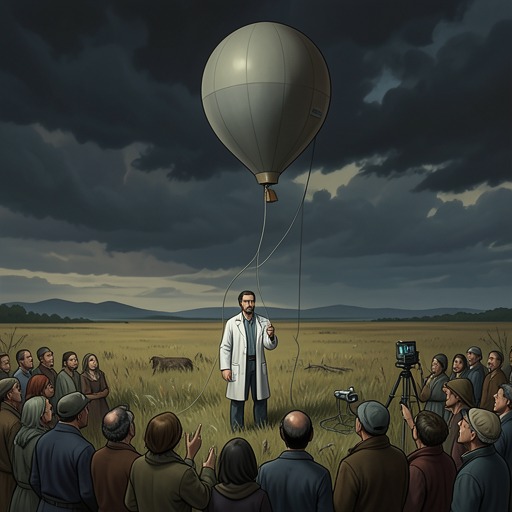
In the first week of November, a balloon supervised by Acharya flew over Hyderabad carrying four sterilized samplers. Designed to open by remote control at a chosen altitude, the devices captured air at 41 kilometres. Three samplers went to laboratories in Boston and Cardiff; the fourth travelled to the Institute in a Toyota Innova. Oparna Goshmaulik coordinated the project, had been involved before launch, and led the analysis of the Institute’s sampler with her research team and two American scientists.
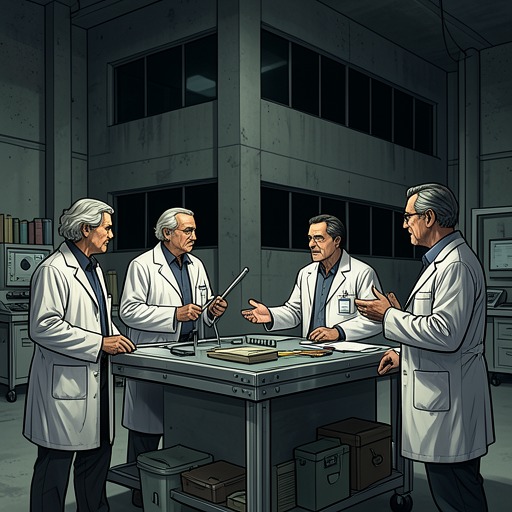
The work took place in isolation from the rest of the Institute. Until the morning of the announcement, the team had given no word of its results. Oparna and the two scientists walked down the third-floor corridor and entered Acharya’s room without waiting for Ayyan Mani’s usual rituals of passage. When Acharya heard the news, he shut his eyes for so long that his visitors eventually left without speaking. The stillness marks a private interval between the result and its public meaning: only once he had emerged from it did he summon the Press Officer.
The team’s findings were set out in handwritten pages bound by a cord. On the last page, Oparna concluded that living cells had been found at 41 kilometres: spores of a rod-like bacillus and the fungus Engyodontium albus de Hoog. The result did not by itself identify where the organisms had originated. It established their presence in the air captured by the sampler, a finding that Acharya interpreted as evidence that living matter could be coming down from space rather than rising from Earth.
From result to announcement
The Press Officer issued a release declaring a stunning breakthrough, and Ayyan heard Acharya dictate the announcement through his spy-phone. Acharya presented the discovery with a playful image of extraterrestrial organisms already woven into ordinary earthly life. Five minutes later, the Press Officer returned with a release headed in oversized capitals, EXTRATERRESTRIAL LIFE FOUND. Acharya objected to the sensational typography but approved the rest. The episode captures the gap between the careful uncertainty of the underlying claim and the categorical language that quickly attached itself to it.
At the press conference, Acharya sat between Michael White and Simon Gore, astrobiologists from Princeton who had assisted the research and independently supervised the sampler analysis. He credited Oparna as project coordinator and leader of the analysis, while noting that she could not attend. Asked what had been found, he named the rod-like bacillus and the fungus. Asked why he believed the material came from space, he qualified the claim: he had not concluded that it did, but called extraterrestrial arrival a reasonable guess supported by several facts.
The proposed explanation rested partly on the difficulty of accounting for the organisms at such an altitude, where bacteria and fungi were believed not to exist, and on the very small chance that debris from defunct satellites could explain their presence. The possibility of contamination in the laboratory was also raised. Acharya replied that precautions had been taken and that the organisms were rare and difficult to culture there. These answers strengthened his case without eliminating uncertainty: the announcement distinguished a surprising observation from a proven account of how the organisms got there.
Consequences and limits
For two hours after the release went out to newspapers and television channels, Ayyan waited for upheaval that did not come. Then, around two in the afternoon, calls began to reach him from the Institute’s faculty. Phones rang across the building, and scientists left their offices to congratulate Acharya. They came, the narration stresses, not merely as friends or opportunists but as scientists recognizing the significance of finding living things in the cold reaches of the stratosphere. The difficult, arrogant man who had resisted the Institute’s radio astronomers now stood before them as the discoverer of a result that might enlarge what science could say about life.
The reach of the finding nevertheless exceeded what the single analysed sampler could settle. Two other samplers were still being studied in Cardiff and one in Boston; the Institute’s result did not report their confirmation. Nor did the observation prove that all life on Earth came from space, or establish that the organisms were extraterrestrial. Instead, it blurred the boundary between terrestrial and alien life by making the presence of living material high above Earth difficult to ignore. The discovery therefore changed the terms of the debate: it offered evidence for life at an unexpected height, support for Acharya’s cosmic-ancestry hypothesis, and a reason to investigate further—while leaving the organisms’ origin open.