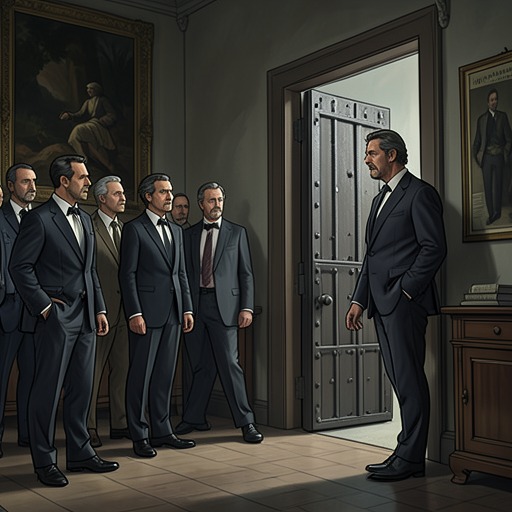
Internal Investigation into Acharya and His Suspension
Serious MenThe Internal Investigation into Acharya and His Suspension turns a dispute over scientific evidence into a public struggle over authority at the Institute of Theory and Research. A letter from Oparna Goshmaulik accuses Arvind Acharya of ordering the fabrication of evidence for the Balloon Mission; the inquiry that follows moves beyond that allegation to complaints about his conduct, and ends with his suspension and Jana Nambodri’s elevation to acting director. Its decisive reversal is also a conflict of accounts: the institute publicly says Acharya confessed, while he later denies having done so.
Causes and Scientific Dispute
The inquiry grows out of an institute already divided over what counted as worthwhile science and who had the authority to decide. Acharya opposed allowing the Giant Ear to search for signals from advanced extraterrestrial civilizations, dismissing the effort as a narrow projection of human life rather than a sound scientific pursuit. Nambodri, by contrast, argued that even a small mathematical possibility justified searching for truth, and said that radio astronomers were unhappy with the ban. Acharya rejected the appeal to hope; Nambodri saw his refusal as autocratic and unfair. Their disagreement made research priorities inseparable from a contest over institutional power.
That background matters because the Balloon Mission’s claim was itself presented as a cautious interpretation of uncertain evidence. At a press conference, Acharya said he had not concluded that the discovered living matter came from space, but considered it a reasonable guess. He pointed to the difficulty of explaining how bacteria or fungi could reach such heights, while acknowledging that the likelihood of their arrival on debris from defunct satellites was very small. He also said the organisms were rare and difficult to culture in a laboratory. The subsequent allegation therefore threatened not just a result, but the credibility of a project and the judgment of the institute’s director.
The Allegation and Hearing
The immediate trigger is a letter from Bhaskar Basu, written to Acharya after the Ministry of Defence independently verified that Oparna was the author of a letter detailing events around the sampler. Oparna, the head of the Astrobiology lab and coordinator of the Balloon Mission, reportedly stated that Acharya had pressured her to contaminate one sampler so the project could claim that microscopic life had been detected at 41 kilometres above Earth. According to the account in Basu’s letter, she had first told Acharya that no life was present in the sampler; he then instructed her to contaminate it and fabricate a report, and threatened serious professional consequences if she refused. Oparna accepted moral responsibility for her own actions and offered to resign.
Basu said he would come to the institute on Wednesday at noon with an empowered committee to conduct an internal inquiry. Senior faculty were instructed to be available, and Acharya was ordered to appear before the committee. The charge thus entered the institute through a formal process, but the hearing did not proceed as a straightforward examination of the sampler evidence. It lasted only one day. After Oparna left, postdoctoral students involved in the Balloon Mission entered nervously and departed without pursuing the case. The jury set aside the sampler scandal and heard instead the complaints of thirteen scientists who said Acharya had mentally tortured them.
Findings and Suspension
At the end of the inquiry, Basu announced to reporters outside the institute gates that the internal inquiry was over. He stated that Acharya had confessed to ordering Oparna to falsify research in an attempt to prove fraudulently that life had been discovered at an altitude of 41 kilometres. He also reported findings beyond the sampler allegation: misuse of institute funds to support the ambitious Balloon Mission, long-standing humiliation of colleagues, and activities in the basement that the institute was unwilling to disclose. Basu characterized this conduct as unbecoming of the director of an institute of excellence.
The announcement carried immediate institutional consequences. Acharya was suspended until further notice, and Nambodri, described by Basu as one of the founding fathers of radio astronomy in the country, became acting director. The public declaration presented the inquiry’s conclusion as settled, but the narrative complicates that certainty. In the days that followed, Acharya fervently denied confessing to sampler contamination. His denial did not erase the inquiry’s announcement; instead, it left a sharp divide between the official account and his own response.
Aftermath and Significance
The scandal damaged Acharya’s standing beyond the institute. The public association of the sampler allegation with the undisclosed basement activities encouraged a broader suspicion that he had been involved in other wrongdoing. Formerly powerful friends distanced themselves: some stopped taking his calls, while others told him to fight his battles in court. Scientific bodies that had once sought his endorsement informed him that his association was no longer necessary. Letters of support still arrived from friends and admirers around the world, but even these did not restore a clear public consensus about his innocence.
The inquiry’s sequence exposes how a dispute over scientific standards becomes entangled with institutional grievances. Acharya had defended the Balloon Mission’s interpretation as a reasonable guess, while resisting the use of the Giant Ear for a search he considered unscientific; Nambodri had challenged both his research priorities and his command of the institute. When the sampler case receded at the hearing, complaints about Acharya’s treatment of colleagues became the central grounds for judgment. The result was not merely a decision about one experiment: it was a transfer of authority, accompanied by a public account that Acharya contested and a reputation that could not readily be separated from the inquiry’s accusations.