Joint Entrance Test
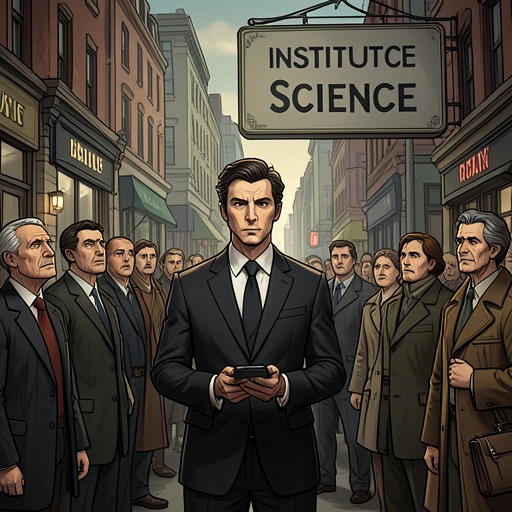
Serious MenThe Joint Entrance Test (JET) is the Institute of Theory and Research’s demanding entrance examination in physics, chemistry, and mathematics. In the novel, it is more than a measure of academic ability: its formidable reputation gives Ayyan Mani a new instrument for sustaining the story that his son, Adi Mani, is a prodigy. As that story moves from classroom disruptions and newspaper attention toward an actual examination, the test’s selectivity and secrecy turn Ayyan’s private game into a scheme with institutional stakes.
Structure and Selectivity
The JET is a three-hour, objective-type examination containing about a hundred questions, broadly divided among physics, chemistry, and mathematics. Its format is presented as both severe screening and something with an artistic quality: the questions are the product of a process that insiders regard as exacting and intellectually impressive, not simply a routine hurdle.
The scale of competition gives the test its intimidating force. About ten thousand candidates sit it each year. Two hundred are shortlisted for interviews, and half of those proceed to the available places: fifty in postgraduate courses and fifty in research positions. Arvind Acharya tells Ayyan that only a hundred candidates make it, a blunt measure of the distance between a child’s public reputation and the examination’s actual demands.
Eligibility becomes part of the argument over Adi’s attempt. Ayyan says that, under the rules, a candidate must already be a graduate. Yet he asks whether his eleven-year-old son can sit the test, and Acharya tells him to forget the rules before objecting that allowing a boy of that age would be ridiculous. The contradiction underscores how far the request lies outside ordinary expectations; it does not make the exam itself less real or less competitive.
A Carefully Guarded Examination
The question papers are protected through custom and restricted knowledge as much as through physical security. Each year, five professors and the Director meet discreetly for three weeks to write the questions by hand in one notebook. They do not use a computer. Three versions are sent to three printers, with a professor visiting each printer while posing as a representative of Aryabhata Tutorials. The printers therefore do not know that they are producing entrance-examination papers. Before the exam, the Director selects one of the three versions.
Ayyan is not officially among the small circle responsible for setting or distributing the papers. Over years at the Institute, however, he has listened carefully, collected fragments of information, and learned the rudiments of the procedure. He has also noticed what he thinks of as a vulnerable point in the security surrounding the paper: a modest bill-file in a lockless steel cupboard in the accounts department. The contrast between a formidable institutional reputation and an unassuming weakness helps explain why he imagines that a breach might be possible.
When Ayyan begins pursuing the papers for Adi, he learns from the printers that the consignments were dispatched a month earlier. With the examination eight weeks away, he calculates that three versions for ten thousand candidates must have arrived in several large cartons. He searches three mysteriously locked rooms, asks guards what they have seen, and questions the Institute’s peons about collections from printing presses or unusually large deliveries. The search turns up nothing, and the people he asks cannot help him. The episode makes the secrecy practical rather than abstract: papers have been printed, delivered, and hidden somewhere within an institution whose corridors Ayyan knows well, but his partial knowledge cannot yet locate them.
From the Genius Story to the Test
The JET enters Adi’s life through the secret pact with his father. Ayyan had first coached him to interrupt class with prepared questions, some simple and some more elaborate; when teachers tried to draw him into discussion, Adi often fell silent because he knew only what his father had taught him. His partial deafness and hearing aid helped shape how others interpreted his quietness, while the attention at school allowed him to feel regarded as extraordinary rather than merely marked as handicapped. Ayyan recognized how readily a genius legend could grow around an innately smart boy who said something unusual in class once a week.
That invented reputation acquired public reach when a newspaper reported that Adi could recite the first thousand prime numbers. Ayyan saw the article in The Times of India and noticed that the photograph showed a hearing-aid earpiece on Adi’s right, better-hearing ear. In the crowded toilet queues of the BDD chawls, neighbors gathered around the newspaper; Ayyan explained prime numbers as people asked what they might teach or feed their own children. The story brought him affection and respect, but also made the fabricated achievement visible beyond the family and school.
For Ayyan, asking for Adi to take the JET promises one more burst of public excitement. He does not believe his son has a real chance of passing. He wants the news that a child has been allowed to attempt one of the country’s toughest tests to make a brief spectacle in newspapers and on television, and to create another festive commotion at home and in the toilet queues. The JET is therefore both an authentic challenge and a prop in Ayyan’s effort to prolong the genius myth. His request to Acharya is not a simple expression of confidence in Adi’s ability; the desired publicity matters more to him than the likelihood of success.
Ayyan’s Scheme and the Exam Day
Ayyan returns to the JET after speaking with Jana Nambodri, presenting the earlier request as an example of Acharya’s rudeness. He says Adi loves the Institute, wants to take the test, and is considered a genius, while admitting that he knows the boy has no chance of making it. This account allows the examination to serve another purpose: it becomes material in Ayyan’s attempt to influence how Nambodri sees Acharya, even as Ayyan continues privately to pursue an attempt for his son.
Later, Ayyan offers Acharya a possible route back to his old job and to sending balloons up again, saying that he knows how to help. In return, he asks for the question paper. Acharya supplies the questions from all three versions, writing down more than two hundred in total and pausing to admire some of their ingenuity. Ayyan asks him to provide the answers as well. Acharya advises that forty correct answers out of a hundred would be an exceptionally good score and warns that Adi should attempt no more than forty; a higher score would look suspicious. The advice reveals the scheme’s precarious design: the aim is not simply to maximize the boy’s score but to make a manufactured performance appear plausible.
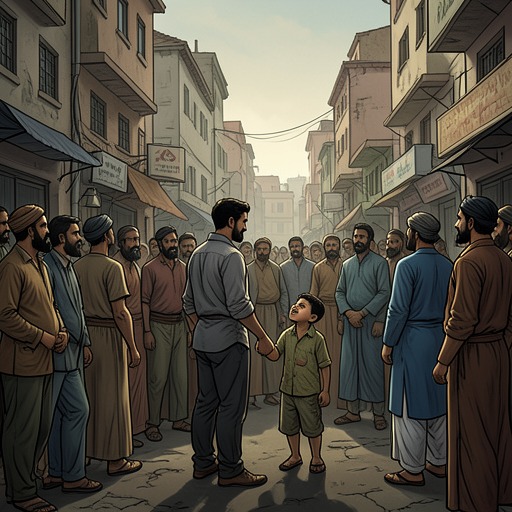
On exam day, Oja Mani oils and scrubs Adi with coconut husk, then dresses him in the new full-length trousers and long-sleeved shirt she bought a week earlier. She hands Ayyan the hall ticket and gives him Adi’s hand. At the door she embraces and kisses her son, then begins to cry as she says goodbye. Adi is exasperated at first, but after she shuts the door he feels low hearing her cry alone inside and asks whether she can come with them. The examination’s approach has thus shifted from Ayyan’s publicity-minded plotting to a family departure marked by Oja’s fear and Adi’s concern for her. The available account establishes the preparations and the plan behind the attempt, but does not state the examination result.