Madras
Serious MenMadras is where Arvind Acharya and Lavanya Acharya begin their married life together, and where the novel sets the private texture of their relationship against the city’s unrelenting public gaze. It is at once a domestic setting, remembered through Lavanya’s letters and ordinary household routines, and a social landscape in which the couple’s height makes them conspicuous enough to attract mockery. Their early life there gives personal scale to the later account of Arvind’s restless scientific career.
Arrival and Early Married Life
After their wedding in Sivagangai, Arvind takes Lavanya to Madras. At the station, her tearful relatives follow the newlyweds in a silent, emotional procession. One aunt turns the family’s concern into a joke by wondering whether Arvind is taking his bride to his hostel room; the others use their tears as cover for laughter. The scene compresses the awkwardness and comedy of a marriage being watched by its extended family before the couple has even settled into the city.
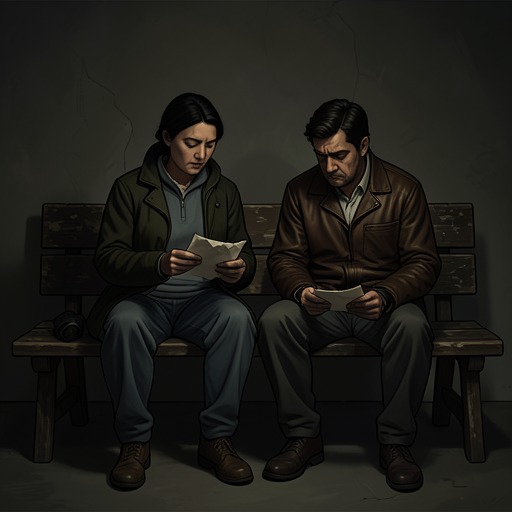
In their new home, Lavanya writes long, melancholy letters to her mother. Arvind secretly reads the first one, gaining an intimate view of how she interprets the life they are making together. Her account measures him not only by his research into gravity at Annamalai University, a subject she finds faintly absurd, but by his usefulness in daily life: he can lift rice sacks into the loft without a stool. She also describes his calm obedience, which invites her to ask him to do things for amusement, and recalls his startled reaction when she tries to touch his feet at the temple. Her letter presents a marriage in which affectionate teasing coexists with a noticeable difference in outlook; she regards his refusal of that gesture as evidence of his Western ideas.
The City’s Public Gaze
Madras is not simply a backdrop to the couple’s intimacy. Its streets turn their appearance into a public spectacle. They are both unusually tall, especially by the standards of the time, and passersby respond as if the pair together were an attraction. Shopkeepers, taxi drivers, and pedestrians laugh at them; mothers point them out to crying babies, whose attention is diverted, while gangs of eunuchs sing teasingly to Arvind about his attraction to Lavanya. Children run after the couple shouting LIC, invoking the fourteen-storey Life Insurance Corporation building, then the city’s tallest. The recurring reactions make an ordinary walk through town feel like an involuntary performance.
That scrutiny also shapes what the newlyweds can do in public. They want to hold hands in the street, not only as an expression of love but as a form of comfort, yet the social conditions of the time prevent them. The contrast is sharp: the city makes their bodies highly visible while restricting a simple gesture of intimacy. Madras therefore holds both the warmth of their private attachment and the discomfort of having that attachment continually exposed to other people’s judgment.
Memory, Work, and Departure
The domestic details recalled from Madras acquire a particular tenderness when set beside the path Arvind later takes. After the influence of an uncle, he leaves his studies for the Indian space programme, which has begun secretly in Thumba, Kerala. There he encounters a government with little money and an ambitious programme that seems to him to seek respect in a world already far ahead. On unpaved roads between tall palms, he carries rocket parts on a bicycle from a hidden shed to a launch site. The modesty of this work differs markedly from the scientific life he will pursue abroad, but the account preserves its closeness to home: he once brings a rocket cone back to show Lavanya, who writes their names on it. The cone is later fitted to a rocket that crashes into the sea.
Disillusioned by the space programme and its rudimentary conditions, Arvind leaves after a few months for Princeton to study cosmology, taking Lavanya with him. He eventually becomes absorbed in gravitation, the subject that had seemed so strange to her in Madras. The sequence links the city’s domestic routines to the widening scale of his career without making Madras itself a scientific institution or a mere point on a travel itinerary.
Narrative Significance
Madras is chiefly rendered through small, concrete memories rather than a broad account of its history or geography. The station joke, Lavanya’s letter, the loft and rice sacks, the temple, and the crowded streets establish the couple’s early relationship through differences in temperament and the pressures of being watched. The city’s social gaze repeatedly turns their height into a spectacle, while the letters allow Lavanya to describe Arvind on her own terms, with humor as well as affection.
These recollections also make the later scientific trajectory legible as a change in scale. In Madras, gravity is a subject Lavanya can tease Arvind about; later it becomes the focus of his work. The city thus anchors a remembered phase of marriage before separation from familiar routines and further travel, preserving the ordinary bond that accompanies Arvind’s increasingly ambitious intellectual life.