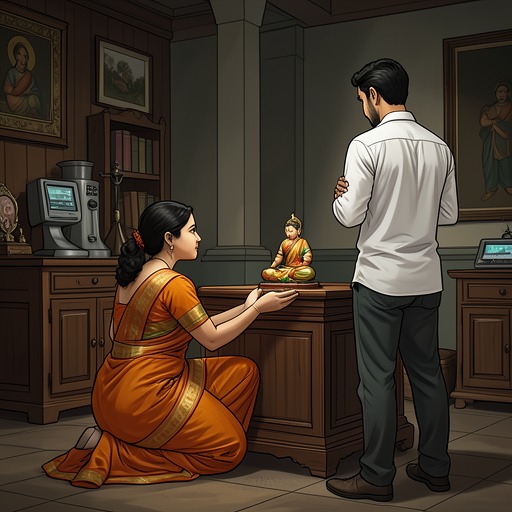
Oja’s Ganesha idol brought home
Serious MenOja’s Ganesha idol brought home is both a visible religious object and the focus of an intimate family conflict over faith, caste, and what Adi Mani should inherit. Hidden in a red cardboard box inside the washing machine, the cheerful elephant-headed god makes Oja’s Hindu belonging impossible to ignore and forces Ayyan Mani to confront a contradiction in his own convictions: he rejects Hindu worship, but wants his son to know its stories and moral world.
Appearance and Recurrence
The idol appears when Oja has settled on the floor to watch television, but her attention keeps straying toward the washing machine. Ayyan notices that she is unusually aware of his movements; opening the machine reveals the red box and its occupant. The concealment turns an ordinary household appliance into a hiding place for the object around which the couple’s disagreement has gathered. Oja first answers his question softly, then speaks more forcefully in defense of having a god at home.
This is not the first time Oja has brought home a Ganesha idol. Ayyan has made a habit of throwing it away on his way to work, yet every few months the god returns, in different moods. The repeated cycle gives the idol a domestic history: its presence is neither settled nor merely decorative, but continually renewed against Ayyan’s attempts to remove it. On this occasion he rolls it in a newspaper and says he will dispose of it the next day. The wrapping postpones the removal without resolving the disagreement; the object remains the material sign of a conflict that keeps coming back.
A Dispute over Religious Belonging
For Ayyan, the idol represents a religious tradition inseparable from caste history. He insists that Buddha is enough for their family and describes the Hindu gods as creations of Brahmins whose stories cast their forefathers as demons. Oja rejects the idea that this history should determine what she is allowed to worship. She says that the gods are hers now too, identifies herself as Hindu, and questions why the family should pretend otherwise. Her voice falters as she speaks, but her claim is direct: the choice of a god is also a claim to belong to a wider religious culture.
Ayyan answers by invoking Ambedkar and the family’s Buddhist identity. He understands conversion as liberation from a religion that subjected people like them to degrading treatment, and he will not accept the idol as an uncomplicated addition to the household. The argument is therefore not simply about whether one small statue may stay. It brings two understandings of identity into the home: for Ayyan, rejecting Hinduism honors a political and historical break; for Oja, Hindu practice offers access to gods and customs from which she does not want her family excluded.
What Oja Wants for Adi
Oja’s defense of the idol expands into a plea about their son. She says she can live with little, but asks to have gods, take Adi to a temple, and celebrate real festivals at home. She wants him to know the gods that other boys know. The statue’s importance thus reaches beyond personal devotion: it stands for a childhood with shared rituals and cultural reference points, rather than an upbringing marked chiefly by their parents’ refusals.
Ayyan considers this argument rather than simply dismissing it. He recognizes that Adi is growing up without much cultural influence, and that the epics he associates with Brahmin propaganda are also the epics available to his son. In his view, those stories offer more complexity than Superman: good people can choose wrongly, demons can be fundamentally decent, and gods can behave badly. He wants Adi to encounter that moral complexity and to learn morality, patriotism, and the stories of the gods. His resistance to the idol does not erase his wish for the cultural knowledge it represents.
The Object’s Place in the Family
Ayyan’s position remains deliberately uneasy. He wishes, in secret, that Oja would win this domestic struggle, yet wants to yield only grudgingly and on terms that keep the upper-caste religion in the home for entertainment and education, not as an unquestioned authority. He hopes that when Adi turns twenty he will have the intelligence to abandon it. The idol consequently marks a compromise Ayyan can imagine but cannot straightforwardly endorse: its stories may serve his son, while their religious claims remain subject to his criticism.
The confrontation also shows how the object is entangled with tenderness between the couple. Oja wipes away tears and looks angrily at Ayyan; he knows she is about to speak, and he cannot bear to see her cry. Searching for something entertaining to say, he offers facts about elephants, including that an elephant’s trunk has four thousand muscles and that elephants can swim. He remembers that she once delighted in the curious facts he collected and rationed out to her. His attempt to console her does not settle the argument or rescue the idol from disposal. Instead, it shifts the scene from their incompatible religious claims to an older form of intimacy: Ayyan trying to reach Oja through the small marvels she used to love.