Panspermia
Serious MenPanspermia, as Arvind Acharya understands it, is the claim that life on Earth began with microscopic spores arriving from space. The idea gives the Balloon Mission its purpose: collect air high above the planet, where terrestrial material is not expected to reach, and search for signs of life coming down. In the novel, the proposal is at once a scientific test and the expression of a conviction Acharya has carried for years, even as the boundary between hypothesis, theory, evidence, and belief remains under scrutiny.
The claim and its reach
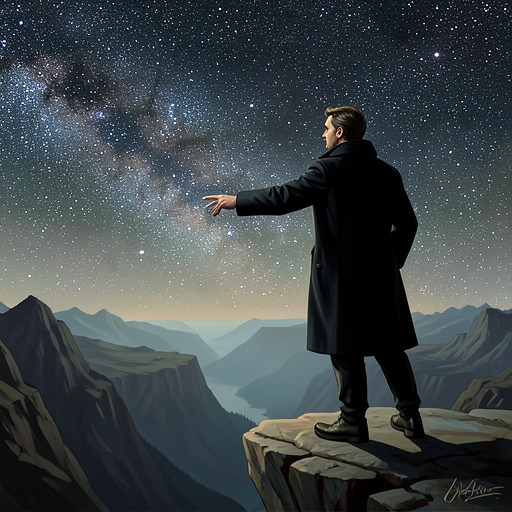
Acharya’s view is broader than the suggestion that meteorites might carry an isolated organism to Earth. He believes that all life on Earth came from outer space through microscopic spores riding on comets and meteorites. He also imagines those spores falling on other worlds, where they could give rise to life adapted to conditions unlike Earth’s. The possible results, in his account, need not resemble familiar organisms: life might develop into forms as strange as immense, zero-mass beings like clouds. Panspermia therefore opens onto a cosmic diversity that human beings may be unable to picture, rather than simply supplying an alternative starting point for life on Earth.
Oparna Goshmaulik explains the immediate premise to Ayyan Mani through meteorites: she says that about twenty thousand enter Earth’s atmosphere each year, and that some may carry extraterrestrial living matter, from alien DNA or fully formed microbes to something unknown. In her account, such matter could survive its passage through the atmosphere and take time to descend. The possibility is presented as a reason to investigate, not as a finding already established by the novel’s evidence.
The Balloon Mission as a test
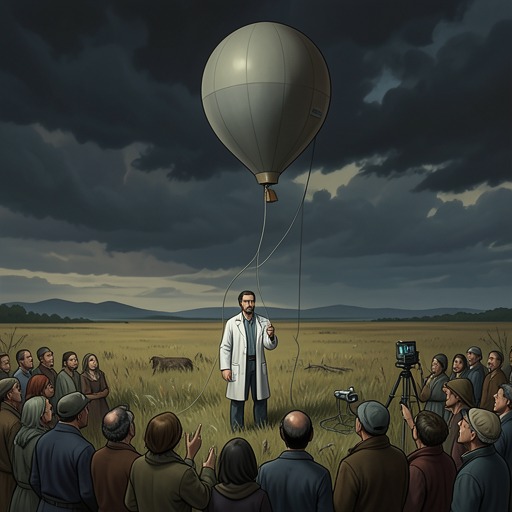
The Balloon Mission is designed to turn Acharya’s belief into a search with a specific location and procedure. A hot-air balloon is to rise to 41 kilometres, carrying four sterilized steel samplers controlled remotely from the ground. At that altitude the cans will open, capture air, and shut immediately. After the samplers return to Earth, Oparna will examine their contents in her basement laboratory. The proposed apparatus matters to the claim: the search is for material collected above the ordinary reach of terrestrial matter, not simply for microbes in a sample from the ground.
Oparna explains why the target is 41 kilometres rather than ten or twenty. She says that nothing from Earth floats that high, not even volcanic ash. If a bacterium were found in a sampler at that altitude, she reasons, it would be coming down rather than rising from Earth. The experiment’s force depends on that directional inference: a living presence in the sealed containers could support an extraterrestrial origin because the collection height is intended to rule out familiar upward-moving material.
The projected consequence is correspondingly large. If the samplers contain microbes, Acharya would become the first person to find living matter from outer space. That outcome remains conditional in the evidence: the account establishes the design, the reasoning, and the hope attached to the mission, but does not establish that the test has succeeded. The distinction preserves the gap between a bold proposal and the evidence that would be needed to support it.
Belief, evidence, and scientific status
Acharya’s pursuit of panspermia is rooted in a characteristic relationship to evidence. Oparna regards him as a man who believes first and then spends the rest of his life seeking evidence. She admires the force of that disposition in a world where practicality can be mistaken for wisdom: for Acharya, the possibility of truth is compelling enough to organize a long search, even before proof is in hand. His conviction that microscopic aliens are continually falling to Earth has endured for years before the planned collection at 41 kilometres gives it an experimental form.
A conversation with Oparna makes his confidence explicit. Asked whether all life on Earth came from outer space, Acharya answers that he does not merely believe it but knows it. He describes spores carried by comets and meteorites, and extends the claim to worlds in other parts of the universe, where they might produce life suited to local conditions. When Oparna asks why he does not present the idea publicly as a hypothesis, he insists that it is a theory. At the Institute of Theory and Research, the distinction carries institutional weight: a hypothesis is a good idea, while a theory is a good idea that merits funding. His chosen term thus declares not only confidence in the claim but its desired standing within the institute.
Cosmological context and significance
Panspermia belongs to a larger pattern in Acharya’s thought, but it should not be confused with his opposition to the Big Bang theory. He rejects the Big Bang because he sees its beginning as bound to Christian theology and insists on a universe without beginning or end. Panspermia addresses a different question: how life might have reached Earth and spread among worlds. Together, the positions reveal a scientist willing to challenge accepted accounts of cosmic origins while pursuing an expansive theory of life’s distribution.
The concept also creates a tension the novel does not resolve simply by naming the experiment. Acharya speaks of panspermia as knowledge, while the Balloon Mission is still a proposed means of collecting the evidence that could substantiate it. Oparna’s account supplies a testable chain of reasoning—meteorites may carry life, high-altitude samplers may capture it, and the altitude may help distinguish descent from terrestrial ascent—without converting possibility into discovery. Panspermia consequently carries both the reach of Acharya’s imagination and the demands of proof: its cosmic vision becomes consequential through the precise, still-uncompleted act of looking.