Professor Jal
Serious MenProfessor Jal is a professor among the Institute radio astronomers, a figure first seen in the despondency that follows their failed attempt to establish Search for Extraterrestrial Intelligence as an autonomous department. His role changes sharply when the Institute’s wider crisis reaches his circle: he becomes an investigator of Ayyan Mani’s claims about Adi Mani, bringing evidence into a room otherwise occupied by fear and uncertainty. His discovery gives the astronomers a possible counterattack, though his conclusion that Ayyan stole the Joint Entrance Test papers goes beyond what he can directly establish.
Identity and Presence
Professor Jal belongs to Jana Nambodri’s usual company of radio astronomers. In one gathering of six, they meet in Nambodri’s office after their failed institutional challenge, their lament disguised as hopeful conspiracy. Jal is recognizable in the narrative through sharply specific physical details: he is portly, bald, and has a stain on his head likened to bird droppings associated with Gorbachev. The description gives him an almost comic visual distinctiveness, set against the serious scientific and political disappointment of the group.
Jal is also marked by a history of heart surgery. When he notices that Nambodri’s hand is trembling as he takes a phone call, Jal asks what has happened. Nambodri refuses to tell him because Jal has had a bypass. This exchange establishes both Jal’s physical vulnerability and the group’s awareness of it: news is withheld not because Jal is peripheral, but because his health makes the others cautious about exposing him to a shock.
Temperament Among the Astronomers
Jal’s responses are not uniformly restrained. When Nambodri later tells Ayyan Mani that Jal knows him, Jal rises angrily and tells the others to stop their talk. The rest of the room asks him to calm down; he sits again, breathing hard, his glasses trembling on the bridge of his nose. The incident shows a man whose frustration can become physically visible, even when those around him attempt to contain it. The account does not explain what specifically provokes his outburst, so it remains a moment of temper rather than a fully stated grievance.
In another exchange, Nambodri introduces Jal to Ayyan Mani and asks whether Ayyan knows the television quiz show BBC Mastermind. Ayyan says he used to watch it with his wife, who wanted to watch something else. The brief conversation places Jal within the Institute’s social world, where professional conflict and ordinary domestic references occupy the same room. It also contrasts with the later scene in which Jal takes command of attention not through an introduction but by arriving with evidence that may change the astronomers’ position.
The Investigation into Ayyan Mani
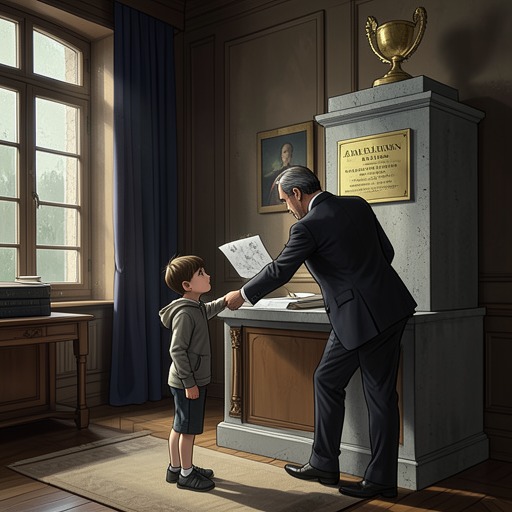
During the Institute’s public scandal, the radio astronomers gather around a television carrying their recorded remarks about the intellectual limitations of Dalits and women. The recording threatens their standing, while they fear that protests will reach the Institute. Into this tense gathering, Professor Jal arrives holding loose sheets, an envelope, and a newspaper. His excitement seems excessive to the others, but he says he has learned something important about Ayyan Mani and his son.
Jal presents Adi Mani’s Joint Entrance Test answer sheet and reports that the boy scored thirty-nine. He argues that this places an eleven-year-old in the top five, a result he finds implausible because, as he says in substance, the astronomers have encountered geniuses and know what is possible. The answer sheet passes from hand to hand, and the group’s mood shifts: Jal’s discovery offers them a new line of action amid the scandal. His evidence is tangible, but its meaning is not self-evident; the score establishes a result, while Jal treats the result as grounds to question how it was obtained.
He then explains how he checked Ayyan Mani’s earlier claim that Adi had won a science contest hosted by the Swiss Consulate. The clipping Ayyan had shown the astronomers described a contest that Jal says the Consulate had never held. He tracked down the reporter, Manohar Thambe, who said Ayyan had supplied the news; Jal adds that some language newspapers officially accept payment for covering stories. This inquiry converts a suspicious newspaper report into a specific discrepancy, linking Ayyan to the story without establishing every detail of how it entered print.
Jal’s next lead comes from calls to printers. He asked whether Aryabhata Tutorials had recently made enquiries. Two printers could not say; a third distinctly remembered someone asking, less than eight weeks earlier, when a consignment was expected. Jal admits that he does not know how Ayyan obtained the Joint Entrance Test papers. Nevertheless, he combines the remembered call, Adi’s score, and the false contest story into a decisive accusation: Ayyan is a con, and his son’s genius is fraudulent. The distinction between evidence and conclusion matters. Jal has corroboration for parts of Ayyan’s public story being false and a printer’s recollection of an enquiry, but the passage does not show him proving who made the call or how the papers were acquired.
Role in the Institute’s Crisis
Jal’s arrival briefly alters the balance in Nambodri’s office. Before it, the astronomers are surrounded by the consequences of their own recorded words and the prospect of protest; after Jal lays out his findings, they have a counterclaim that redirects their attention toward Ayyan Mani. His phrase about going to war frames the discovery as a chance to fight back, not merely as an academic correction. The irony is that the evidence he brings may expose Ayyan’s deception while also serving the interests of men seeking relief from a scandal of their own making.
The character’s importance lies in this uneasy combination of practical inquiry and forceful certainty. Professor Jal checks the Consulate’s records, contacts the reporter, and calls printers; he does not rely solely on rumor. Yet the leap from those checks to the claim that Ayyan stole the papers remains his inference. The answer sheet, newspaper clipping, and printer’s recollection function as material clues in a room where reputations and institutional power are already under pressure. Jal turns them into an accusation, making him the catalyst for a new phase of the conflict without resolving, on the evidence presented here, every question his accusation raises.