Research Institute Riot and Citywide Protests
Serious MenThe Research Institute Riot and Citywide Protests turn an institutional scandal into a public crisis: the Institute of Theory and Research, already shaken by revelations about its leadership, becomes the target of a siege and assault, while protests spread across the city. The violence follows the circulation of recordings that expose degrading views about Dalits and women, but it unfolds amid a wider history of caste exclusion and political anger. Its aftermath leaves the Institute damaged, its astronomers publicly disgraced, and its carefully guarded hierarchy exposed to forces beyond its control.
Causes and Background
The immediate crisis takes shape as recordings transform private remarks into public evidence. News channels stop replaying the poignant conversation between Oparna Goshmaulik and Arvind Acharya and instead broadcast the voices of men in the Institute discussing the intellectual limits they attributed to Dalits and women. Female reporters and presenters respond with pointed criticism of the men running Indian science. The scandal does not remain a matter of reputation: the prospect that another recording could clear Arvind Acharya, and make his return likely, becomes a source of fear for those whose positions are at stake.
The political force behind the unrest has a longer history. In an earlier conversation, Sister Chastity tells Ayyan Mani that upper-caste people still privately demean Dalits even when public language has changed. Ayyan Mani describes the distance between generations of Brahmin privilege and his own upbringing as the son of a sweeper in a one-room home. His argument is not simply about individual wealth or education; it concerns a social order that, in his view, has accumulated advantages over centuries and then treats those advantages as proof of innate superiority. When Ayyan Mani disputes Oja Mani’s Hindu identity, he also invokes Ambedkar’s liberation of Dalits from a religion he regards as cruel, identifying as Buddhist instead. These exchanges establish the depth and variety of feeling surrounding caste, religion, and dignity, without making the Institute’s immediate crisis reducible to a single grievance.
A political history of organized protest is also present. S. Waman recounts having been tied to a tree by Brahmin priests as a child for entering a temple, then leaving his village and arriving in Bombay with almost nothing. Ayyan Mani knows more of S. Waman’s later path: from selling vegetables to coordinating freelance goons and entering politics. S. Waman is known for quickly assembling angry Dalit youth, sometimes into violent crowds, particularly when people feel their community has been slighted. The narrative supplies this background as context for how humiliation can be converted into collective action; it does not establish that S. Waman directed the Institute assault.
The Institute Under Pressure
The Institute’s internal struggle predates the scandal. Jana Nambodri challenges Arvind Acharya over the ban on using the Giant Ear to search for extraterrestrial signals. Jana Nambodri points to requests from radio astronomers around the world, discontent among researchers at the Institute, and the possibility of substantial usage fees. Arvind Acharya rejects both the proposed use and the commercial argument, maintaining that scientists should not pursue what he considers a misguided search. He argues that the search for alien signals projects human expectations onto a universe too vast and too poorly understood to justify that narrow conception of life.
That dispute becomes an institutional power challenge when Jana Nambodri says the Balloon Mission cannot be the Institute’s only priority and puts opposition to Arvind Acharya’s position on SETI openly before the room. The disagreement concerns scientific judgment, but also who has the authority to decide which projects count as legitimate research. By the time the recordings circulate, the Institute is therefore vulnerable on more than one front: leadership is contested internally, while broadcast exposure brings the conduct of its senior men before a much wider public.
As the crisis gathers, Jana Nambodri and the other astronomers face two distinct fears. The Oparna Goshmaulik recording may exonerate Arvind Acharya, whose return they expect; another recording has made their comments about Dalits and women public. Police vans at the gates do not reassure them. The Institute’s peons have stopped work and gathered near the main lawn. Before striking, they have left taps running and blocked toilets with broken cutlery. These disruptions make the conflict material and immediate: the institution cannot maintain its ordinary operations even before the crowd enters.
The Siege and Assault
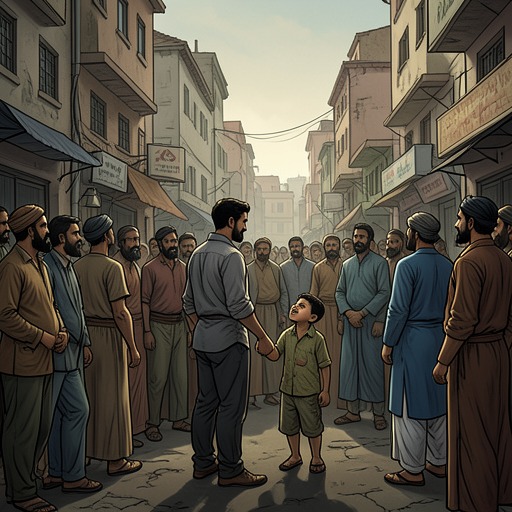
When Ayyan Mani urges Jana Nambodri to look outside, Jana Nambodri initially responds with defiance. Curiosity overtakes it, and from the window Jana Nambodri sees a crowd at the gates carrying metal rods, sticks, and banners. The people are waiting calmly, as if for a decisive signal. Jana Nambodri returns to the sofa and insists that the situation can be managed, but the apparent calm at the gates proves temporary.
Jana Nambodri takes out a phone, intending to make a call. Before the call can be made, a stone cracks the large window; another breaks it. The astronomers take cover as stones enter the room, other windows break, and the sounds of destruction and distress draw closer. About two dozen men then force their way into the room and attack the scientists with iron rods. One of the attackers intervenes to direct how the assault is carried out, ordering the others to avoid the head and demonstrating where to strike. The detail presents the attack as organized rather than as an uncontrolled collision: even amid the violence, a leader exercises authority over the group.
It takes three hours for order to return to the Institute. Police remove rioters while cameras record them waving. A car burns in the driveway; the other cars have broken windscreens, and windows hang from the main block. The astronomers leave in a silent line under police escort. The movement from a room of institutional authority to an escorted, stunned procession reverses the scene’s earlier hierarchy: those accustomed to directing the Institute are no longer in control of the space around them.
Citywide Protests and Aftermath
The unrest extends beyond the Institute, though protests elsewhere in the city are less violent. Later that evening, outside Bombay Hospital, crowds parade an effigy named after Jana Nambodri, strike it with slippers, and burn it. Reports describe further isolated violence in other parts of the country, but the riots recede after two days. The sequence distinguishes the concentrated assault on the Institute from the broader, more dispersed demonstrations while showing how the scandal’s consequences travel beyond the people directly involved in its internal disputes.
The Institute’s physical damage and the public humiliation of its astronomers mark different forms of consequence. Broken windows, damaged cars, and the disruption of work expose the institution’s vulnerability; the broadcasts expose the attitudes that its prestige had helped keep within a closed professional circle. Meanwhile, the possibility of Arvind Acharya’s return and the disclosure of the other recording leave the leadership’s future unsettled. The riot does not resolve the Institute’s scientific disagreements or restore confidence in its authority. Instead, it makes those disputes part of a larger confrontation over caste, public respect, and who is permitted to speak for Indian science.