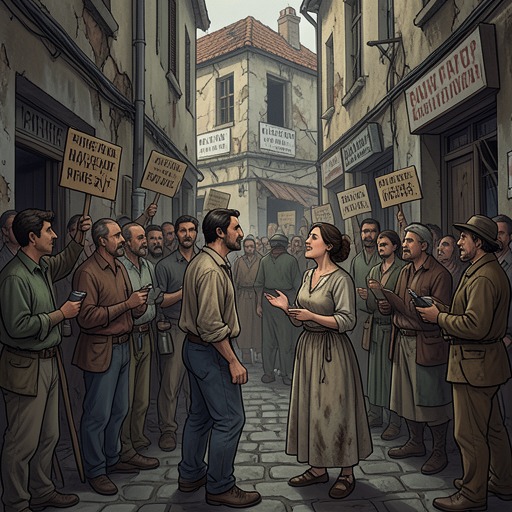
The overcrowded, dilapidated living conditions in BDD chawl
Serious MenBDD Chawl is a densely populated, badly deteriorated housing complex where the scale of communal life presses against the confines of the one-room home. Its identical buildings and failing walls hold more than eighty thousand people, while shared toilets, crowded corridors, and rooms scarcely large enough for a family make scarcity a daily condition rather than a passing crisis. For Ayyan Mani, born there and still living there with Oja Mani, the chawl is both home and an environment whose limits seep into domestic life.
Buildings and History
BDD Chawl consists of one hundred and twenty identical three-storeyed buildings, containing about ten thousand one-room homes. The buildings stand like grey ruins: old rains have stripped away their paint, a million clothes hang from small, dark windows, and parts of the outer walls—and sometimes the roofs—fall away. The monsoon rains of August make the deterioration particularly calamitous. The damage is not a single dramatic collapse but an accumulated condition of exposure and decay, visible in the fabric of everyday life.
The British built the chawls more than eight decades earlier as an attempt to house the homeless. Their construction was so poor, however, that street dwellers refused to exchange the open world and sky for a small, dark room along a seemingly endless corridor. The unclaimed rooms were instead used as cells for freedom-fighters, turning a failed housing project into a prison. By the time of the novel’s present, the same complex—once rejected even by the homeless and then used to confine political prisoners—has become home to more than eighty thousand residents. That history sharpens the contrast between the stated purpose of shelter and the conditions the buildings actually provide.
Crowding and Domestic Space
The one-room homes bring multiple generations and branches of families under a single roof. Lovers who meet along the seafront return at night to rooms shared with children, elders, siblings, nephews, and nieces, in densely packed households. The narrative compares the area of these homes to that of a Mercedes, a measure that makes the imbalance between the number of people and their available space immediately legible. New unions and deaths alike take place within a population living close together, so private changes unfold amid communal density.
Ayyan and Oja’s own home measures fifteen feet by ten. A cleared patch of smooth grey stone occupies the centre, while a television, washing machine, golden Buddha, and tall steel cupboard line a wall. The kitchen is rudimentary, and the bathroom is so small that its dimensions prompt a joke about how two people would have to be in a relationship to fit. The room’s few objects and carefully cleared floor do not undo its limits; they show how household life is arranged within them. Even the door opens onto a corridor marked by the turbulence of other open doors and the movement of neighbours.
Shared Facilities and Daily Routines
The pressure of the chawl extends beyond the home. Its residents queue for four toilets, with the women’s line longer both because it moves more slowly and because fewer men use the shared facilities. Working men have adapted by waiting until they reach their offices, where they can use the toilets—and sometimes shower. Ayyan ordinarily follows that routine, but on one morning he stands in the queue with a small blue bucket. The choice makes the ordinary calculations of the residents visible: access to basic facilities depends on time, work, and the ability to defer a bodily need until elsewhere.
The queues also become places where information circulates. While waiting, Ayyan holds a copy of Yug; soon men and women with their own buckets gather around him to read, some aloud and some silently, in the soft light entering through broken glass above the toilets. A shared, inadequate facility thus becomes an impromptu public space. Reading there does not remove the crowding, but it shows how residents use the limited spaces available for more than their intended function.
Effects on Residents and Narrative Significance
The chawl’s physical conditions register in both crowd scenes and intimate relationships. Its narrow rooms, common corridors, and shared facilities leave little separation between household life and the presence of others. Ayyan’s memories of Oja include the sense that the chawl has seeped into her: the morning singing and spontaneous words he remembers have given way to a darkness he sometimes sees in her expression. The account connects this change to the place without reducing her to it; her altered manner is experienced within a home and neighbourhood that constrain the couple’s daily life.
At the same time, BDD Chawl is not depicted as a population without variety or energy. Its residents include families, lovers, working men, children, and neighbours who gather to read. The buildings’ deterioration coexists with the continual formation of households and the routines by which people get through the day. This tension gives the setting its significance: the chawl is at once a place of belonging and a record of structural neglect, where overcrowding is made concrete in the dimensions of a room, the length of a queue, and the damaged walls overhead.