
Honor Between Duty and Survival
ShōgunThis thread follows competing definitions of honorable conduct, from samurai obedience and ritual death to Blackthorne’s preservation of life and the painful compromises each system demands.
increasing Bearing strength in each event
 decreasing
Bearing strength in each eventdecreasingThe Lottery and Refusal
The Lottery and Refusal
A procedure for choosing a victim
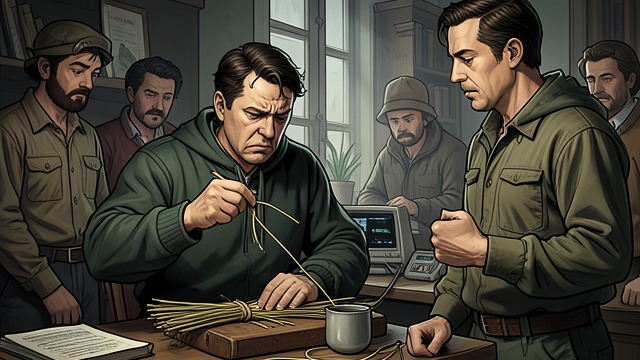
The captured crew agree to draw straws after Yabu’s men demand that one prisoner be surrendered for execution. Their decision makes the selection appear impartial, and religious language frames the chosen death as a sacrifice for the others.
Blackthorne rejects the procedure
When Johann Vinck draws the short straw, Blackthorne refuses to let him go without resistance. His refusal is not supported by every crewmate; it breaks their agreement and exposes them to greater violence.
The scene places two moral languages in collision. The crew’s appeal to chance and divine will offers order under terror, while Blackthorne insists that leadership includes responsibility for resisting a condemned outcome. His act protects no one immediately, but it establishes a standard he will continue to apply even when it costs him authority.
A Samurai Refuses Water
A Samurai Refuses Water
Loyalty carried into captivity
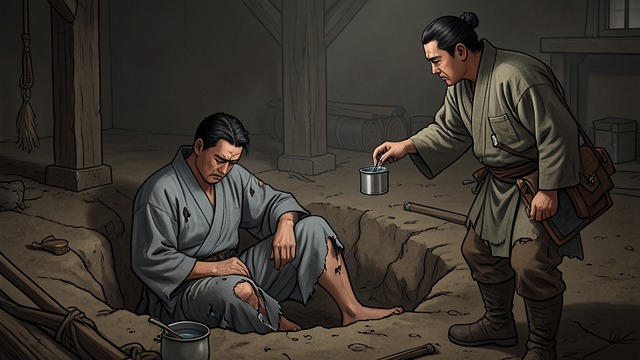
The wounded samurai left in the pit refuses the prisoners’ water and eventually asks Blackthorne to help him die. He understands his defeat as a failure of service and sees death as the remaining way to recover honor.
Competing understandings of mercy
Blackthorne refuses to strangle him, partly because his faith forbids deliberate killing and partly because he does not accept the samurai’s request as an order he must obey. The men around them debate whether an enemy deserves aid, revealing that confinement does not erase the moral distinctions each side brings into the pit.
The samurai’s despair and Blackthorne’s refusal are not reduced to a simple contrast between compassion and cruelty. Each man is trying to remain faithful to a code that supplies meaning under powerlessness, and each code makes different demands on the other.
Buntaro and the Shame of Capture
Buntaro and the Shame of Capture
Death preferred to captivity
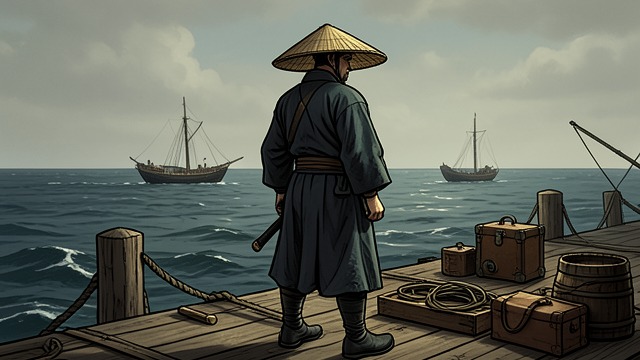
When Buntaro remains on the wharf as the galley pulls away, Blackthorne assumes he should swim or fight his way to safety. Mariko explains that her husband fears capture more than death because captivity would strip a samurai of status and expose him to public dishonor.
An order to continue living
Buntaro begins to prepare for seppuku, but Toranaga orders him to escape. He obeys, abandoning the death he had chosen and accepting the uncertain dangers of flight.
The episode shows that honor is not simply a preference for death. It is a structure of public meaning and obedience, and Toranaga can redirect it by command. Blackthorne sees the choice as wasteful, while the samurai around him understand that dying at the right time—and surviving when ordered—can each be duties.
The Death of Ueki-ya
The Death of Ueki-ya
A command obeyed literally
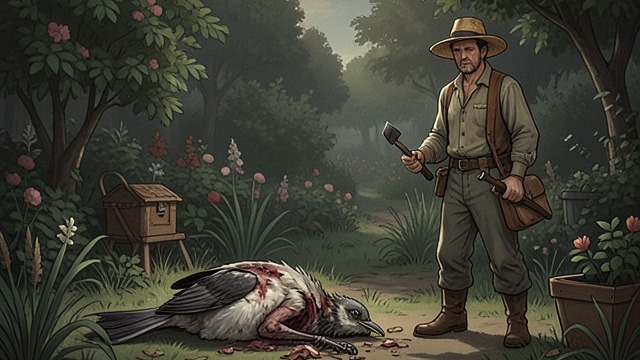
Blackthorne discovers that Ueki-ya has been executed after removing the decaying pheasant from the garden. The old gardener acted to protect the household from the smell and flies, but doing so violated Blackthorne’s explicit order that no one touch the bird.
Responsibility without intention
Blackthorne cannot treat the death as an accident merely because he did not intend it. He gave the order, and Fujiko carried out the household law that made a master’s commands consequential. His anger therefore turns back on him as he recognizes that his authority has made the gardener’s death possible.
The episode complicates both guilt and obedience. Fujiko’s conduct is legally correct within her world, yet Blackthorne cannot accept the idea that correct procedure settles the moral question. His grief reveals how an imported authority can wound people even when its holder believes he is acting lightly.
Mariko’s Public Sacrifice
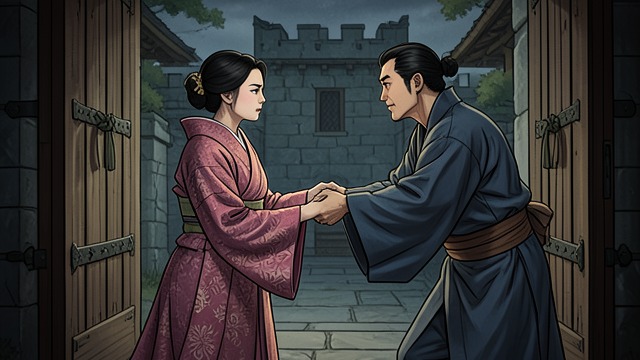
Mariko’s Public Sacrifice
A refusal made visible
At the castle gates, Mariko insists on her right to leave under her liege lord’s orders, despite Ishido’s attempt to keep her confined. She knows the confrontation may end in death, but she refuses to let captivity become an unspoken fact that others must accept.
Honor transformed into leverage
Her readiness to commit seppuku makes the political cost of detention visible to the people watching. Ishido eventually permits the party to proceed, while Mariko’s formal challenge turns a private dispute over movement into a crisis of authority and public honor.
Her action is neither merely obedience nor uncomplicated defiance. She serves Toranaga, acts through the social form available to her, and risks her life to force a decision. The scene shows how a woman’s constrained choices can become politically decisive without erasing the danger of those constraints.
During the first night in the Anjiro cellar
During the prisoners’ second day in the cellar
During the Osaka escape and the standoff at the wharf
After the pheasant is removed from Blackthorne’s garden
During the confrontation at Osaka Castle’s exit
