
Foreignness and the Making of Identity
ShōgunThis thread traces the novel’s shifting boundary between barbarian and civilized, following Blackthorne’s changing status and the Japanese characters’ competing definitions of belonging.
increasing Bearing strength in each event
 decreasing
Bearing strength in each eventdecreasingThe Stranger in Anjiro
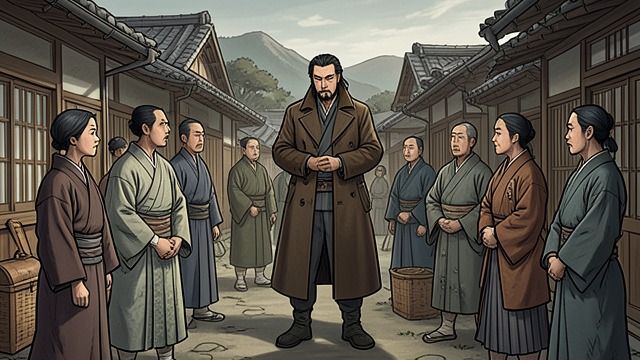
The Stranger in Anjiro
A world interpreted from the outside
Blackthorne arrives in Japan with categories shaped by European conflict: Christian and heretic, ally and enemy, civilized and heathen. The clean house, unfamiliar food, bathing customs, and unarmed villagers unsettle those assumptions before he has the language to explain what he sees.
The label becomes contested
Father Sebastio calls him a pirate and a heretic, while the villagers treat him as an extraordinary guest and Omi treats him as a potentially useful captive. No single description is sufficient to explain how the newcomers will be received.
The opening encounters show identity functioning as a political instrument. Blackthorne’s own account cannot control what others call him, while his size, religion, and ship acquire different meanings depending on who is speaking and what that person hopes to gain.
The Interpreter’s Uneasy Bridge

The Interpreter’s Uneasy Bridge
Language as power
Father Alvito interprets Blackthorne’s answers to Toranaga, and Blackthorne immediately recognizes that an interpreter can shape political reality. The priest’s fluent rendering gives him authority over what Toranaga hears, even when Blackthorne cannot verify every nuance.
Mariko changes the terms
Later, Mariko’s ability to speak Portuguese and Latin allows a different kind of exchange. She is not neutral—she serves her liege lord and must manage her Christian conscience—but her directness and caution give Blackthorne more room to communicate.
The changing interpreters demonstrate that language is not a transparent channel. It is an institution of trust, power, and risk. Blackthorne’s effort to learn Japanese is therefore more than practical study: it is an attempt to become less dependent on other people’s accounts of his intentions.
From Captive Barbarian to Hatamoto
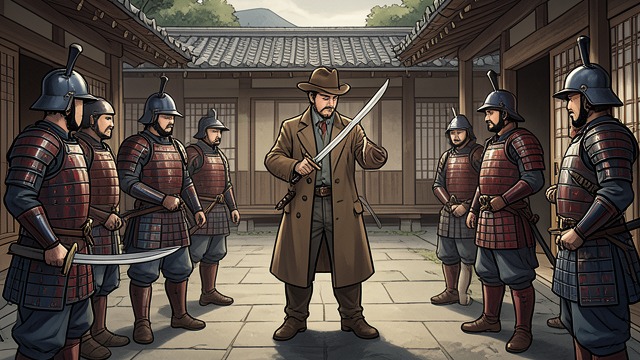
From Captive Barbarian to Hatamoto
Status is granted and tested
Blackthorne moves from prisoner to useful foreign expert, then receives a hatamoto appointment and samurai swords. The new status offers protection and privileges, but it also places duties on him and makes others expect him to behave within a Japanese hierarchy.
Belonging remains provisional
He learns greetings, bathing practices, and forms of respect, yet his misunderstandings continue to expose the distance between his assumptions and Japanese custom. Even when treated as a favored retainer, he remains someone whose speech, faith, and origin are scrutinized.
The change is real but not complete. The title gives Blackthorne a place in the political order without erasing his English identity, and his growing fluency makes him more effective while also making him more vulnerable to claims on his loyalty.
The Eta Boundary

The Eta Boundary
A familiar world becomes alien
Blackthorne discovers that his crew have been living beside an eta community. His first reaction is conditioned by the European contempt he has absorbed, but he also knows the stigma attached to people who handle bodies and hides in Japan has shaped the village’s treatment of his men.
Seeing the insult from both sides
When the crew are described as choosing the village because it resembles home, Blackthorne hears how foreign they must appear to others. His attempt to think of Japanese villagers as neighbors with their own customs does not erase his crew’s prejudice or the social system that marks the eta as outcast.
The episode exposes how stigma travels in several directions. Blackthorne can be both a target of Japanese contempt and a bearer of European contempt, while the eta remain subject to a hierarchy they did not choose. His response develops through discomfort rather than instant enlightenment.
The Ship as Cultural Translation
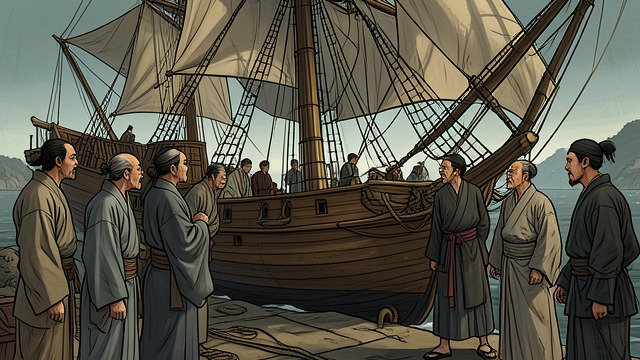
The Ship as Cultural Translation
Knowledge becomes reciprocal
Blackthorne’s knowledge of navigation, cannon, and ship construction gives Toranaga a way to imagine sea power outside Portuguese control. At the same time, Blackthorne learns that a ship’s meaning in Japan is shaped by trade, politics, social rank, and the limits placed on foreign presence.
A future built from exchange
After the Erasmus is destroyed, Blackthorne proposes building another vessel. Toranaga offers workers and materials, while Blackthorne imagines a ship that can return him home and open a new route between their worlds.
The project makes cultural exchange concrete without making it innocent. Each side hopes to use the knowledge for its own purposes, and their cooperation depends on mutual need rather than shared beliefs. The Lady becomes a possible bridge between societies—and a possible instrument in their conflict.
Immediately after Blackthorne wakes in Anjiro
During Blackthorne’s first audience with Toranaga
After Blackthorne’s first interview with Toranaga and before the Yokosé encounter
After Blackthorne reunites with his crew in Yedo
From Blackthorne’s first naval lessons through the planning of The Lady
