Christian commandment “Thou shalt not kill”
ShōgunThe Christian commandment “Thou shalt not kill” is presented not as an abstract doctrine but as a demand tested in moments when weapons are ready and political loyalties are at stake. Its meaning shifts with the people invoking it: Alessandro dell’Aqua treats it as a limit he must enforce, while Toranaga and Mariko expose the conflict between Christian conscience and service to a lord. Around them, the novel sets religious prohibition beside Japanese law, European privateering, and the conditional permissions of war.
The commandment and competing laws
When Toranaga questions Blackthorne, he establishes the immediate force of Japanese jurisdiction: foreigners are in the country by permission, and public mischief or quarrels are to be punished by death. Blackthorne’s answer that his party comes in peace and wishes to trade does not displace that rule; Toranaga tells him to answer the questions asked. The exchange distinguishes a foreigner’s account of his purpose from the law governing his conduct on Japanese soil. In this setting, peaceful intent does not confer a right to act independently.
The interrogation also makes the word “pirate” a dispute about which authority defines violence. Toranaga asks whether a pirate is an outlaw who rapes, kills, or plunders for personal profit, then challenges Blackthorne with the possibility that a mercenary is much the same thing. Blackthorne replies that his ships carry letters of marque from the rulers of the Netherlands, authorizing war against their enemies and the search for markets. Conduct that Blackthorne presents as legally authorized can therefore appear to his opponents as piracy and religious heresy. The commandment stands within this field of competing claims: an act’s description as lawful service, criminal plunder, or religiously forbidden killing depends partly on whose authority is recognized.
A prohibition tested at sea
The sharpest confrontation comes when Ferriera prepares to fire on Toranaga’s galley from ambush. Alessandro dell’Aqua interrupts the sequence at the point of action. He advances to the cannon’s muzzle, stands in its way, and puts his hand on the crucifix. His words are a repeated refusal to let the attack proceed: “Thou shalt not kill!” Ferriera answers that they kill all the time. Dell’Aqua does not deny that contradiction; he admits his shame and asks God’s forgiveness, then declares that while he is present there will be no killing and he will not condone killing from ambush.
The scene gives the commandment a physical form. Dell’Aqua does not merely advise the gunner or appeal to Ferriera’s judgment: he places his body between the weapon and its intended use. Ferriera asks what should happen if the Japanese attack or try to take the ship, pressing the conflict between a categorical prohibition and fear of future danger. Dell’Aqua offers no tactical resolution to that question. His refusal is therefore a boundary, not a complete plan for every possible encounter.
His private reasoning makes the political context explicit. He recalls that Toranaga has promised everything, while Ishido has promised nothing. The commandment’s force is inseparable from a choice about which Japanese power to trust, and the priest’s restraint frustrates Ferriera’s immediate military advantage. Ferriera turns away from the priests and orders his men to repel an attack if the galley comes within fifty yards uninvited. He does not authorize the ambush to begin, but neither does he abandon armed defense. The scene leaves the practical boundary between killing and protection unsettled even as Dell’Aqua insists that the first strike cannot be justified by convenience.
Conscience, service, and the samurai response
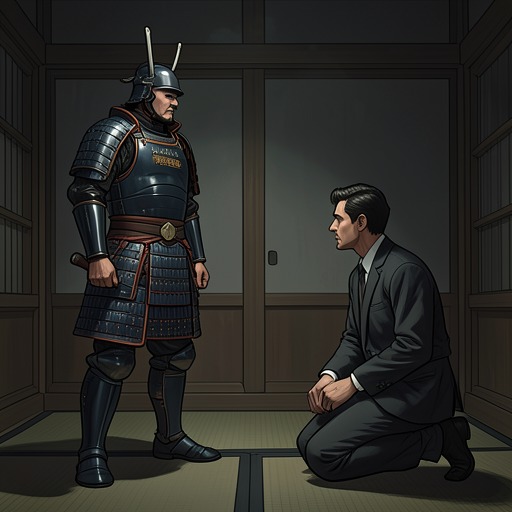
Toranaga directly tests whether the commandment can bind Christians who serve him. He asks Mariko whether she and her family are prepared to kill Christians, naming the prohibition as what makes that prospect seem impossible. Mariko answers that she, her husband, and her son will go gladly into hell for their lord. Toranaga calls them true samurai and says he will remember that they took up the sword to defend him. In this exchange, religious identity does not prevent service in an armed conflict; Mariko accepts the cost to her Christian conscience as part of her loyalty to Toranaga.
The exchange does not erase the commandment. Toranaga’s question depends on its recognized force, and Mariko’s answer acknowledges a conflict rather than denying one. Yet the response places duty to her lord above the prohibition as she understands its demand. Toranaga’s praise also translates her action into another moral vocabulary: she is recognized as a samurai because she accepts the responsibility to defend him. The same willingness that might appear as a violation within one religious framework is affirmed as fidelity within another.
Limits, exceptions, and political use
The novel’s other statements about violence make the prohibition part of a broader contest over where force may be used. Toranaga’s stated policy, relayed by Mariko, rejects attacks by one foreign nation on another on Japanese soil and forbids foreigners to kill Japanese people. He distinguishes that restriction from harrying the Queen’s enemies on the high seas, and from action against enemies of the Emperor. Japan is described as the Land of the Gods, not as an arena in which foreign powers may settle their quarrels. The permission to fight is therefore bounded by place and political allegiance, rather than treated as a universal license.
That distinction resonates with Toranaga’s earlier insistence that foreigners obey Japanese law while present in his country. It also contrasts with Blackthorne’s account of letters of marque, in which overseas violence is authorized by his own rulers against their enemies. Neither the Christian commandment nor a European commission operates in isolation from the authority that interprets and enforces it. The novel repeatedly shows that the same act can be framed as murder, piracy, lawful warfare, defense, or service, while the people exposed to its consequences face immediate danger regardless of the name given to it.
Toranaga’s promise that a Christian temple may receive its foundation stone on the forty-first day further places religious practice within negotiation. The promise is made in return for help persuading Onoshi and Kiyama to become allies; it is a political concession, not a resolution of the moral problem posed by killing. Across these episodes, the commandment remains a real restraint for Dell’Aqua, a question used by Toranaga to probe Mariko’s loyalties, and a principle whose application is pressed by competing laws and wartime purposes. Its dramatic force lies in the gap between the clarity of the words and the difficulty of obeying them amid power, danger, and obligation.