Eta Stigma
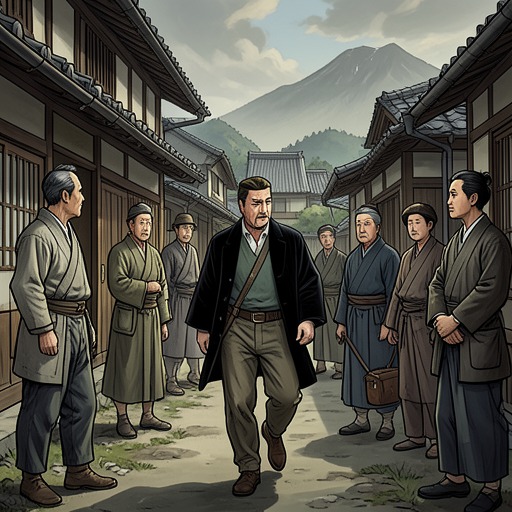
ShōgunEta Stigma marks a hierarchy in which a community is treated as fundamentally separate because of work associated with hides, execution, and the handling of the dead. The novel makes that boundary visible not through an abstract account of social rank but through encounters: John Blackthorne explains the distinction to his crew, feels compromised by the explanation, and later faces the fact that his own shipmates live in an eta village. The resulting tension is at once social and personal: knowledge of the division does not free him from its assumptions or from concern about how others see him.
Social classification and assigned work
Blackthorne explains that Japanese people understand eta as a separate group, identifying work with hides, the killing of old horses and oxen, and the handling of dead bodies as occupations assigned to them. The explanation gives the stigma a material basis in the social order: eta are distinguished not simply by where they live, but by a category of labor that other people regard as contaminating. The passage presents the work as a social designation rather than evidence of any inherent quality in those who perform it.
The setting of the explanation matters. Blackthorne is speaking to members of his own crew, and the conversation has to be prompted. Sonk asks Johann Vinck to tell the others; another crew member urges Baccus van Nekk to continue. The group’s requests frame the information as something the men are trying to understand together. Yet Blackthorne, rather than an eta person, supplies the account of the community and its work. The people being classified remain absent from this exchange, while their social position is described by outsiders.
Blackthorne’s divided response
As Blackthorne explains the category, he notices the crew looking at him, especially Jan Roper. His effort to sound casual does not eliminate the pressure of their attention. After the exchange, he says there is nothing wrong, and knows that to be true, yet still feels befouled. The contrast is central: his conscious judgment rejects the idea that the explanation has made him unclean, while his bodily sense of contamination persists. The stigma thus appears not only as a rule imposed on eta, but as a prejudice capable of affecting even someone who recognizes its injustice.
On his way back to the castle, Blackthorne’s thoughts turn to the fact that his own people are living in an eta village. He sees the contradiction without resolving it: there is nothing wrong with eta, and yet everything seems wrong because his crew is there. His reasoning joins attachment to the sailors with the assumptions he has just described, and it also places them within a division he had previously explained at a distance. The passage does not portray this recognition as a completed change of mind. Instead, it records his confusion as he tries to hold loyalty to his crew together with the social distinctions surrounding them.
Contact, avoidance, and the village
The eta village recurs as a point of contact between Blackthorne’s crew and the surrounding society. When someone at a bath house mentions that he has been to the eta settlement, the response is courteous but makes clear that other guests will appreciate his thoughtfulness. Blackthorne is being treated as a possible carrier of social taint, even though he has already rejected the idea that eta are inherently wrong. Polite language manages the encounter without removing its exclusionary premise: his presence is welcome on condition that he take account of the stigma attached to the people he has visited.
Later, the village is invoked as a possible place to find Blackthorne’s absent friends. The suggestion offers a route toward them, but Blackthorne declines. He distances himself from both the crew’s location and eta, while pointing to obligations to his clients, Kiku of Izu, and his son. This refusal complicates his earlier distress about his men. Their residence in the village has troubled him, but concern does not become a decision to join or visit them; competing responsibilities and the pressure of status remain active. The episode leaves that distance in place rather than presenting a simple resolution.
Narrative significance
Across these scenes, Eta Stigma operates through naming, occupation, residence, and social avoidance. The crew’s discussion turns a hierarchy into an explanation; Blackthorne’s reaction reveals how its assumptions can persist even when he consciously denies them; the bath-house encounter shows those assumptions governing ordinary hospitality; and the later refusal demonstrates that knowing where his friends are does not automatically overcome the boundary. The community’s own perspective is not supplied in these moments, so the reader encounters the stigma chiefly through the responses it elicits from outsiders.
That restricted viewpoint is part of the subject’s significance. The narrative shows how easily a person may describe a prejudice accurately and still feel its force, or recognize the injustice of a category while acting within the separations it sustains. Blackthorne’s conflict is not presented as proof that he has escaped the hierarchy; it is evidence of his uneven awareness of it. The eta village therefore becomes more than a location for the crew. It exposes the distance between moral recognition and conduct, and the way social stigma can shape relationships even when those involved know that the underlying judgment is wrong.