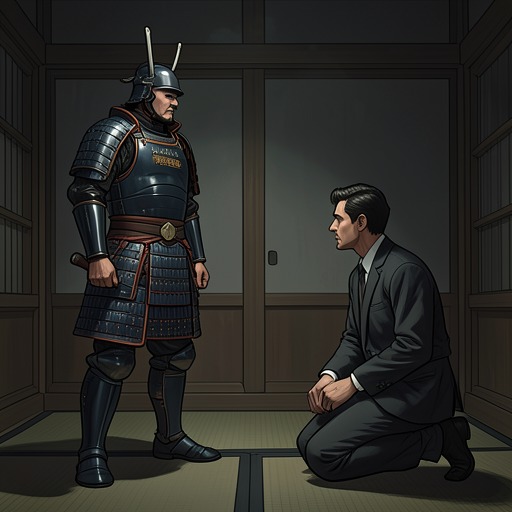
Lord’s legal power over the lives of retainers’ households
ShōgunLord’s legal power over the lives of retainers’ households is a form of personal authority nested within the feudal chain of command. As Toda Mariko explains it to John Blackthorne, a household head possesses the lives of his wife, children, consorts, and servants, but his own life is possessed by his liege lord. The rule makes household authority both immense and conditional: a man may command those under his roof, yet must obey the superior whose power reaches over him.
Scope and Structure
The rule is not described as an abstract statute administered by an impersonal institution. It operates through personal relationships of lordship and household membership. A father’s authority extends over the people dependent on him, while the father himself belongs to a larger structure of obedience. Mariko presents these relations as legally established custom, not as a private license detached from social order. Her account places the household inside the same hierarchy that binds a retainer to a lord.
The resulting chain runs in both directions. A liege lord’s command may reach into a retainer’s household, but the retainer remains the person expected to enact that command within the family. When Blackthorne asks whether a father could kill anyone in his household, Mariko confirms that the law permits it. She later says she would consider it her duty to put her only son to death if Toranaga ordered her to do so, provided her husband agreed. Her answer specifies both the reach of the superior command and a further condition within the household; it does not make obedience a simple, solitary act.
The rule therefore joins privilege to exposure. The household head’s authority over dependents is real, but it exists inside a superior authority that can demand obedience from him. Mariko’s explanation gives no suggestion that family ties automatically exempt a person from a lord’s command. Instead, household intimacy is one of the places where feudal obligation takes effect most starkly.
Household Authority in Practice
The arrangement becomes immediate when Mariko explains that Lady Fujiko is now Blackthorne’s consort because Toranaga ordered the arrangement and Fujiko agreed. Blackthorne has become master of a house, a status Mariko connects to concrete duties and privileges. Fujiko is to manage the household and servants and attend to his needs. Mariko urges him to accept her formally, emphasizing that Fujiko has no other home and that rejecting her could leave her disgraced and without a place in another household.
Blackthorne is not asked merely to choose whether he likes Fujiko. Mariko lays out the legal consequences of the choices available to him as head of the house. He may accept Fujiko as his consort; if he refuses that status, Mariko says he may still accept her into the household and, as its head, kill her; or he may make her an outcast. Each option carries power over her standing and safety. Mariko’s appeal to mercy does not erase the authority she describes; it asks Blackthorne to exercise it in a way that does not destroy Fujiko’s life or social place.
The episode also shows how household authority is assigned and recognized, rather than simply assumed. Toranaga orders the consort arrangement, Fujiko agrees, and Mariko tells Blackthorne that the resulting household status gives him responsibilities toward her. His uncertainty about whether he is truly master of a house meets an explanation grounded in his new position and salary as a hatamoto. The rule enters the plot through a particular person’s precarious situation, making an unfamiliar legal principle legible as a decision Blackthorne must make about Fujiko.
Duty, Faith, and Moral Conflict
Blackthorne reacts to the rule through the moral framework he brings with him. He calls a society that permits a father to kill a dependent a nation of murderers, and asks how such a custom can coexist with the Commandments. Mariko does not claim to resolve the contradiction for him. She says that being Christian, samurai, and Japanese are not, in her understanding, hostile identities, and asks him to be patient with customs he does not yet understand. Her response distinguishes her own participation in the system from Blackthorne’s condemnation of it without pretending that she can make the difference easy for him to accept.
The exchange over her son makes the conflict personal. Asked whether she would obey Toranaga even at the cost of her child’s life, Mariko says she believes she would, because she would regard it as her duty if her husband agreed. The answer joins obedience to the liege lord with the household condition she has already described. It also exposes the cost of treating duty as binding: the person who accepts the rule may be required to act against ordinary familial attachment, while an outsider may see only the killing and reject the moral language used to justify it.
Fujiko’s case sharpens the same tension from another direction. Blackthorne sees himself repeatedly placed in situations where refusal appears to endanger an innocent person; Mariko, meanwhile, regards death as one of the consequences a household head may legally impose, not as an option that lies outside the system. Her counsel that he need not endure the unendurable does not remove the pressure of the law. Instead, the scene lets their different assumptions remain in conflict: Blackthorne searches for a choice that harms no one, while Mariko explains the choices recognized by the social order around them.
Political Limits and Significance
The novel places household power within a broader world of competing jurisdictions and obligations. Yabu’s villagers fear his rule because he cheats them of their rightful shares of the catch and crops, and Mura sees the villages trapped between powerful lords. This account is not itself an example of a lord exercising the specific right over a retainer’s household, but it shows how personal lordship reaches beyond the home into the material lives of dependents. Toranaga’s offer to let Yabu rule Izu, Suruga, and Totomi if he wins the war similarly connects political territory to a personal bargain: Yabu’s prospective authority depends on accepting Toranaga as liege lord.
At the level of the regency, authority is also constrained by agreements. Ishido invokes the Taikō’s prohibition on Regents taking hostages against one another and accuses Toranaga of violating it by keeping Lady Ochiba in Yedo. The dispute shows that personal leverage and political command operate alongside formal covenants; a powerful lord cannot make every contested act legitimate merely by claiming authority. Toranaga’s warning to Blackthorne that foreigners are in Japan only by permission, and that public mischief is punishable by death, marks another jurisdictional boundary: the ruler’s law governs foreigners in the country, while the household rule concerns authority over dependents within the feudal order.
The rule’s narrative force comes from this overlap of command, status, and responsibility. It is not presented as an isolated legal curiosity: it shapes what Mariko believes she may be required to do, what Blackthorne is newly empowered to decide, and how Fujiko’s security depends on recognition within a household. By making the authority concrete in a proposed consort arrangement and a threatened household member, the story tests whether obedience can be separated from violence, and whether the power granted to a householder can be exercised mercifully when the law also permits harsher choices.