Samurai legal privileges and duties
ShōgunSamurai legal privileges and duties define a social order in which hereditary status brings both exceptional authority and binding service. Samurai govern, bear arms, and claim the produce of the land, while their code demands loyalty to a liege lord and an honorable readiness to die in his service. The system’s violence is not merely a private threat: it is reinforced by rules that make attacks on samurai, and failures to report them, punishable as rebellion. Yet the same order is unsettled by the political struggles among its lords, by weapons that challenge its ideals, and by Toranaga’s efforts to subject foreign conduct to Japanese law.
Status, Rank, and Material Privilege
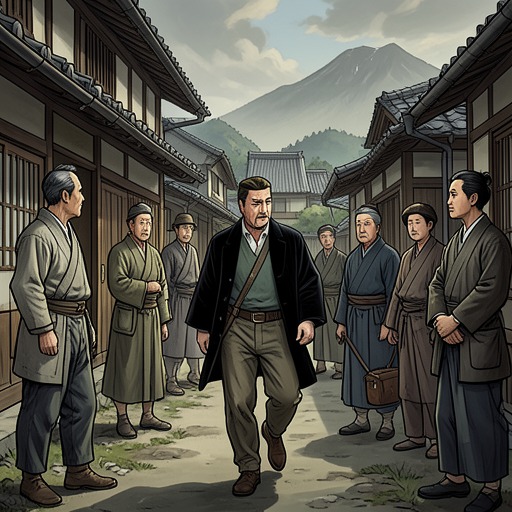
Samurai status is hereditary. As Rodrigues explains to John Blackthorne, the class contains ranks from the daimyo at its summit to foot soldiers at its base; family and rank determine a person’s place within it. He contrasts the present order with an older, more fluid arrangement in which peasants could become soldiers and soldiers might rise in rank, noting that The Taikō had once been a peasant soldier who reached the highest position. In the society Rodrigues describes, however, a person must be born a samurai to belong to the class.
That hereditary distinction organizes both political authority and material life. Samurai rule the country and are the only people permitted to carry arms. Rodrigues says that only peasants may own land, but that samurai own the produce, including the rice that matters most, and return only part of it to those who farm it. Mura’s experience gives this arrangement a local cost: he fears Yabu’s cruelty and lack of honor, and the way Yabu cheats villages of their rightful shares of their catch and crops. The privileges of the ruling class thus reach into ordinary subsistence, while villagers have little power to contest what their lord takes.
The hierarchy also governs deference. Blackthorne sees Omi bow to Yabu and Yabu defer to Toranaga; Rodrigues describes such submission as part of a society in which everyone bows to someone above, even though all samurai share the class’s special privileges. Rank therefore differentiates samurai among themselves without dissolving the legal boundary between samurai and non-samurai.
Armed Authority and Unequal Punishment
The sharpest privilege is the samurai’s power over non-samurai. Rodrigues tells Blackthorne that even the lowest-ranking samurai may legally kill a non-samurai man, woman, or child, for any reason, including to test a sword’s edge. His account makes lethal violence an expression of status as well as an instrument of enforcement: the sword is not simply a weapon, but a visible guarantee that the law protects the armed class more fully than those beneath it.
The rules also extend liability beyond the person who commits an offense. An attack on a samurai by anyone outside the class is treated as rebellion and punished by immediate death. Anyone who witnesses such an attack and fails to report it is equally liable; the penalty can extend to the witness’s wife and children. Rodrigues recalls families being killed under this regime, presenting collective punishment as a consequence of the obligation to defend the samurai order. The law thereby makes silence dangerous and recruits households into its surveillance and enforcement.
Service, Honor, and the Problem of New Weapons
The privileges of the class are matched by obligations to a lord and to Bushido, the Way of the Warrior. The code, as described in the narrative, requires samurai to fight, live, and die with honor; to give their feudal lord undying, unquestioning loyalty; to show no fear of death and even to seek death in the lord’s service; and to keep their own names unsullied. Service is not an incidental duty added to status: it is the principle that justifies the samurai’s place in the hierarchy.
This ideal also shapes what counts as honorable combat. Japanese warfare is described as almost ritualized, centering on individual hand-to-hand fighting in which the sword is the most honorable weapon. Guns, by contrast, are treated as cowardly and dishonorable, contrary to Bushido. Though firearms had been introduced by the Portuguese and Japanese manufacture began within eighteen months, they were long regarded as novelties; bows were considered more accurate even for hunting.
Yabu’s response to the weapons aboard the ship exposes a conflict between inherited martial ideals and strategic advantage. After discovering five hundred muskets, twenty cannon, and extensive ammunition, he plans to move the armaments secretly to his castle at Mishima. He imagines five hundred chosen samurai trained to fight as a unit, supporting twelve thousand conventional troops, with specially trained men operating the cannon. The proposal makes disciplined firearms a possible instrument of power precisely because the established code has treated them as dishonorable. The tension is not resolved by the rule itself: the narrative shows an ambitious lord preparing to test whether military effectiveness can override the inherited definition of honorable warfare.
Lords, Vassalage, and Political Limits
The samurai order operates through personal obligations as well as formal institutions. When Toranaga is away in Osaka, Yabu and other neighboring daimyo are expected to remain in Yedo until his return. Yabu recognizes that they and their families serve as additional protection for Toranaga, in effect hostages, although no one uses that word. The arrangement shows how a lord’s security can depend on the presence of other lords’ households, turning allegiance and political leverage into overlapping forms of control.
The limits on hostage-taking are themselves contested. The Taikō’s will forbids Regents from taking hostages against one another, and the Regents have sworn to uphold its covenants. Ishido argues that Lady Ochiba, the Heir’s mother, is being held in Yedo as a hostage against Toranaga’s safety in Osaka and that this violates the will, which the Regents signed in their own blood. Toranaga answers that she is visiting her sister, who is in labor, and disputes Ishido’s characterization. The dispute shows that a rule’s force depends not only on its wording but also on who controls the people and places through which it can be enforced.
Toranaga’s offer to Yabu likewise makes the personal basis of authority explicit. He asks whether Yabu would accept him as liege lord in exchange for the prospect of ruling Izu, Suruga, and Totomi if Toranaga does not lose the war. Land and rank are offered through a political bargain, while the price is vassalage. For Yabu, whose conduct is driven by both self-interest and fear of his position, service is at once a legal duty and a route to greater power.
Japanese Jurisdiction and Foreign Conduct
Toranaga asserts that foreigners are present in Japan only by permission and that public mischief or quarrels will be punished by death. When Blackthorne asks to discuss trade and the repairs his ship needs, Toranaga refuses to let commercial demands displace the immediate questioning. The exchange places foreign visitors under Japanese jurisdiction, rather than treating their own political or commercial purposes as an exemption from local law.
The same principle governs warfare. Toranaga says that what foreigners do at sea or in their own countries is their affair, but disputes in Japan are subject to one law. He distinguishes a pirate, who rapes, kills, or plunders for personal profit, from Blackthorne’s claim that his ships carry letters of marque authorizing war against Spain and Portugal. The distinction exposes competing legal accounts: an action described as authorized warfare by one power may be treated as piracy by its enemy, while Toranaga reserves the right to judge what conduct is permissible on Japanese soil.
That boundary is reiterated in a discussion of possible attacks involving Lord Harima and the Jesuits who lead the Portuguese. Toranaga says that no daimyo would permit one foreign nation to attack another on Japanese soil or allow foreigners to kill Japanese people; enemies of the Emperor are a different case. He will not permit Blackthorne to make a land attack, though he accepts that Blackthorne may harry his Queen’s enemies on the high seas. The contrast between permission at sea and prohibition on land turns sovereignty into a practical limit on the foreigner’s military role. Across the rule’s different settings, samurai privilege is not presented as an isolated code: it is part of a wider contest over who may command, punish, fight, and define the law.