Taikō’s weapons prohibition
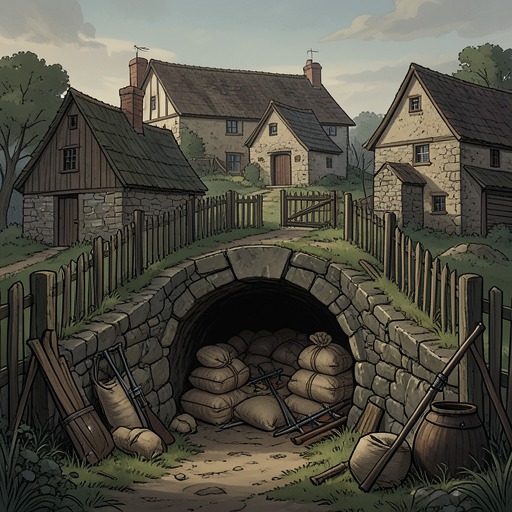
ShōgunTaikō’s weapons prohibition forbids ordinary villagers to possess weapons, making disarmament a tool for fixing social status as well as limiting violence. Its force is clearest in Anjiro, where Mura secretly gathers arms for a war he believes is coming, while other villagers fear the law’s penalty. The rule stands at the fault line between the Taikō’s imposed peace and the renewed military mobilization that threatens to undo it.
Scope and purpose
The evidence presents the prohibition as a recent law, barely twelve years old, rather than an ancient custom. Mura recalls that before it, villagers could own weapons and were not tied to the village: people might fish, trade, serve as peasant-soldiers, and, in some cases, rise even to samurai status. The law changed that freedom. Its ban on weapons helped make the villagers’ place in the social order more fixed, while its stated penalty—instant death—made disobedience a matter of life and death.
The rule appears in a political world where authority is personal and layered. The Taikō made the law; after his death, Mura argues, the conditions that sustained it are changing. He expects Omi-san to need trained men as conflict approaches and points to the villagers’ own experience of alternating between fishing and warfare. His claim that they will soon soldier again treats the prohibition not as an enduring moral truth, but as a settlement that war may overturn.
Anjiro’s concealed preparations
Mura acts on that expectation before the law has changed. On his orders, thirty koku of rice is taken from the samurai commissariat and hidden around the village with other supplies, equipment, and weapons. When his old companions discuss the stores, he insists cautiously that nothing exists. The denial is more than a cover story: it recognizes that openly admitting to weapons would expose the villagers to the very punishment they fear.
The preparations also reveal disagreement within the village. Uo accepts the need for rice but protests against storing weapons. Ninjin is more alarmed, reminding the others that possession is illegal and that the prohibition was made by the Taikō. Their fear is not abstract. Ninjin expects that the authorities will discover the arms and show no mercy, invoking the barbarian who was boiled as an example of what might happen to someone in their power. The scene distinguishes the law’s explicit penalty of instant death from Ninjin’s fearful prediction of a particular punishment; his words register how terror circulates among those subject to enforcement.
Mura answers by placing the law in historical perspective. The villagers, he insists, had weapons and movement before the Taikō’s order, and the old combination of fishing and warfare could return. His confidence is political calculation, not proof that the ban has been repealed. Until that change comes, the hidden arms remain evidence of a punishable breach, and the villagers remain exposed if discovered.
Disarmament and unequal military power
The prohibition’s practical meaning emerges through the contrast between villagers’ clandestine stores and the arsenals available to lords. Yabu, after discovering a ship’s cargo, privately orders five hundred muskets, twenty cannon, and their ammunition moved to his castle at Mishima. The narrative describes him imagining a force of selected samurai trained to use muskets as a unit, supported by conventional troops and artillery. These elite preparations do not establish a formal exception to the Taikō’s law; rather, they show that weapons remain central to the struggle for power even while villagers are forbidden to possess them.
That contrast extends to the changing reputation of firearms. Japanese warfare is described as traditionally organized around individual, hand-to-hand combat, with the sword treated as honorable and guns regarded as cowardly and contrary to bushido. Yet Yabu sees disciplined musket formations as a possible decisive advantage. In the demonstration witnessed by Jozen, the soldiers form ranks and fire in coordinated volleys, regrouping after a simulated retreat to deliver further salvos. The episode shows how military practice can change while established ideals resist it. The prohibition belongs to a wider contest over who may hold weapons, what kinds of force are legitimate, and who gets to decide when war overrides settled rules.
Law under the pressure of war
Mura’s preparations make the prohibition’s political vulnerability visible. He does not claim the law has already ceased to apply; he argues that the Taikō is dead and that the coming war will make trained villagers useful again. The tension is therefore between current legal danger and an anticipated military demand. In the interim, commoners may be expected to supply labor and face punishment for preparing to fight, even as lords acquire weapons and organize forces.
The law’s significance lies in that unequal exposure. For the villagers of Anjiro, arms are not simply tools of defense: possessing them can bring instant death, while remaining unarmed leaves them subject to the decisions of their rulers. Mura’s concealed stores turn disobedience into a wager on political change. The prohibition thus measures the Taikō’s continuing hold over village life against the approaching collapse of his peace, when military necessity may restore practices that the law had forbidden.