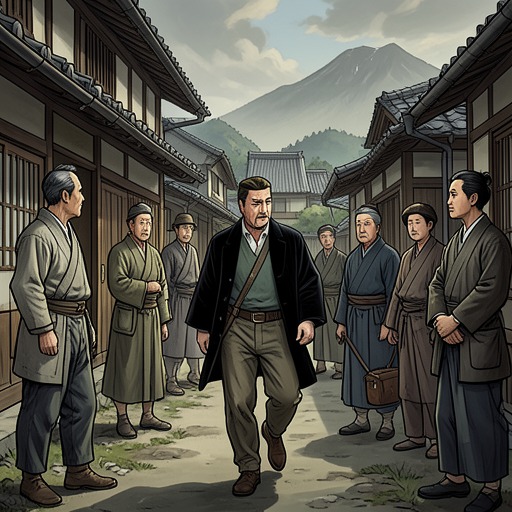
Toranaga–Blackthorne relationship
ShōgunToranaga and John Blackthorne are bound by a relationship in which strategic usefulness comes first but does not remain the whole story. Toranaga regards the foreign pilot as a potential instrument of power, protects him from assassination and rival influence, and draws on his expertise in a country whose rulers have depended on Portuguese pilots for ocean voyages. Blackthorne, meanwhile, continues to press for his ship, his crew, and the freedom to sail home. Their exchanges bring real regard into a distinctly unequal bond: Toranaga controls Blackthorne’s safety and movements, while Blackthorne possesses knowledge and maritime capabilities that Toranaga cannot simply command into existence.
Strategic Value and Maritime Knowledge
Blackthorne’s importance rests in part on the scarcity of reliable navigational knowledge. The charts available to mariners are vague, and longitude cannot be fixed. A navigation manual compiled by a pilot who has already sailed a route can offer practical guidance unavailable from charts alone: courses between ports and capes, depths and seabed conditions, currents and winds, storms and safe anchorages. Such manuals are imperfect and can contain deliberate errors, so even a skilled pilot must test their claims at sea. Blackthorne’s professional knowledge is therefore both valuable and difficult to replace with a document.
The political context magnifies that value. Portuguese and Spanish pilots have sailed waters beyond their own regions, while their states guard route knowledge as a national treasure. In Japan, the Taikō had required the few ocean-going ships to carry Portuguese pilots. When Rodrigues pilots Toranaga’s galley along the Izu Peninsula and then turns west across open water toward Cape Shinto, Blackthorne understands the risks of the route and the demands of piloting beyond the coast. The episode makes clear that the sea is not incidental to Toranaga’s political calculations: control of ships and navigation can open routes, shorten journeys, and create leverage beyond the shore.
Toranaga’s estimate of Blackthorne is correspondingly stark. After an assassin enters Toranaga’s private quarters, he concludes that Blackthorne, not himself, was the intended target. The attack follows the foreigner’s extraordinary revelations and persuades Toranaga that someone considers him too dangerous to leave alive. Toranaga orders the guards around him doubled, judging Blackthorne worth ten thousand men. The valuation is not a declaration of personal intimacy; it identifies a person whose knowledge and presence may alter the balance of power.
Protection, Captivity, and Political Use
Toranaga’s protection of Blackthorne is deliberate and politically managed. He had anticipated further danger after the foreigner’s revelations, yet the speed and location of the attack surprise him. He suspects that information may be leaking through hidden listening places in the castle and garden, where rival spies could overhear private conversations. His response is not to remove Blackthorne from political danger altogether, but to increase his protection inside an enemy stronghold where Ishido and others have informants.
That protection follows an earlier decision to use Blackthorne’s imprisonment for a purpose. Toranaga had sent him to prison partly to make Ishido believe the stranger was of little consequence and partly in the hope that he would draw knowledge from the imprisoned Spanish priest. Toranaga already knew the priest was hostile to the Portuguese, but considered him the Taikō’s prisoner and recognized that he lacked jurisdiction over people in Osaka. When Blackthorne asks for the sick, elderly monk to be released, Toranaga does not disclose that he has already sent samurai to fetch him. The gesture of apparent consideration thus sits alongside a hidden political plan: Toranaga grants Blackthorne’s request while pursuing his own purposes for both men.
Toranaga also acts to preserve Blackthorne from rival control. His agents report that the prisoner and the monk have become friends, with the monk speaking and Blackthorne asking questions and listening. Toranaga is not troubled that Ishido may have spies in the cell; he believes Blackthorne is protected. When Ishido unexpectedly tries to spirit him away into another sphere of influence, Toranaga’s established safeguards acquire a sharper meaning. Protection is a way of keeping a valuable person available and preventing an opponent from claiming him.
Regard Beyond Calculation
The relationship is not confined to surveillance and political utility. After a dance, Toranaga gives Blackthorne his own brown silk kimono, marked with five scarlet crests, and takes a simpler garment for himself. Mariko explains that even an old kimono from one’s liege lord is considered a great honor. Blackthorne accepts the gift with a formal bow and asks that Toranaga be thanked both for the honor and for joining in his dance. Toranaga is pleased. The exchange briefly makes their connection legible through reciprocal attention: Toranaga gives a sign of favor, and Blackthorne responds by recognizing the personal gesture as well as its rank-bound meaning.
Toranaga’s next message keeps that moment connected to a broader purpose. He has enjoyed the dance and may one day show Blackthorne Japanese dances; he also wants him to learn Japanese as quickly as possible. Blackthorne welcomes the prospect, but his private wish remains to be back in his own clothes, eating his own food aboard his own ship, with his cannon ready and the sails drawing. His desire does not dissolve into gratitude for Toranaga’s favor. The scene instead places cultural exchange beside continued captivity and homesickness: Blackthorne can value the honor without mistaking it for the return of his freedom.
Ships, Bargaining, and Unequal Dependence
Blackthorne makes his priorities explicit by asking when he can have his ship back. He reminds Toranaga that his crew and cargo matter too, including twenty thousand pieces of eight in the strongbox, and presents the crew as merchants who would like to trade and continue homeward. The voyage home, he says, would take almost eighteen months. His appeal treats the seizure of ship and cargo as a practical obstacle to his obligations, not as a matter settled by receiving favor at court.
When he asks whether the crew will receive protection and be sent to Yedo, Toranaga’s answer is that arrangements have already been made and that Blackthorne need not worry about them or the ship. He later learns that the ship is already at Yedo. The information reassures him that the vessel has not been abandoned, but it also reveals how completely Toranaga controls the timing and terms of access. Blackthorne asks; Toranaga has already acted, without making his decisions transparent in advance. Their reliance is mutual in kind but unequal in power: Toranaga needs what Blackthorne can offer, while Blackthorne’s immediate prospects depend on Toranaga’s decisions.
The same imbalance becomes visible in negotiations with the Jesuits. Toranaga points to the foreign pirate as an enemy of their country whose presence could be discouraged or encouraged, placing Blackthorne’s fate within the bargaining space. He then tells Father Alvito that he needs help immediately and agrees to wait forty days. This places Blackthorne within a larger contest over Christian daimyos and foreign influence without establishing that his fate has been decided. For Toranaga, the pilot is simultaneously a person under guard, a source of maritime capability, and a political factor that can be invoked in negotiations.
A Relationship Measured at Sea
Blackthorne’s actions show why Toranaga’s reliance is not merely theoretical. When the Santa Theresa pursues the galley near the harbor mouth, Blackthorne assesses the vessels’ different advantages: the frigate is faster but must tack against the wind, while the galley can maneuver more freely in confined water. With little sea room beside the cliffs, the distance between success and disaster is narrow. Blackthorne insists that the galley hold its course, and invokes Toranaga’s authority to establish that he is now its chief captain. Toranaga’s appointment of him has therefore given him an operational role at the moment when his piloting can matter.
Across these encounters, the relationship develops through a recurring tension between command and competence. Toranaga can move Blackthorne between prison, guarded rooms, and political negotiations, and he controls access to the ship and crew. Yet the pilot’s knowledge, judgment, and ability to act at sea remain distinct sources of power. The gift of a kimono and the shared dance suggest a measure of personal recognition, but neither cancels the strategic structure around them. Their bond is most accurately understood as a continuing negotiation: Toranaga protects and employs a man he considers indispensable, while Blackthorne accepts neither that protection nor that usefulness as a substitute for the ship and independent life he still seeks.