Brett Kavanaugh
She SaidBrett Kavanaugh enters the book as a distinguished federal judge nominated by Donald Trump to serve on the Supreme Court, and as the man Christine Blasey Ford said had assaulted her when they were teenagers. The account follows how a private memory became a public allegation during a consequential confirmation process. It does not resolve the conflicting accounts: Ford described an assault at a high-school gathering, while Kavanaugh denied that the encounter or any sexual or physical encounter between them had occurred. Their opposed accounts made his nomination a test of how institutions weigh an old allegation against a candidate for extraordinary public power.
Background and nomination
Kavanaugh and Ford had grown up in the same affluent suburban social world, though in different schools. Ford later became a scientific researcher in California, while Kavanaugh rose through a legal career to become a federal judge. In 2012, after reading that George W. Bush had attended Kavanaugh’s wedding, Ford first registered how far his career had advanced and wondered whether he might eventually be nominated to the Supreme Court. His possible elevation thus came to matter to her not only as a national political question but as the prospect that a person connected to a painful memory could hold a lifetime appointment.
Ford did not initially present herself as a political activist or public accuser. In 2016, while talking with her friend Keith Koegler about the sentencing of Brock Turner, she told him that she had been assaulted as a teenager by someone who was now a federal judge. Koegler did not press her for more. After the Weinstein reporting, Ford briefly posted #metoo, but did not become a prominent participant in the debate. When Kavanaugh’s name appeared on Donald Trump’s Supreme Court shortlist in June 2018, she wrote to Koegler that the nominee was the person she said had assaulted her in high school and that, if confirmed, he could remain on the Court for the rest of her life.
The timing gave the memory a new public consequence. As the nomination approached, Ford believed the information was relevant to evaluating a candidate for a lifetime role. She wanted to protect her privacy and avoid embarrassing her family or publicly shaming a hometown figure; their fathers still belonged to the same private golf club. Her stated aim was more limited: to pass on her account before Kavanaugh became the nominee, so decision-makers could consider it while another candidate might still be chosen. She also acknowledged that her knowledge was incomplete: she could not know whether the incident she remembered was isolated or part of a broader pattern.
The allegation and its path to public view
In August 2018, Debra Katz told Jodi Kantor, off the record, that she had begun representing a woman who accused Kavanaugh of assaulting her as a teenager. Katz described a party in suburban Maryland and said the client had experienced lasting anguish and anxiety. The woman had not told anyone at the time, and the particulars were not all clear to her decades later. Her recollections had been discussed with her husband, some friends, and therapists; Katz had also arranged a lie-detector test. The book emphasizes both the allegation’s seriousness and the limits of what could then be corroborated.
Ford’s identity and professional life gave the story a contrast with the public image of a political insider. She was a professor of psychology and a biostatistician, a mother of two, and a researcher whose work addressed subjects including trauma and resilience. She had largely kept away from national political debate. The anticipated controversy in her life had concerned an upcoming scientific paper on ketamine, not an accusation against a Supreme Court nominee. Her account, however, had been present in her life for years, even when it was not publicly central.
Ford’s confidential letter to Dianne Feinstein set out the allegation and named Mark Judge as Kavanaugh’s close friend and a participant in the episode. It described an early-1980s gathering at a private home, where Ford said Kavanaugh and Judge had physically assaulted her and she had eventually escaped to a bathroom and left the house. The account also stated that she had not knowingly seen Kavanaugh since the incident, though she had once encountered Judge. These particulars were Ford’s account, not findings established in the material presented here.
The route to representation was uncertain. Lawrence Robbins, an attorney who had argued cases before the Supreme Court, listened to Ford and concluded that the gaps in her memory did not erase the parts she could recall or the corroboration she offered. He thought the allegation deserved to be taken seriously, but could not represent her publicly because his partners feared the effect on their appellate work. Ford later met Katz and Lisa Banks, lawyers experienced in such allegations, after Feinstein’s office connected them. The decision to disclose therefore involved not simply whether to speak, but how to retain control of a story whose public consequences could rapidly exceed its author’s intentions.
Confirmation proceedings and opposing accounts
The allegation posed an unusual problem for the #MeToo debate as the book describes it. Unlike the workplace complaints central to the Weinstein investigation, it concerned conduct Ford said occurred at a private party when she and Kavanaugh were teenagers. The passage of time, the absence of contemporaneous reporting, and incomplete corroboration meant that the facts were likely to be disputed. Some might understand the allegation as a serious assault; others might dismiss it as drunken horseplay. At the same time, the question was not only how to judge adolescent conduct in isolation: Kavanaugh was being considered for a role in which he could help decide matters with far-reaching consequences for women and girls.
The institutional and electoral setting intensified the conflict. A public allegation risked recalling Anita Hill’s testimony during Clarence Thomas’s 1991 confirmation hearings. The nomination unfolded under Donald Trump, with a Supreme Court vacancy and midterm elections approaching. Republican control gave Judiciary Committee chairman Chuck Grassley extensive influence over the hearings, with majority leader Mitch McConnell also looming over the process. Grassley and Trump publicly promised respectful treatment of Ford. The book connects that posture to the political risks of a confrontation that could resemble the all-male Republican side of the committee facing a vulnerable woman, and to Republican concern about female voters.
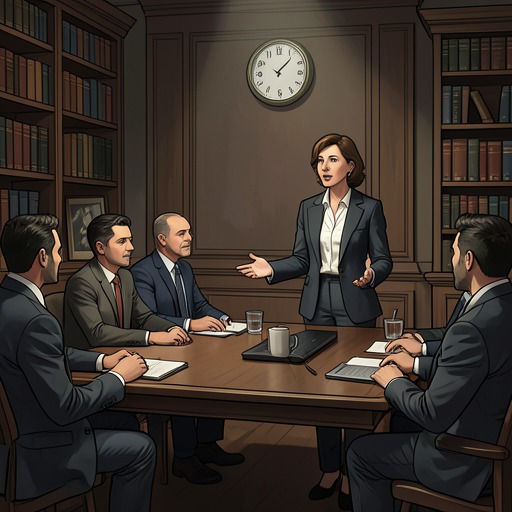
When Kavanaugh testified, he did not adopt a restrained position of uncertain recollection. He issued a sweeping denial under oath, rejecting Ford’s allegation and denying that he had attended the kind of gathering she described. He also characterized the process as a politically orchestrated attack connected to anger over Donald Trump and the 2016 election. The contrast between the two appearances became part of the story’s public meaning: Ford had been measured and careful in describing what she remembered, while Kavanaugh spoke with anger and framed the accusation as partisan. The narrative reports this contrast without treating demeanor alone as proof of either account.
Kavanaugh also placed the allegation amid other complaints during the confirmation dispute. Julie Swetnick, represented by Michael Avenatti, came forward with a sworn statement and a television interview; her accounts were seen by many as contradictory and not credible. Her case affected the wider setting in which Kavanaugh defended himself, but it did not settle Ford’s distinct allegation. The proceedings brought several claims and political arguments into one compressed public contest, making it harder to separate the evidentiary questions about each allegation from the battle over the nomination as a whole.
Consequences and narrative significance
On October 5, 2018, the Senate advanced Kavanaugh’s nomination, with a final vote expected the following day. The date was the first anniversary of Jodi Kantor and Megan Twohey’s first Weinstein story and fell almost exactly two years after the release of the Access Hollywood tape. For Ford, the advance of the nomination carried a stark consequence: despite having come forward and testified, Kavanaugh still appeared likely to take a seat on the Supreme Court. Katz urged her to remain strong, acknowledging that Ford had done far more than she had originally planned.
Kavanaugh’s role in the narrative is defined less by an account of his private interior life than by the institutional force of his candidacy and his response to an accusation. He stands at the intersection of two questions that the book refuses to collapse into one: what can responsibly be established about a decades-old allegation, and what should the public require of someone seeking a position of lasting authority when such an allegation is made? The tension between an accuser’s imperfectly corroborated memory and a nominee’s categorical denial remains unresolved in the account. The Senate’s movement toward a vote supplies an outcome to the immediate procedural struggle, not a definitive answer to the underlying dispute.