Rowena Chiu
She SaidRowena Chiu is a former Miramax colleague of Zelda Perkins whose account of the 1998 Venice incident with Harvey Weinstein was constrained for years by a settlement and confidentiality agreement. Her trajectory in the book is not a quick passage from silence to public disclosure: she remained unidentified through the initial investigation, attended a gathering of women who had spoken out without promising to tell her story, and only later decided to go on the record. The change matters because it shows how speaking publicly could become possible through other women’s example, while remaining a decision with consequences she had reason to fear.
Background and the settlement
Chiu’s name appears in the chronology of allegations and settlements connected to Weinstein: in 1998, she and Perkins were associated with an incident in Venice, Italy, followed by a settlement. The book places their experience within a wider pattern of complaints that often remained difficult to report publicly. When the reporters were preparing their investigation, Perkins was still bound by a confidentiality agreement, and Chiu had not spoken to them at all. Their history could therefore be represented only in a few short paragraphs, enough to indicate serious allegations and a settlement while protecting the women involved. The limits on what could be printed were not a lack of significance; they were part of the story of how the matter had been kept from public view.
The settlement’s effects continued well beyond the original incident. For years after the Weinstein story broke, Chiu remained publicly unidentified and communicated with Jodi Kantor through her lawyer. Her decision not to speak was not presented as proof that she had nothing to say. Rather, it reflected the conditions under which she could make that choice: a confidentiality agreement remained in force, and the investigation’s early reporting offered no guarantee that she would want, or be able, to become a public source. When the reporters invited her to a later gathering, she agreed on the condition that her name remain confidential if she ultimately chose not to come forward; she also asked that her lawyer attend.
A life beyond the case
By the time of the gathering, Chiu had built a life far from her earlier work in film. Her parents had moved from Hong Kong to the United Kingdom before she was born, and she spoke with a British accent. She had left the film industry, earned a law degree, worked as a management consultant, moved to the United States, and was writing research papers for the World Bank while raising four children. Her husband was with her at the gathering; apart from him, she said, her family still knew nothing about her story. The contrast between her established family and professional life and the prospect of public disclosure gives the decision its particular stakes: speaking could reach into a life she had built after leaving the industry.
Chiu was also not approaching the question of disclosure from a distance. She lived near Christine Blasey Ford, who, three months after the Kavanaugh hearing, was still receiving death threats and had not returned to local shopping for fear of being approached by strangers. Chiu had watched friends and neighbors organize a candlelight vigil and deliver meals to Ford. She imagined that public criticism and attention could come to her too, including news vans outside her home and the possibility that her children might be followed to school. The parallel was not exact: the Weinstein case was more settled and less controversial. But Ford’s experience gave Chiu a nearby, concrete view of what public exposure could entail.
At the gathering
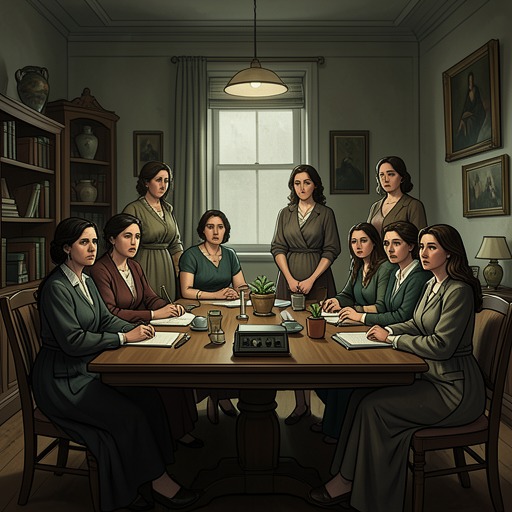
The gathering brought together women whose occupations, resources, and experiences differed sharply. Chiu, a former film-industry worker now writing research papers and raising four children, met participants including Lawson, a McDonald’s worker who had been homeless six months earlier and was then earning ten dollars an hour, as well as women known for their work in film and their public accounts. The group met in Gwyneth Paltrow’s home, where the comforts of the setting made those economic differences visible rather than dissolving them. The gathering aimed to give each woman’s account equal importance, but the women did not arrive with equal degrees of public recognition, financial security, or exposure.
At first, Chiu remained apart from the decision to speak. She had never shared her story aloud with a group, and when her turn came, Kantor offered her the option of passing. Chiu chose to take a turn, while making clear that she had little practice telling the story and was the only person at the table who had not yet gone public. She then described a barrier she understood as extending beyond her own circumstances: she felt that few Asian women came forward with such accounts, not because these experiences did not happen to them, but because expectations associated with the model-minority idea could discourage making a fuss, speaking up, or disrupting one’s work. Her intervention gave the conversation a perspective the group might otherwise have missed. Silence, in her account, could be shaped not only by a legal agreement but also by cultural expectations about keeping one’s head down and not causing trouble.
She told the group that disclosure frightened her because it could shock her friends and alter her life. Hearing the other women describe what had led them to speak helped her consider the choice, but she did not present the decision as settled that evening. The gathering was an interview for the journalists; for Chiu, it was also a chance to listen to people who had crossed a threshold she had not yet crossed. That difference in purpose turned the group’s conversation into a practical point of deliberation rather than a simple celebration of speaking out.
From witness to public source
Ford’s presence sharpened that deliberation. Chiu had imagined Ford’s public controversy happening to her, and meeting her in person strengthened rather than extinguished Chiu’s wish to go public. She said that being among the women inspired her and that speaking could change who she was. Around her, the others responded with support, including Lawson, who treated the possibility of disclosure as a step of growth regardless of how long it had taken. Chiu’s movement toward speaking was therefore neither solitary nor automatic: it developed through observing Ford’s experience, hearing the group’s accounts, and receiving encouragement without being pressed to make an immediate commitment.
A few weeks later, Chiu called the reporters and said she was ready for them to share her name publicly. More than eighty women had already come forward about Weinstein, and she was uncertain whether the public would still care about her account. She nevertheless wanted to speak. During the initial investigation, she had not been ready; the women in Los Angeles and elsewhere had made the way easier. She was also concerned that the legal cases against Weinstein might not succeed, and wanted to help establish the history and continue pressing for change. Her decision thus connected personal disclosure to a wider purpose: preserving an account that confidentiality had kept out of public discussion and adding it to the record even when attention might have moved on.
Narrative significance
Chiu’s arc makes the limits and costs of visibility legible without treating public disclosure as the only meaningful response. She attended the gathering while keeping her name protected, spoke there for the first time before a group, and chose to go on the record only weeks later. The sequence preserves the uncertainty between those stages: being present did not oblige her to disclose, and hearing other women did not erase her concerns about the effect on her family and life.
Her story also links institutional secrecy to the conditions that shape who can speak. The confidentiality agreement restricted what the journalists could initially publish; Chiu’s long absence from public accounts left her experience largely outside the investigation’s named testimony. At the gathering, she identified another pressure on speech in the expectations placed on Asian women, while the differences among participants showed how economic circumstances and public standing could alter the risks of disclosure. Her eventual choice did not undo those constraints. It did, however, change her position from a person represented only within the narrow limits of a settlement-bound investigation to a source who chose to contribute her name and account to its public history.