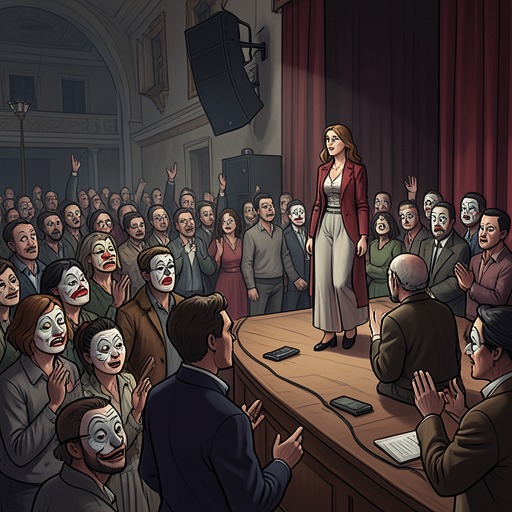
Comedy as a social force
Shrill: Notes from a Loud WomanComedy as a social force is the principle that humor participates in shaping the world it appears merely to reflect. In Lindy West’s account, jokes carry cultural consequences because audiences encounter them within unequal social conditions: a joke can challenge injustice, or make existing contempt easier to dismiss. This idea grounds her argument that discussing comedy’s targets and effects is not censorship but a necessary examination of artistic choice.
Definition and Cultural Reach
West begins from a contrast between comedy’s acknowledged influence and the convenient claim that stand-up exists apart from ordinary life. People readily recognize that television comedy can affect perceptions of social groups, that satire can matter politically, and that propaganda can persuade. If these forms of communication have power, she argues, stand-up should not be granted a special exemption simply because its message arrives as a joke. Comedy is made with choices about words and purpose; examining those choices is part of taking the art seriously.
The claim is not that each joke single-handedly changes an audience or causes a particular act. Rather, comedy operates as one cultural force among others: it can reflect attitudes already present and help make them more familiar, permissible, or difficult to contest. West invokes Tina Fey’s portrayal of Sarah Palin and the role that comedy can play in political life as examples of humor’s potential reach. She also points to the place of The Daily Show in some viewers’ understanding of current events. These examples make the central inconsistency plain: comedy is often celebrated as a potent form of public expression, then treated as inconsequential when audiences criticize what it communicates.
Target, Context, and Responsibility
For West, the key question is not simply whether a joke concerns a painful subject. It is whom the joke makes its target. In her discussion of jokes about rape, she distinguishes between humor that directs criticism toward rapists and rape culture and humor that makes victims the object of ridicule. The subject alone cannot determine the joke’s meaning: its target and the culture in which it circulates matter. A comic can address terrible realities while using the art to expose or oppose them, rather than strengthening the conditions that make them worse.
This distinction also underlies West’s rejection of the claim that a comedian is harmless because an act offends everyone equally. Groups do not occupy equal positions of power, so a performance that claims to insult everybody may still strike people who are already socially vulnerable harder than those who are not. The difference is not merely the performer’s declared intention; it is the relation between the joke’s target and the existing distribution of power. West therefore treats choosing a target as an ethical and artistic decision, not as evidence that comedy must be stripped of difficult subjects.
Her account also challenges the idea that an audience’s ability to recognize a performance as comedy settles its effects. Irony may distinguish a comic persona from the performer’s literal beliefs, but it does not guarantee that everyone will experience the joke as safely detached from real-world attitudes. For people affected by sexual violence or misogyny, the assurance that everyone already rejects rape is not self-evident. West argues that victim-targeting jokes can reinforce a culture in which assaults are minimized, reporting carries high social and emotional costs, and victims are blamed. The relevant question is thus not only what a comic claims to mean, but what familiar assumptions a joke may affirm.
Debate and Illustrations
In the public argument over rape jokes, West confronts Jim Norton’s position that comedy reflects or reacts to society rather than causing its violence. She counters that this framing separates speech from the social conditions in which people live. To make the point, she compares changing comedy with changes in how Black people are treated: the existence of racist jokes in an earlier period cannot be detached from the more openly hostile conditions of that period. Her argument is not that jokes alone explain injustice, but that it is inconsistent to praise comedy as powerful when it speaks truth to power and deny that words matter when their effects are criticized.
West further argues that context cannot be reduced to the performer’s intended irony or the audience’s presumed consensus. In discussing jokes about AIDS, she notes that some people who consider themselves compassionate may still hold stigmatizing beliefs about gay men and the disease. A joke need not create prejudice from nothing in order to matter; it can validate or intensify an assumption that is already present. This example broadens her analysis beyond rape jokes: comedy’s social effects can include making latent prejudice feel acceptable, even when the audience does not openly identify itself as prejudiced.
The Steubenville rape case provides a stark contemporary setting for the argument. As the case received extensive news coverage, jokes about the victim circulated alongside social-media posts and videos; the victim’s identity was exposed, while public discussion also dwelled on the perpetrators’ futures. West presents this convergence as evidence of the environment in which jokes operate, not as proof that a particular joke caused the crime. The episode makes visible how humor, online circulation, institutional responses, and public narratives can coexist around sexual violence—and why claims that comedy is sealed off from social life ring hollow.
Significance
Comedy as a social force does not, in West’s account, require a ban on offensive material or a rule that comedians avoid painful subjects. It requires recognizing that artists choose how to speak and that audiences may assess those choices. Her defense of jokes that confront terrible realities is inseparable from her criticism of jokes that make vulnerable people bear the punchline. The distinction preserves comedy’s capacity to criticize power while refusing to treat all targets, intentions, and effects as interchangeable.
The concept also explains why West sees criticism as a form of engagement with comedy rather than hostility toward it. If stand-up can shape public feeling, then asking what its jokes normalize is part of recognizing its importance. Her argument ultimately turns on a double standard: culture often credits comedy with influence when that influence is celebrated, yet invokes the phrase just a joke to evade responsibility when the influence is contested. Treating comedy as a social force means holding both propositions together—that humor can be art with genuine power, and that its power makes its choices worth examining.