Eagle Rock house
Shrill: Notes from a Loud WomanThe Eagle Rock house is the little yellow home Lindy West rented in Los Angeles for herself, Ahamefule J. Oluo, and their shared attempt at a future. Its short life gathers several kinds of instability into one place: a relationship built on unequal expectations, the demands of a complicated family life, and, at last, a storm that brought the backyard eucalyptus down across the house. The building is not merely a setting for the breakup. Its destruction makes the collapse of the couple’s imagined home brutally literal, while the circumstances surrounding it connect that loss to West’s departure from her father shortly before his death.
A home built around an uncertain future
In the summer of 2011, Ahamefule J. Oluo and Solomon reached the semifinals of NBC’s Stand Up for Diversity contest, giving them a possible route to greater attention from Los Angeles television-industry figures. West understood that the prospect was uncertain: Ahamefule J. Oluo might stay in Los Angeles for only a few months, six at most, while she was signing a lease for a full year. He had two children and an established life in Seattle; the move was not a straightforward relocation for a family, but a limited trial tied to a comedy opportunity. West nevertheless went ahead, convinced that he was the person with whom she would build a life.
The house therefore stood inside a wager whose terms were unequal from the start. West’s lease made a longer commitment tangible, while Ahamefule J. Oluo’s possible stay had a stated limit and depended partly on what happened with the contest. In the driveway, he said they would live together and be a real couple. West took that declaration as confirmation that her earlier doubts could be set aside. Looking back, she recognizes how much she wanted his words to settle the question, despite the warnings she had heard about his recent divorce, their loud and hurtful arguments, and the many demands on his life. The house gave the hoped-for relationship an address, but not a guarantee.
Domestic life next door
West describes renting a little yellow house with a large eucalyptus tree in its backyard. The property belonged to a church two doors away; church members sometimes visited and tried to persuade the household to attend activities. The same church owned the neighboring house, which looked identical from the outside but concealed a markedly different domestic scene. Its occupants were a middle-aged couple and their teenage son. The wife, Kathy, had severe early-onset Alzheimer’s and repeatedly wandered into West’s home, confused and distressed, asking where she was and where her husband, Jeff, had gone.
West and the others tried to comfort Kathy and guide her back. The neighboring interior was dark and cluttered, with towels covering the windows, takeout containers on the counters, and little furniture beyond mattresses on the floor. On one especially hot afternoon, West went to settle Kathy in the back bedroom and discovered Jeff asleep under blankets, despite Kathy’s distress and her search for him. When Jeff came to collect his wife on another occasion, his usual cheer briefly gave way as he acknowledged that she used to take care of everything. The two houses were alike in their ownership and outward form, yet the scene next door exposed how vulnerable a household could become when illness altered the work and care that sustained it. West’s house was a place where that vulnerability crossed the threshold, not a sealed refuge from it.
Separation and the storm
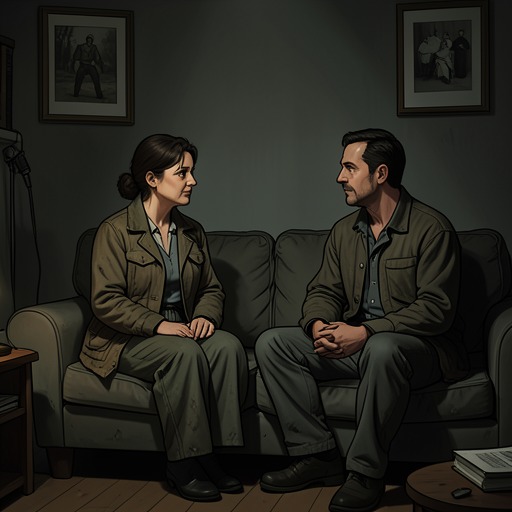
The relationship ended before the house did. Four weeks after Ahamefule J. Oluo told West he was leaving, she was alone in the bed that had been theirs. He was in Seattle while she returned to Los Angeles; Solomon was also out of town. The Santa Ana winds intensified, the power failed, and the windows rattled. West, having taken Ambien, heard the house groan and crack and mistook the disturbance for a nightmare intruding into waking life. By morning, leaves covered the windows and pushed through the screens and over the sills; the back door, Solomon’s room, and the kitchen were obscured by them.
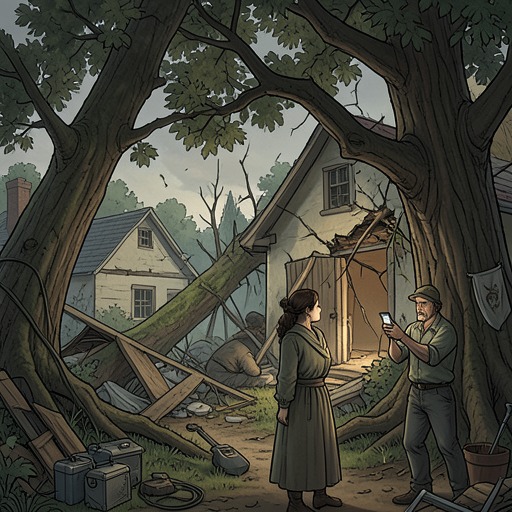
The old eucalyptus could no longer withstand the winds. It split in half and crushed the little yellow house. The damage was sudden, but its place in West’s chronology gives it the force of an ending already prepared by earlier losses: the breakup had come four weeks before, and her father would die two weeks later. West had left Seattle and her father despite sensing, in retrospect, that the move was wrong along the way. The book’s account sets the tree’s fall against that departure and the bed from which the relationship had vanished. The house’s ruin cannot explain either loss, but it gathers them into the same final stretch of time.
Meaning and afterlife
West explicitly recognizes the danger of treating the fallen tree as a neat literary symbol: its destruction seems so perfectly matched to the failed love story that it risks feeling too obvious to belong in fiction. That self-consciousness matters. The house is not presented as proof that the relationship was doomed, nor does the tree cause the breakup. Instead, the material event arrives after the emotional rupture and gives it an image that the narrator herself distrusts for being too apt. The force of the scene lies in that tension between an actual storm-damaged home and the temptation to turn disaster into a tidy metaphor.
The Eagle Rock house also holds the contrast between an imagined shared life and the conditions that actually shaped it: a year-long lease beside a possible six-month stay, a new home beside the unresolved pressures of family and work, and a bedroom once shared with someone who had changed his mind. After the tree fell, West’s mother called in tears to say that the time had come, and West returned to the airport. The house’s destruction thus closes more than a domestic episode. It marks the end of the Los Angeles arrangement at the moment West was called back to face her father’s final illness, leaving the promised home behind as a physical ruin and a concentrated record of what did not hold.