Ingrid
Shrill: Notes from a Loud WomanIngrid, Lindy West’s mother, is a nurse, caretaker, and practical force in her family, known for rigid standards, dry humor, and the habit of following through. Set against her husband’s exuberance and imaginative temperament, her realism is not a lack of feeling but a different way of sustaining the people she loves. As her daughter recalls her, Ingrid’s care takes the form of preparation, structure, and action—and, in the family’s final vigil around her husband, of a fierce refusal to let routine erase grief.
Family Background and Character
Ingrid was the sixth of seven children raised by Clara and Ole, who married, moved to Seattle, and made room for a crowded household. Clara kept house, preserved fruit, sewed clothes, and maintained a pot of coffee for whoever arrived; Ole worked as a carpenter and, despite living in the United States, privately longed to return to Norway. They took in people who needed a place to stay. At times, as many as thirteen people shared their three-bedroom, one-bath home, including children who shared beds and bathwater. Ingrid later described helping her mother in the kitchen as a way to find time alone with her amid the bustle. Lindy speculates that her mother’s experience may help explain why Ingrid herself had only one child, but presents that connection as a possibility rather than a certainty.
The family’s capacity to carry on under pressure became part of Ingrid’s identity. Her mother had been sent back to Norway as a teenager during the Great Depression to help raise younger sisters, while Ole had lost his father in the 1918 flu pandemic and later joined resistance fighters retrieving Allied supplies during the German occupation. Ingrid grew up among histories of separation, labor, and endurance, and took pride in the cramped household’s ability to manage. The narrative places her practicality within that inheritance without making it a simple product of hardship: she is someone who knows how to get by and considers that knowledge worth passing on.
Care, Work, and Humor
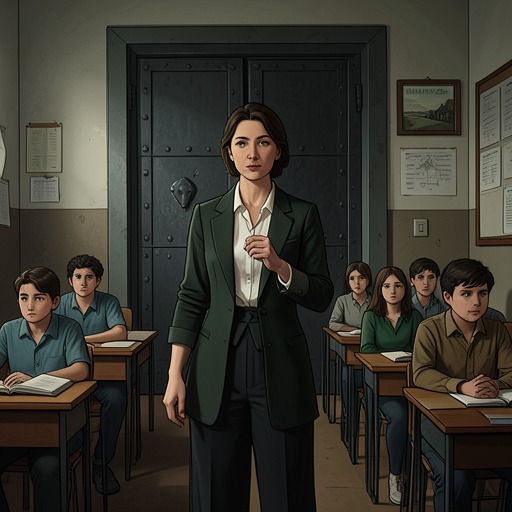
Ingrid worked as a registered nurse for forty years. Her daughter portrays her as aggressively competent, willing to examine an infected toe and exacting about how tasks should be done. Her domestic standards could be almost comically inflexible, but they also convey her conviction that care depends on doing the necessary work. During Lindy’s childhood, Ingrid even brought her to a four-hour mother-daughter puberty class at an elementary-school library. The preparation did not prevent Lindy’s later embarrassment and reluctance to discuss menstruation, but Ingrid’s decision to take her reflects an effort to address growing up directly rather than leave her daughter entirely alone with it.
Her humor was as important as her practical instruction. Lindy distinguishes her mother’s dry, sarcastic comedy from her father’s more expansive performance: Ingrid taught her to divide pain into pieces small enough to laugh at. A neighbor’s temporary-employment agency had a deliberately suggestive vanity plate; Ingrid turned its lettering into a running joke, first recasting the owner’s name and later shortening it. At a block party she accidentally introduced him by the comic name, apparently forgetting that he did not share the joke. The incident shows both the speed of her wit and its occasional social misfire.
Ingrid’s parenting also worked in counterpoint to her husband’s encouragement. He offered unrestrained enthusiasm and told their daughter that she could become anything; Ingrid emphasized limits, practical skills, and the possibility of disappointment. Lindy recalls her mother explaining that she did not want her to expect that anything was possible. Their opposing approaches did not amount to a simple division between love and restraint. Her father supplied affirmation and imaginative possibility; Ingrid supplied structure and a grounding sense of what life might require. Lindy describes the balance as a complement between her father’s words and her mother’s practical support.
Marriage and Contrasting Temperaments
Ingrid was her husband’s fourth wife, and the final marriage lasted. Lindy reads his repeated willingness to begin again not simply as irresponsibility or fear of being alone, but as evidence of his durable optimism and capacity to see possibility in other people. The contrast helps define Ingrid as well: she was the realist paired with a man drawn to enthusiasm and escape. Before their daughter was born, he played piano in bars, lived on credit, and filled his apartment with zebra-themed objects; by the time the couple had become financially stable, most of that collection had given way to an ordinary working life, though a life-sized stuffed zebra remained.
Ingrid’s own way of meeting the world was less fantastical. She preferred accounts of people facing difficult circumstances to stories about dragons, a preference that became a family refrain. Lindy connects this realism to her mother’s competence, but also distinguishes it from her father’s response to loss. He could sink into melancholy when something went wrong; Ingrid’s humor and practical attention offered another means of enduring difficulty. Their contrasting temperaments were not dissolved into sameness. Instead, each gave their daughter a different model: one of exuberant encouragement, the other of preparation and follow-through.
That combination also informs Lindy’s account of her own adult decisions. When she became pregnant, she did not tell her mother and instead approached her longtime doctor. Lindy describes her assumption that abortion would be a routine medical procedure as a product of her own middle-class, white upbringing in Seattle and continuous insurance coverage. She also characterizes Ingrid as supportive, liberal, and well-to-do, and recognizes that she could have turned to her mother for help. Her silence was therefore not evidence that Ingrid would have rejected her; it exposed Lindy’s shame and the loneliness she felt in her romantic relationship. The episode places Ingrid within a family relationship that could offer support, while making clear that her daughter did not always know how to ask for it.
Illness, Loss, and What Remains
When her husband’s prostate cancer worsened, Ingrid took on the knowledge he did not want to hear. She met with his doctors herself and carried the prognosis without him, continuing the familiar division between her realism and his imaginative hope. Their daughter remembers the illness not as a clean sequence of warnings and farewells but as a period in which hospital stays, hope, and despair repeatedly displaced one another. Ingrid’s nursing career had immersed the family in medical settings, yet professional familiarity could not make her husband’s decline easy or turn a hospital into a place where death was comprehensible.
In the final weeks, Ingrid, Lindy, and Lindy’s sister took turns staying beside him in a hospital room too small for all three to sit comfortably at once. They slept in a chair, rested on a bench, or withdrew to the family lounge. When doctors could no longer stop his body from failing, the family agreed to treatment focused on easing his suffering. After he lost consciousness, Ingrid told Lindy to go home and sleep and said she would call if death seemed near. Lindy returned the next morning; the family kept watch through Sunday and into Monday, listening as his breathing slowed.
When he died on Monday afternoon, the hospital’s routines continued almost at once. A nurse brought snacks and juice, a worker began cleaning the room, and someone arrived with a clipboard. Ingrid sharply asked them to give the family a moment: her husband had died only thirty seconds earlier. That response is a concentrated expression of the character Lindy has described throughout the book. Ingrid’s competence does not mean grief can be managed into silence, and her practical steadiness does not require politeness when the people around her fail to recognize what has just happened.
In her acknowledgments, Lindy thanks Ingrid for teaching her that there is a right way and a wrong way, for taking care of her, and for always following through. She credits her father with kindness, ebullience, creativity, and unconditional love, but remembers her mother through the repeated acts that made care dependable. Ingrid’s significance lies in that distinction: she is the family’s realist, yet not a figure untouched by feeling. Her work, humor, and presence give practical form to love, while the hospital vigil shows the cost and force of that care when no action can prevent loss.