Menstrual anxiety and shame
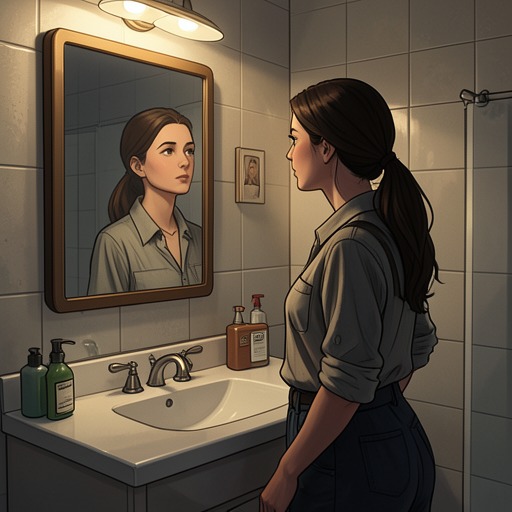
Shrill: Notes from a Loud WomanMenstrual anxiety and shame are part of Lindy West’s account of growing up estranged from her body: menstruation becomes not simply a physical change, but a subject surrounded by contradictory instructions to celebrate it and keep it secret. The account traces how embarrassment made ordinary needs difficult to voice, how the same avoidance returned month after month, and how time brought practical confidence. Its eventual movement toward bodily ownership gives the private discomfort a broader feminist meaning: shame belongs not only to an individual, but to a culture that teaches women to regard their bodies as wrong or not fully their own.
Conflicting Lessons About Menstruation
West recalls menstruation being presented to children in two incompatible ways. One account romanticized it as a joyful transition into womanhood, using euphemistic language; another treated it as a secret suitable only for closed-door conversations among women. Rather than making the subject easier to understand, that combination left her feeling isolated, as though she alone recognized the strain between public celebration and enforced silence. The period was supposed to be welcomed, yet not discussed plainly.
The expected transformation also failed to match the reality she encountered. Puberty did not instantly make a child feel grown or at ease; it brought a recurring bodily experience while she still felt young and unprepared. The contrast between idealized stories and practical discomfort helped make menstruation feel like an unwelcome disruption rather than a reassuring milestone. Her account’s comic register makes the mismatch vivid without treating the anxiety as trivial: humor sits alongside the memory of a child trying to make sense of a change she had been told both to celebrate and conceal.
Avoidance in Everyday Life
Before her first period, West’s mother sensed her anxiety and took her to a mother-daughter puberty class called Growing Up Female. The four-hour Saturday session, held in an elementary-school library, addressed bodies and puberty, but did not prevent the process from feeling awkward when it arrived. West remembers its arrival only uncertainly: she thinks she may have been swimming near her uncle’s house, and recalls flashes of confusion and panic in an unfamiliar bathroom. The uncertainty itself matters to the account: she describes avoidance so strong that the memory did not remain clear.
That avoidance continued in practical ways. For years, she did not tell her mother when menstrual supplies had run out, leaving her mother to make urgent grocery trips while West sat quietly in the car. Once, when there was no time to get supplies before work, West went to school wearing an old-fashioned pad belt that had been kept in the family’s first-aid drawer. The incident shows how silence could turn a manageable need into a source of acute embarrassment: the obstacle was not only menstruation, but being unable to ask for what she needed in time.
A printed slogan on the backing strips of a maxi pad became a small, private point of recognition. During moments when her period seemed to signify the loss of innocence and safety, West stared at the words Kotex Understands and cried. The package could not resolve the shame, but the slogan offered the sense that someone, somewhere, recognized what she was feeling. Its importance lies in the contrast between the secrecy surrounding her and this impersonal message of understanding.
Repetition and Gradual Change
The anxiety did not disappear after one difficult episode. At the end of each period, West returned to denial, behaving as if her body would not produce another one; when it did, the blood surprised her again. This monthly repetition gives the account a pattern of temporary retreat rather than a single turning point. Avoidance offered a short-lived escape from attention to her body, while the recurring cycle repeatedly brought the subject back.
West describes change as gradual and cannot identify a single moment when she got over the shame. Over time, she moved from pads to tampons, and from applicator tampons to ones inserted with a finger. Social ease developed through similarly small tests: asking a female friend for a tampon, then having one fall from her purse on a crowded bus without inventing an elaborate explanation. Eventually, she became comfortable asking her husband to buy a particular kind of tampon. These milestones do not erase the earlier embarrassment; they show how ordinary actions that once seemed impossible became unremarkable through time and experience.
The shift also appears in her ability to speak. West notes that twelve years passed before she finally said the word period aloud in public. That delay places public language alongside the private practical milestones: becoming less ashamed involved not just managing supplies, but making the subject speakable. The account does not credit a dramatic cure. Its sequence instead emphasizes incremental familiarity, from handling products and asking for help to naming menstruation openly.
Bodily Ownership and Wider Significance
West ultimately distinguishes her discomfort with menstruation itself from the more pervasive alienation she experienced in relation to her body. She describes a surrounding set of beliefs that teach women their bodies are enemies, disgusting, defective, measured against male preferences, or less important than a fetus. The period’s shame belongs to this larger pattern: a woman may be encouraged to manage her body while being made to feel that it is not truly hers.
Against that inheritance, West names herself and her body as her own. Her closing return to the Kotex slogan revises its earlier meaning: what once offered a lonely child the sense of being understood now accompanies a statement of bodily ownership. The change is neither a claim that menstruation is pleasant nor a denial that it can hurt or cause practical trouble. Instead, she separates physical discomfort from moral judgment and shame. In that distinction, the account turns an intimate history of silence into a claim about autonomy: bodily experience need not be hidden, and a body need not meet an ideal in order to belong to the person living in it.