Menstrual stigma
Shrill: Notes from a Loud WomanMenstrual stigma is the social shaming of a routine bodily function, maintained by contradictory demands that periods be treated as both a celebrated passage into womanhood and an unspeakable private matter. In Lindy West’s account, that contradiction makes menstruation feel isolating and humiliating; more broadly, she argues that disgust attaches not to blood itself but to women’s bodies and the power women claim over them.
Childhood Scripts and Private Shame
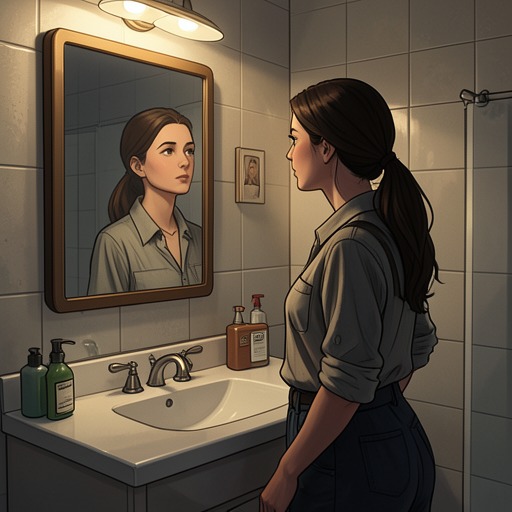
West recalls learning about periods through a confusing mixture of romanticized language and strict secrecy. Adults presented menstruation as a joyful transformation, yet treated it as a subject fit only for closed-door conversations. As a child, she experienced those messages as incompatible: periods were supposedly wonderful, but acknowledging them openly was forbidden. The gap between public celebration and private silence left her feeling alone with an experience she had been taught to anticipate but not discuss plainly.
The practical realities of managing a period made that silence consequential. West avoided telling her mother when menstrual supplies had run out, sometimes leaving her mother to make an urgent trip to the store while West stayed quiet. On one occasion, she went to school wearing an old menstrual belt from the family first-aid drawer because there was no time to get supplies. The episode illustrates how embarrassment could turn an ordinary need into a solitary problem, even within a household where help was available.
A slogan printed on the backing strips of a maxi pad became an unexpected point of recognition: “Kotex Understands.” West remembers staring at those words while distressed by the onset of menstruation and by the changes and embarrassments she associated with growing up. The slogan mattered not because it changed her circumstances, but because it suggested that someone, somewhere, understood. Yet the reassurance was temporary. Each month, once her period ended, she returned to denial and was surprised by its return, as though the body she had tried not to acknowledge belonged to someone else.
Shame as a Gendered Social Rule
West locates her personal discomfort within a broader social taboo. She contrasts the public tolerance for blood in horror and action films with the disgust directed at photographs of a woman whose running clothes showed menstrual blood during the 2015 London Marathon. In her analysis, the material is the same; the difference is that this blood came from a woman’s body. That contrast exposes the stigma as a judgment about women’s natural bodies, rather than a consistent aversion to blood.
The taboo also operates selectively. Periods may be invoked to dismiss women’s concerns or to cast their emotions as irrational, while open acknowledgment of menstruation is treated as indecent. West argues that this double standard helps sustain the idea that people with male bodies and male identities are naturally more rational or competent. Menstrual stigma thus does more than prescribe privacy: it can help make women’s participation in positions of authority seem questionable, even when the bodily function at issue is ordinary.
West does not claim that menstruation itself is pleasant. She describes disliking and finding it inconvenient, while rejecting the idea that this makes it uniquely shameful. Other bodily functions are accepted as ordinary parts of life rather than grounds for stigmatizing the people who experience them. In her account, misogyny is the active ingredient that makes menstruation carry a different moral and social weight.
Reproductive Care, Access, and Privilege
West connects the taboo around reproductive bodies to the way reproductive healthcare is valued and provided. She suggests that treating vaginas as disgusting or their care as unimportant can help make funding for that care seem wasteful. She also links the inability to speak openly about periods to what boys learn about women’s bodies: when menstruation is kept out of ordinary conversation, women’s anatomy can be made to seem mysterious and repellent rather than worthy of care.
Her account of seeking an abortion offers a related, but distinct, example of how reproductive care depends on material access as well as legal availability. West writes that her middle-class upbringing, insurance, and location in Seattle led her to assume that arranging the procedure would be straightforward. After insurance, the clinic quoted a cost of $400; West had about $100 left after paying rent and could not afford the full amount immediately. When the clinic’s director agreed to let her pay after the procedure, West later reflected that this help was easier to obtain for someone with her advantages than for people in greater need. The episode does not make menstruation and abortion the same issue; it underscores her larger argument that reproductive health is shaped by stigma, resources, and whose needs institutions recognize.
From Concealment to Bodily Ownership
West describes a gradual change rather than a single moment of liberation. Over time, she moved from pads to tampons, became able to ask a friend for one, and stopped treating a tampon falling from her purse in public as a crisis requiring an elaborate excuse. Eventually, she could ask her husband to buy tampons. These small changes mark a shift from managing menstruation as a secret to treating it as a mundane need that another person can help meet.
The larger change is in how West understands her body. She connects her earlier discomfort to a pervasive message that a woman’s body is wrong, hostile, or less important than other people’s desires. As a fat child, she was already alert to possible humiliation; menstruation became another occasion to guard her dignity and hide what her body did. Her later assertion that her body belongs to her directly reverses that learned alienation. The pad slogan returns at the end not as a substitute for her own voice, but as a remembered reassurance alongside her claim of bodily ownership.
West’s account therefore moves between a private childhood embarrassment and a public critique of gendered power. Its recurring contrast is between a body treated as a problem to conceal and a body whose ordinary needs deserve attention. Speaking about menstruation does not make every discomfort disappear; it challenges the rule that discomfort must be borne in silence, and insists that women’s bodies are not less human, less credible, or less worthy of care because they bleed.