Menstrual taboo
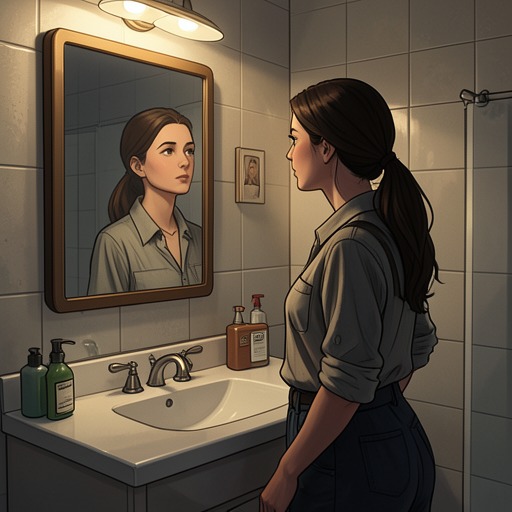
Shrill: Notes from a Loud WomanMenstrual taboo, as Lindy West describes it, is the contradiction between presenting periods as a joyful rite of passage and treating them as an unspeakable secret. That contradiction makes an ordinary bodily function seem shameful and helps police women’s bodies: West traces its effects from her adolescent anxiety to broader assumptions about women’s credibility, health, and autonomy. Her account also follows a gradual change in her own relationship to menstruation, from careful concealment toward practical acceptance.
A Contradiction Learned Early
West recalls growing up with two messages at once. Periods were framed in romantic, celebratory terms, as though they marked a girl’s transformation into womanhood; at the same time, menstruation was kept behind closed doors and discussed only in private. The praise did not make the subject easier to approach. Instead, the mismatch made the celebration feel false and the secrecy feel like evidence that something was wrong. As a child, she experienced the culture around menstruation as a system whose public language and private rules could not be reconciled.
The physical realities of puberty further unsettled the promise that menstruation would be a happy transition. A period did not instantly make a girl mature; it arrived alongside the ordinary difficulties of adolescence. West’s account presents the gap between the polished story and the lived experience as one source of anxiety. The taboo taught girls to manage not only a recurring bodily function, but also the risk of embarrassment if it became visible or needed to be discussed.
Shame and the Public Meaning of Blood
West argues that menstrual stigma is not simply a response to blood. She contrasts the disgust provoked by photographs of a runner whose clothing showed period blood during the 2015 London Marathon with the much broader visibility of blood in horror films, action films, and news coverage. In her analysis, the substance itself is not the decisive difference. Disgust attaches to its association with women’s bodies and their ordinary reproductive functions.
The taboo also permits selective discussion. Menstruation can be invoked to discredit women’s concerns or portray their emotions as irrational, while frank acknowledgment that periods are natural is treated as unacceptable. West connects this double standard to the assumption that male bodies and male gender identity represent rational competence, while women’s reproductive bodies supposedly compromise it. Menstrual silence therefore does more than preserve privacy: it helps sustain a hierarchy in which women’s bodies are used to question women’s authority.
From Bodily Stigma to Material Consequences
West links menstrual shame to the wider treatment of reproductive health. She raises the possibility that stigmatizing ordinary reproductive functions helps make it harder for people with uteruses and vaginas to secure health-insurance coverage for care involving those systems. Euphemisms that cast menstruation as dangerous or grotesque, she suggests, reinforce the idea that vaginal care is unworthy of public concern or expenditure.
Her argument follows that logic beyond insurance. When girls are discouraged from speaking openly about periods, boys may grow up encountering vaginas as mysterious or disgusting rather than as parts of ordinary human bodies. That distance can affect whether women seek medical care and whether reproductive health is treated as worth protecting. West presents better sexual understanding and fewer deaths from cervical and uterine cancer as possible consequences of a culture that takes women’s bodies seriously. These are linked concerns in her argument, not claims that changing language alone would resolve every barrier to care.
The taboo belongs, for West, to a larger pattern of bodily alienation. Women absorb messages that their bodies are wrong, disgusting, subordinate to men’s preferences, or less important than a fetus. Menstrual shame is one expression of that pervasive judgment: it encourages a woman to experience her own body as an adversary and to hide what it does. West’s earlier experience of shame about being fat offers a related, though distinct, example of how public contempt can make a body feel exposed and unsafe. In both cases, the harm lies not simply in a physical condition but in a culture that attaches diminished worth to it.
Gradual Change and Reclamation
West does not describe overcoming her discomfort through a single revelation. She recalls a gradual progression: moving from pads to tampons, then to tampons without applicators; becoming able to ask a female friend for one; and eventually letting a tampon fall from her purse on a crowded bus without inventing a cover story. As an adult, she could ask her husband to buy o.b. super-plus tampons. These small, practical changes mark a substantial shift: an ordinary need no longer required elaborate concealment or a private test of courage.
She distinguishes dislike of menstruation from shame about it. Periods could still be inconvenient and unpleasant without being evidence that her body was defective or morally suspect. West’s concluding insistence that her body belongs to her turns that distinction into a claim of autonomy. The ending does not suggest that the discomfort of menstruation disappears; instead, it refuses the demand that discomfort become self-disgust.
Narrative Significance
The essay moves from the intimate scale of a girl trying to manage embarrassment to the public scale of gendered power, health coverage, medical care, and cultural representation. Its humor exposes the absurdity of the messages surrounding periods, while its progression through ordinary episodes makes clear how those messages settle into habits of secrecy. The contrast between concealment and visibility is central: menstruation is treated as something that must not be named, while women’s bodies are simultaneously judged and regulated.
West’s account ultimately treats speaking plainly as a form of bodily reclamation. The change is neither instantaneous nor complete, and personal acceptance does not by itself remove institutional barriers or cultural stigma. But the movement from isolation toward everyday candor demonstrates what becomes possible when menstruation is no longer treated as an unspeakable exception. The taboo’s power depends on making a normal bodily function seem uniquely shameful; West challenges that power by separating physical inconvenience from the social verdict imposed on the body.