Mike
Shrill: Notes from a Loud WomanMike is Lindy West’s boyfriend during a relationship built more on habit and loneliness than on mutual understanding. When West becomes pregnant, their difficulty speaking honestly about intimacy and commitment shapes how she handles the news; after she tells him about the abortion, their brief renewed closeness gives way to a final breakup. Her account remembers him as a good person, while insisting that goodness alone could not make their relationship work.
Identity and Background
Mike is a conventionally attractive jock whose interests center on cross-country running and New England. West’s interests are markedly different: candy, naps, hugging, and wizards. They are both lonely and intelligent, she recalls, and they spend a great deal of time together in coffee shops and bars despite having little in common. Their companionship is sustained less by shared enthusiasms than by repetition and the comfort of having someone nearby.
At twenty-seven, West regards the relationship as the best she has experienced, even while recognizing how little it offers. Mike has had official relationships with thin women, while his friends tease him for often hooking up with fat women. He sometimes expresses affection after drinking, and once follows West home when she tries to leave, weeping as he tells her he loves her. The next day she tells him she loves him too. In retrospect, she believes the feeling was probably mutual, but describes it as shallow and watered down, accumulated through familiarity rather than a deep interest in each other’s lives.
Unequal Expectations
Mike is clear about the limited emotional commitment he can offer, but West keeps trying to fit herself to those limits. She works at becoming interested in the details of his running, while he continues to call her his friend when speaking to his mother. Her retrospective account does not present this mismatch as his deception: he had communicated his terms. Instead, the strain comes from her attempt to turn those terms into a more intimate relationship, exhausting both of them in the process.
West understands her own persistence as a mistaken idea of love. At the time, she believes that love means continuing to try, even when the relationship leaves her lonely. Her admission that being alone with another person can feel worse than being alone by herself gives the relationship its central contradiction: Mike is present, and at times affectionate, but his presence does not relieve her isolation. Their closeness is real enough to make separation difficult, yet insufficient to provide the partnership she wants.
Pregnancy and Disclosure
West discovers she is pregnant while the relationship is still ongoing. The pregnancy makes their existing uncertainty feel consequential: she believes that carrying it to term would bind them together, but expects they would separate before the birth. She cannot remember exactly how the pregnancy happened; she says they were mostly careful. Her account does not assign Mike blame for it. Rather, she describes two people whose relationship was already strained by unmet needs and whose circumstances now demanded a decision about the future.
She imagines several possible lives that might have followed a birth. Mike might have softened toward the baby, and they might have shared custody amicably; she might have moved into her parents’ basement and continued technical case-study writing, while Mike either helped financially or eventually moved away. She doubts the last possibility because she considers him a good person. Even in this counterfactual, she can picture a life that might have been good. But she also believes they would have broken up before the baby arrived. The possibility of a workable future does not change her sense that this was not the life she wanted.
West does not tell Mike about the pregnancy before having the abortion. She later explains that she may have feared he would be angry, and that her shame was entangled with her belief that her need to be loved had made her cling to a relationship that was not truly secure. She feels alone within the relationship and handles the decision alone as well. Her account places that silence in the context of her own embarrassment and insecurity, rather than claiming to know what Mike would actually have done.
The Conversation and Separation
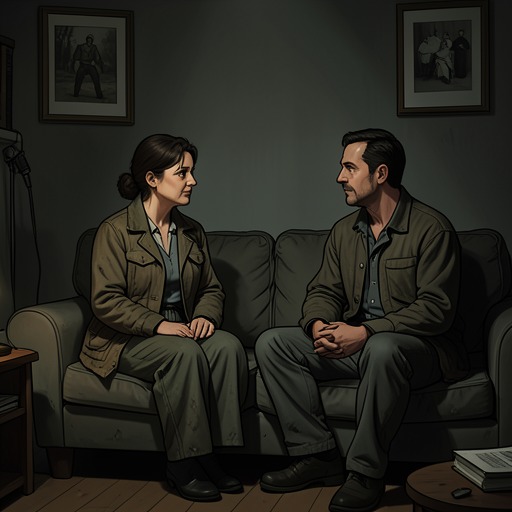
After the abortion, Mike does not stay at West’s home because he has to get up early for his high-school reunion. When she drives him to his house, he senses that something is wrong. West begins to cry and says she cannot tell him. After a silence, Mike asks whether she had an abortion; she tells him that it happened that day. The exchange turns the relationship’s central failure into a concrete moment: she has made a major decision without feeling able to confide in him, and he has to infer what she has kept hidden.
Mike cries, not from regret about the abortion or a moral crisis, but because West felt she had to conceal it from him. He feels guilty, while she feels pathetic, and for a while their mutual distress brings them closer. That closeness is temporary. He still goes to the reunion the next day and does not text as much as she hopes; West spends the day in bed, aching and crying a little. She soon feels almost normal again, but the relationship does not return to its old pattern of Mike running and West pursuing him.
Within six months, they have broken up for good. Within seven months, West is no longer angry with him; within a year, Mike has moved back east, toward the New England life he had long wanted. West remembers that his desire to leave hurt her, because she wondered why she mattered less to him than running trails and the prospect of returning to his former life. Yet she also wanted him to have the future he sought. Her account preserves both the hurt and her goodwill rather than reducing their separation to a contest of blame.
Narrative Role and Significance
Mike matters to West’s story as the partner through whom she encounters an early, consequential assertion of what she wants. She later describes the abortion as her first major adult decision: a moment of taking responsibility for the direction of her life rather than continuing as a passenger in her own body. That significance belongs to her decision, not to a claim that Mike caused her later transformation or that the abortion mechanically produced it. She places the episode just before a period of change in her body image, work, voice, and confidence, while describing those developments as changes whose beginnings reached back years.
The portrait of Mike holds affection and insufficiency together. West does not deny that he loved her, that he was affected by the secret, or that another version of their future might have been good. She also does not mistake those possibilities for evidence that they should have stayed together. His eventual return east marks the close of a relationship whose temporary moments of tenderness could not overcome its uneven terms or their different desires for the future.