Moving to Los Angeles with Aham and starting to live together
Shrill: Notes from a Loud WomanMoving to Los Angeles with Ahamefule J. Oluo and starting to live together was the leap that made an early, carefully qualified romance into a shared life. For Lindy West, the move carried both the exhilaration of deciding that they were best friends and in love and the risk of building a future on a commitment whose practical terms were unequal: she signed a year-long lease, while he expected to stay in Los Angeles for no more than six months. In retrospect, the move became inseparable from the breakup and her father’s approaching death that followed.
Background and the decision
West and Ahamefule J. Oluo had been friends for eight years before they kissed. By the time they contemplated moving, they had been dating for four months. Their affection had already crossed into the rhythms of family life: on a day spent with his daughters, they swam in Lake Washington, played his favorite roughhousing game, picked blackberries, and made a pie. At a garage sale, a woman mistook West for the girls’ mother and complimented their children. West panicked and loudly corrected her, insisting she was only “SOME LADY.” In her later account, that reflex reveals how hard she was trying not to seem as if she expected a family, even as their day together had begun to resemble one.
After the children went inside with the pie, Ahamefule J. Oluo held West back and told her he had loved spending the day with her and the girls. The exchange gave voice to a closeness that West had tried to keep unnamed. They had both planned to move to Los Angeles, but insisted they were not moving there together: he would live with a female friend she did not know, while West would live with their mutual friend Solomon Georgio. The arrangement was meant to preserve the appearance of two independent moves. On that hot, berry-stained day, playing family made the distinction difficult to sustain. They decided they should live together because they were best friends and in love, even though neither had said so plainly before.
A shared plan with unequal horizons
The decision joined two very different circumstances. Ahamefule J. Oluo was a single father of two, with a history that included abandonment, poverty, becoming a parent at nineteen, two divorces by twenty-seven, and depression. He had repeatedly said he was broken and not ready for a relationship: his divorce was recent, his conflicts could be loud and mean, and his life had too many moving parts. West describes herself as approaching thirty while still on her parents’ phone plan, an imbalance that helps explain why the future he was weighing carried responsibilities she had not yet experienced.
In summer 2011, Ahamefule J. Oluo and Solomon Georgio reached the semifinals of NBC’s Stand Up for Diversity contest, a competition that offered development deals and a chance to be seen by Los Angeles entertainment-industry figures. Ahamefule J. Oluo’s move was therefore provisional: he expected to stay only a few months, six at most, to see whether the opportunity led anywhere. He imagined that success might eventually let him leave his three-hundred-square-foot home and give his daughters a larger life in which nobody had to sleep in the laundry room. If the contest did not lead to work, he could return without having lost much. West, by contrast, signed a one-year lease. As she later put it, her love story appeared to have a six-month shelf life, barring unlikely circumstances, but she went ahead believing he was her person.
The distinction between a shared decision and a shared commitment came to a head in the driveway. Ahamefule J. Oluo said aloud that they would live together and be a real couple. West took his declaration as the resolution of his earlier warnings, and later recalled thinking that she could make him all right through sheer force of will. She treated his words as a binding promise; her hindsight identifies that confidence as the thinking of a “little girl,” for whom love meant perseverance. His later explanation was that he loved her and wanted to be near her, but had also told her he could not do it. The distance between wanting closeness and being ready for a lasting shared life was already present in the decision to move.
The house in Eagle Rock
West rented a little yellow house in Eagle Rock, with a large eucalyptus tree in the backyard, for the new household. It was owned by a church two doors away. Church members sometimes came by to urge the residents to attend activities, an everyday reminder that the home belonged to an institution beyond the couple. The move was not simply a romantic gesture: it meant creating a home around Ahamefule J. Oluo’s daughters and the practical pressures of his family life.
The neighboring house, an identical property owned by the same church, brought another form of care and vulnerability into their days. Its resident, Kathy, had severe early-onset Alzheimer’s and would sometimes wander into West and Ahamefule J. Oluo’s home, lost and crying for her husband, Jeff. They tried to calm her and guide her back through the dim, crowded rooms of her own house. One sweltering afternoon, while West was settling Kathy in a bedroom to wait for Jeff, she discovered that he was already there, asleep beneath blankets and apparently drunk. She shook him and called his name, but he did not wake. When Jeff later came to collect Kathy, his usual cheer briefly fell away as he said she used to take care of everything. This neighboring household was not the couple’s story, but its appearance in the account places their new home among the ordinary demands of care, dependence, and lives that could not be made secure simply by moving.
Retrospect and consequence
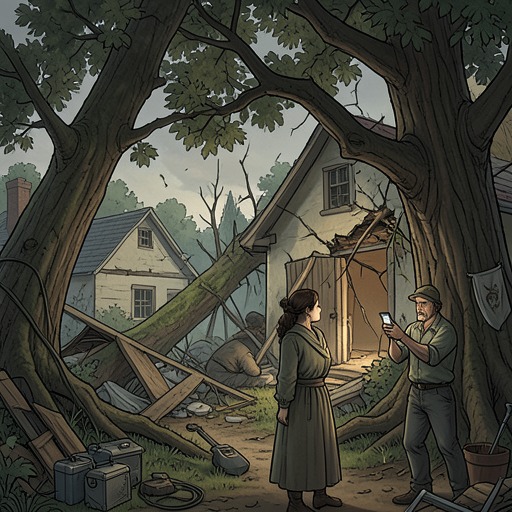
The move’s meaning changes when West recounts it from the far side of the relationship. In the later chronology, the tree fell on the house while she was sleeping alone in the bed that had belonged to them, two weeks before her father died and four weeks after Ahamefule J. Oluo told her he was leaving. She remembers that they had moved into a new state only eight weeks earlier, with what she calls grand plans. Her recollection then runs backward through the road trip and the last time she saw her father out of bed, wrapped in a plaid blanket and leaning on her mother. The joyful beginning and the losses that followed are held together by those compressed intervals.
West does not present the move as a simple mistake or as proof that the early affection was false. The day at the lake, the pie, and the decision in the driveway remain evidence of genuine intimacy; so do the warnings and the mismatch between his temporary opportunity and her year-long lease. Her later questioning of why he made the commitment sits beside his explanation that he loved her and wanted to be around her. The event’s significance lies in that unresolved contrast: a declaration could make them a couple and a household, but it could not by itself make their circumstances equally stable or guarantee that the future West imagined would last.