Paul West’s Prostate Cancer
Shrill: Notes from a Loud WomanPaul West’s Prostate Cancer is the illness through which Lindy West’s family confronts the limits of prediction, treatment, and preparation for death. Rather than unfolding toward a single, orderly moment of farewell, it brings gradual decline and sudden crises into the same stretch of time. The account also traces how the disease reshapes family roles and becomes part of Lindy West’s later grief—and of an online harasser’s deliberate violation of her family’s private loss.
An Unpredictable Illness
Lindy West describes cancer as offering no dependable itinerary. Her father’s illness did not follow a neat progression from manageable disease to a clearly recognizable final stage. In his case, multiple systems broke down in a course that could be slow and then suddenly acute: the family might have months, then only hours. This unevenness makes it difficult to know when a crisis has become final or when loved ones should gather for a last goodbye.
Treatment, too, resists a simple story of rescue. It could be painful, messy, and humiliating, while its possible benefit was hard to assess. The account does not present medical care as a guaranteed path back to health; it shows a family having to live with uncertainty about what treatment can accomplish and what it costs. That uncertainty persists even in a hospital surrounded by clinicians, medicines, and machines.
A Family Facing the Prognosis
Paul West was seventy-six that year, but Lindy recalls him as retaining the exuberance that had marked him before the disease disrupted his life. He did not want to die. The cancer made that desire increasingly difficult to reconcile with his failing health, but it did not erase the energetic character his daughter remembered.
His response and his wife Ingrid’s response differed. Paul did not like hearing his own prognoses, so Ingrid met with the doctors herself and carried the information about the future without sharing its full burden with him. Lindy presents her mother as the realist and her father as the fantasist, a familiar division between them made especially consequential by the illness. The arrangement did not make the prognosis less real; it shaped who had to absorb it and how directly Paul encountered it.
The change became unmistakable to Lindy at Thanksgiving, when Paul became ill at the dinner table. She understood that he had begun grieving for himself and for a life he was not ready to leave. Her own response was fear of his grief. In retrospect, she connects that fear to missed chances for closeness: she wonders why she did not sit with him more, read aloud to him, or allow herself to be vulnerable instead of keeping their interactions cheerful. She also questions her move to Los Angeles three months before his death. Paul had encouraged her to go, wanting to see his children flourish, but his support could not spare either of them the pain of the time they lost.
The Final Hospitalization
Eventually, the family ran out of opportunities to postpone the reality of his decline, and Paul was taken to the hospital for the last time. Lindy’s account makes clear how different this experience was from her childhood understanding of hospitals as places people went to get better. During the final hospitalization, the family had to accept that the doctors could no longer save him. Their decision shifted the aim of care toward easing his suffering; after that, his loved ones could agree to the plan and wait.
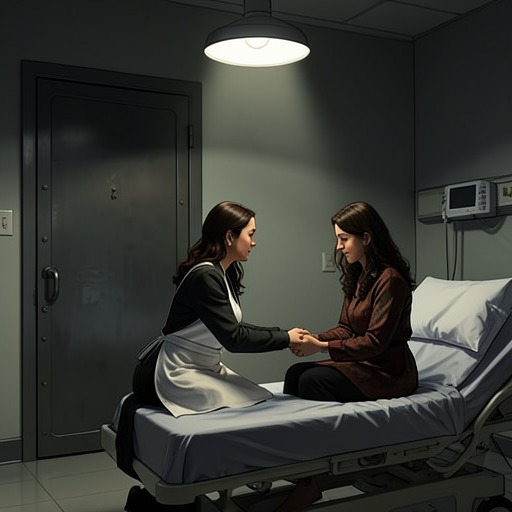
Lindy, her mother, and her sister shared the confined routines of the hospital room, taking turns beside Paul’s bed and resting elsewhere when space required it. As he drifted in and out of consciousness, Lindy and her sister read from the book he had been reading, A Jazz Odyssey: The Life of Oscar Peterson. Paul sometimes roused and chuckled. The reading gave the family a way to be with him that belonged to their shared life, even as his awareness faded.
After Paul lost consciousness on a Saturday night, Ingrid told Lindy to go home and sleep, promising to call if his condition suggested he was near death. Lindy returned the next morning, and the family resumed its shifts beside him. They stayed through Sunday and into Monday as his breathing slowed and grew more difficult. The account does not turn his death into a single, cleanly timed scene: the family waited through a prolonged final period, with no certainty about when it would end.
Death, Memory, and Exposure
Paul’s death continued to shape Lindy’s understanding of what she had and had not said to him. In the last period when he was lucid, the family called her brother in Boston. Paul told his firstborn that he had been a special little boy and that he loved him; he said little after that. Lindy’s wish for one more sentence, even one more brief message, gives the illness an afterlife in memory: the finality of his lost voice becomes inseparable from her grief.
The disease also became a means of targeted online harassment. The person behind the account called Paw West Donezo researched Paul and the family, identified which Paul West he was, and drew on information from the obituary Lindy wrote two days after her father’s lungs finally gave out. The impersonator knew that Paul had died of prostate cancer, that he had been treated at Seattle Cancer Care Alliance, and that Lindy had a brother and a sister. Lindy concludes that the harasser must also have understood how recent the loss was. The account’s use of those details shows how a medical history that had belonged to a family’s experience of illness and bereavement could be repurposed to wound the bereaved.
As a result, Paul West’s prostate cancer occupies two linked but distinct parts of Lindy’s narrative. It is first the uncertain, devastating illness that altered her father’s final months and left her with enduring regret and grief. Later, knowledge of the diagnosis becomes evidence of how deliberately an online troll invaded those memories. The connection does not reduce Paul’s illness to a symbol: the account remains grounded in its particular course, its family caregiving, and the death that followed.