Seattle comedy boom
Shrill: Notes from a Loud WomanSeattle comedy boom was a locally concentrated comedy scene that emerged in 2005, bringing experimental shows, mutual support, and new creative connections into Lindy West’s life after she returned from Los Angeles. In her account, its significance lies not only in the comics who performed there, but in the unusual convergence of people, rooms, mentorship, audiences, and a sense that something was beginning.
Return to Seattle and First Connections
After giving up on Los Angeles, West moved back home. Seattle’s comedy scene offered a new point of entry: Hari Kondabolu, a college roommate of one of her friends, had moved to town and joined her social circle. Before they had even met, West found his Friendster profile and learned that he was a comic. The discovery made the prospect of having a comedy friend feel suddenly real, linking an online introduction to an emerging local community.
Kondabolu also connected West to the city’s open-mic circuit. Through him, she began spending time around the scene, where comedy was not yet a distant profession but part of a social world taking shape around familiar faces. The memoir situates this welcome against West’s recent departure from Los Angeles: the move home did not end her involvement with performance, but brought her into a scene where she could find both companionship and a place to participate.
A Scene Built by Its Participants
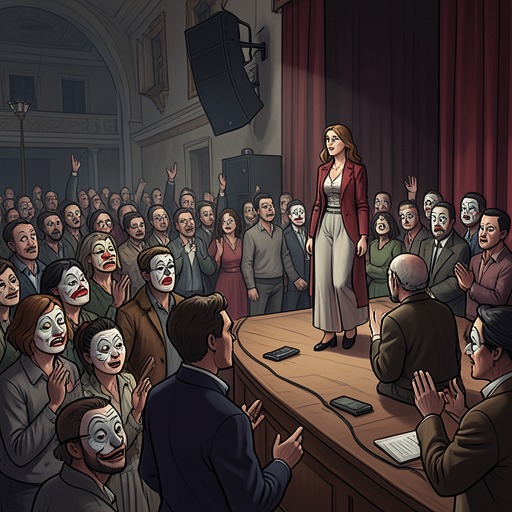
West recalls Seattle’s 2005 comedy boom as a moment people who experienced it continued to remember with reverence. Its special character came from a fortunate convergence: the right people, rooms, mentorship, crowds, and branding. Comics performed unusual and experimental material, and they filled seats at one another’s shows. The scene’s energy was reciprocal: performers helped make one another’s events draw audiences, so the sense of momentum arose from a network rather than from a single star or venue.
Several comics appeared repeatedly at those early shows: Kondabolu, Emmett Montgomery, Dan Carroll, Derek Sheen, Andy Peters, Scott Moran, Andy Haynes, and Ahamefule J. Oluo. Oluo was a tall, gloomy single father who quickly formed a writing partnership with Kondabolu and was drawn into West’s social circle. His collaboration with Kondabolu shows how the scene’s communal life also generated working relationships; the performers were connected through friendship and shared activity as well as through the stage.
Local Momentum and a Wider Boom
Seattle’s scene developed while a national comedy boom was gathering force. West places the local excitement alongside Louis CK’s rise toward household-name recognition and the growing realization that podcasting had significant potential. The account does not present Seattle as isolated from broader changes: local experiments and national shifts were happening at the same time, lending the city’s small-scale scene a sense of participation in a larger transformation.
The memoir’s description emphasizes the scene’s contingent nature. Its success depended on a particular mix of participants, spaces, guidance, audiences, and identity, rather than on an inevitable progression. Recalling that the city felt as though something was happening captures both the excitement of the moment and the retrospective understanding that its ingredients had briefly aligned.
West’s Place in the Scene
West occasionally tried stand-up, usually at Kondabolu’s urging, but quickly recognized that the form did not suit her. She disliked repeating the same jokes and the grind of the circuit, and acknowledged that she had not worked hard enough at stand-up to become good at it. A poorly attended early performance in a brightly lit pizzeria at six in the evening, before four people who had not been told comedy would take place, crystallizes the mismatch between the effort of stand-up and her own tastes.
That rejection of stand-up did not amount to a rejection of performing. West enjoyed being onstage and later hosted the Seattle outpost of The Moth, a live storytelling show, twice a month. Each event involved three hours of crowd work, a format at which she says she was good. The distinction clarifies her relationship to the boom: the scene introduced her to comedy, but her strongest role emerged through live storytelling and hosting rather than through the repeated delivery of stand-up jokes.