Unplanned pregnancy
Shrill: Notes from a Loud WomanLindy West’s unplanned pregnancy with Mike brought an already strained relationship into sharper focus and made a private decision about her future unavoidable. Her account traces not only how she obtained an abortion, but how money, timing, privacy, and social privilege shaped that access. In retrospect, she describes the decision as her first major act of adult self-determination—not as a magical transformation, but as a moment when she took charge of the life she wanted.
Circumstances and the relationship
West was twenty-seven when a home pregnancy test showed that she was pregnant. She and Mike had been careful, but she could not recall how the pregnancy occurred. Their relationship was close in duration and company, yet emotionally limited: they spent substantial time together, while Mike’s displays of affection were infrequent, and he still described West as a friend when speaking to his mother. West felt lonely within the relationship and had tried to make herself fit the terms it offered, believing at the time that love meant continuing to press against those limits.
Mike had spoken about wanting to return to New England, where he had spent his happier earlier years. West wanted that future for him too, even as his longing hurt her. She could imagine possible lives in which they raised a child together, separated amicably, or continued to share responsibility; she thought Mike was a good person and could picture a good life with him. But she also believed they would have separated before a child was born. The pregnancy did not create the relationship’s problems so much as make their consequences harder to set aside: she did not want to bind them together permanently when she already felt alone beside him.
Finding out and seeking care
West initially kept the pregnancy from Mike. She remembered only faintly thinking that he might be angry, and she associated the pregnancy with shame about her own need for affection and her wish to believe that they were a real couple. Because the relationship had already left her feeling isolated, handling the discovery by herself seemed consistent with their existing pattern. Her silence was not presented as a considered judgment about Mike’s character; later, he was hurt that she had felt unable to tell him.
At first, West did not expect obtaining an abortion to be complicated. She had grown up middle-class and white in Seattle, had always had health insurance, and understood abortion to be legal. She therefore approached it as she would an ordinary medical procedure, arranging an appointment with the doctor who had cared for her since she was twelve. The doctor confirmed the pregnancy and asked whether West wanted to continue it. West said that she did not.
The practical obstacle emerged when West contacted a clinic. It could see her the following week, but the cost after insurance would be $400, and the clinic required payment on the day of the procedure. Having just paid rent, West had about $100 in her bank account and would not be paid for another two weeks. She did not want to wait, spend more days thinking about the pregnancy, or feel her body changing while she remained uncertain about what would happen next. When she explained how urgently she needed the appointment, the clinic’s director spoke with her until she could calm down, then agreed to let her be treated and billed afterward if she promised to pay. West paid when her next paycheck arrived; the clinic, surprised by her prompt payment, sent her a thank-you card.
The appointment and its immediate aftermath
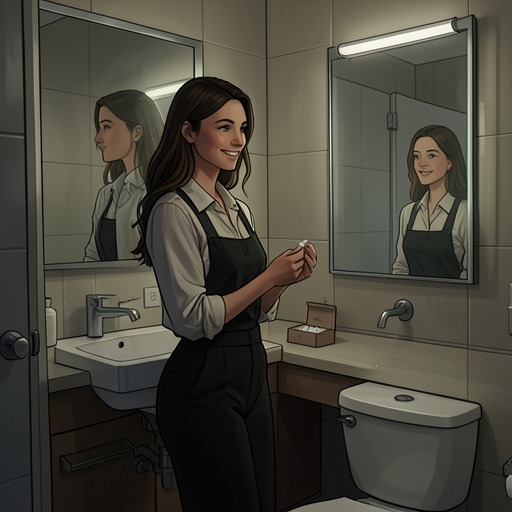
West later recalled that the clinic was crowded and that the people waiting had come with others, though they did not make eye contact. Before the procedure, a counselor asked why West had not told her partner. The question brought her to tears: she could not explain her silence, and the word partner did not fit the relationship as she experienced it. The medical staff told her that the embryo was about three weeks old and gave her two pills in a cardboard packet, with instructions to return in two weeks. The written information also described possible effects of the medication, details West had not expected to learn in that form.
The first pill coincided with a public evening at which West and Mike appeared together. They had one of their best nights as a couple, even though West was privately coping with the abortion; she later described photographs from the event as showing her smiling while exhausted. She confided in a friend, who reassured her about the frightening side effect mentioned in the clinic’s pamphlet. The contrast between a shared evening and a decision West had not disclosed to Mike sharpened the account’s portrait of their closeness and distance existing at once.
After Mike learned that West had kept the experience from him, he cried—not because he regretted the abortion, but because she had felt she had to keep it secret. The disclosure brought them closer for a while, but it did not repair the underlying mismatch. West was no longer pregnant after the medication; within six months, she and Mike had broken up for good. She was no longer angry with him within seven months, and within a year he had returned east. The account remembers him as a good person while remaining clear that goodness alone did not make them right for each other.
Access, privilege, and the meaning of the decision
West stresses that she could have obtained the abortion even without the clinic director’s accommodation: she could have waited two weeks or had an uncomfortable conversation with her supportive, well-off mother. That recognition complicates the story of individual kindness. The director helped West without being required to, and West remains grateful, but she also asks why she seemed trustworthy enough to receive that help. Her conclusion is that people with the least need can be especially well positioned to receive assistance. Her insurance, available family support, and ability to pay after her next paycheck meant that the clinic’s flexibility could solve a temporary problem for her in a way it might not for someone with fewer resources.
In reflecting on abortion access more broadly, West rejects the idea that a person must provide a morally approved explanation for wanting an abortion. She distinguishes between people who want to end a pregnancy and those who do not, and between those who have access and support and those who encounter institutional obstacles and misinformation. The account’s specific financial delay gives that distinction practical weight: legal access did not remove the immediate problem of having to produce $400 on a fixed date. A staff member’s willingness to change the payment arrangement mattered because West could promise to pay soon afterward.
West later placed the pregnancy among the changes that gathered momentum in the five years after the abortion. Three months after it, she began to stop hating her body; other changes in work, relationships, confidence, and public voice followed over the years. She explicitly resists treating the abortion as the cause of all that followed or as an inherently empowering rite of passage. Instead, she identifies it as her first major grown-up decision: the moment she asserted that the life before her was not the one she wanted. Its significance lies in that act of choice, and in her insistence that a commonplace medical procedure can matter deeply without needing to be either miraculous or traumatic.