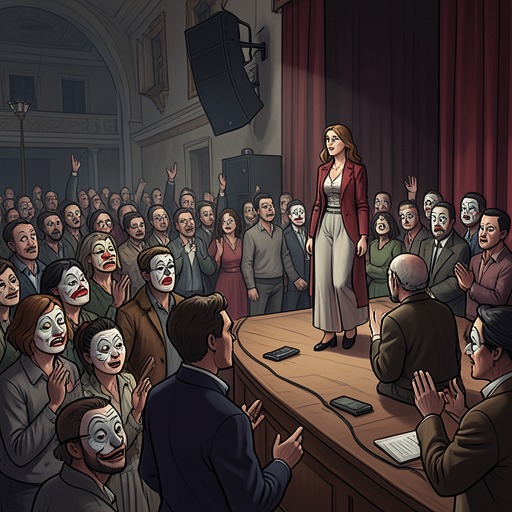
Comedy’s social responsibility principle
Shrill: Notes from a Loud WomanComedy’s social responsibility principle, as Lindy West develops it, rejects the idea that stand-up exists apart from the world it helps shape. Its central claim is that comedians choose what to say and where to aim a joke; those choices can reinforce or challenge existing power, so comedy’s cultural effects are open to scrutiny without making scrutiny equivalent to censorship.
Comedy as an Active Force
West begins from a contrast: people readily accept that entertainment and satire can influence public understanding, yet often treat stand-up as though it were exempt from the same influence. She invokes the accepted cultural impact of The Cosby Show, The Daily Show, and Ellen, alongside the recognized force of propaganda, satire, and Shakespeare’s fools. These examples establish her premise that popular forms do not merely mirror social attitudes; they can help shape them.
That premise turns artistic influence into a question of responsibility. If comedy contributes ideas to public life, artists can attend to which ideas they introduce and consider the purpose those ideas serve. West describes art as communication made with intention and care, rather than indiscriminate provocation. The principle therefore does not require comedians to avoid difficult subjects. It asks that their choices be treated as choices, with consequences that can be discussed.
Craft, Choice, and the Limits of Offense
West challenges the claim that a comic’s refusal to censor themself, or their willingness to offend everyone equally, is automatically a virtue. Comedy itself involves selection: a comic chooses words and shapes them to produce an effect. In her account, self-restraint is part of that craft, not proof that a comic has abandoned artistic freedom. Without such choices, provocation alone is not a substitute for comic construction.
The idea of equal-opportunity offense also fails, West argues, when it treats people as though they occupy equal positions of power. Her deliberately disproportionate image of a comic punching everyone—from people to a baby duck, a lion, and even the ocean—makes the consequence of that false equivalence plain: the duck does not emerge unharmed. The analogy turns an abstract defense of indiscriminate offense into a question about who bears the cost of a joke.
Target, Context, and Consequence
In discussing rape jokes, West distinguishes between jokes aimed at rape culture and jokes aimed at people who have been victimized. She analyzes four jokes that she considers successful because they target the culture rather than its victims, while acknowledging that her earlier assessment of Louis CK had been too forgiving. The distinction is not simply between acceptable and forbidden subject matter; it concerns the joke’s target and the social meaning it carries.
West places that choice against a broader context in which sexual assault is often not reported or taken seriously. For people engaged in anti-rape activism, people moving through the world in vulnerable bodies, or women represented online by female avatars, the assumption that everyone already rejects rape cannot be taken for granted. In that context, a joke that defenders describe as ironic may still contribute to trivializing assault if it makes victims, rather than perpetrators or the surrounding culture, its object.
Criticism Without Censorship
West frames criticism as a way of asking what a joke does, not as a demand to prohibit speech. In her account, comedy can be a powerful lever of social change: Tina Fey’s Sarah Palin impression may have affected the 2008 election, and some of West’s peers identify The Daily Show as their primary news source. These examples support her argument that speech can both reflect and catalyze the conditions in which people live.
During her debate with Jim Norton, West argues that it is inconsistent to praise comedy as powerful when it speaks truth to power and then dismiss language as socially inconsequential when its effects are challenged. She invokes the history of racist comedy to contest the notion that hostile jokes and hostile social conditions are unrelated. The principle’s final demand is one of accountability rather than compulsion: identify whether a joke targets perpetrators or victims, consider whether it makes the world better or worse, and recognize that choosing an aim is part of making comedy.