Lindy West’s airplane-seat conflict and online pile-on
Shrill: Notes from a Loud WomanLindy West’s airplane-seat conflict and online pile-on turns an ordinary flight into a public test of whose account of a shared space will be believed. After discovering that she no longer fit comfortably in an airplane seat, West began planning each trip around the risk of embarrassment and discomfort. A brief confrontation with a seatmate became an essay for Jezebel, then a target for online distortion and abuse. The sequence shows how an access problem can be recast as an individual passenger’s misconduct, while the person describing the problem is required to defend both her body and her credibility.
The discovery and the work of flying
In the fall of 2013, after years of being fat while still mostly able to fit into ordinary airplane seats, West found that she could not sit comfortably in one. She had flown about twenty times in the previous eight months during a professionally busy year. On the return leg of a two-day work trip to Texas, the seat that had been manageable on the outbound flight suddenly required her to cram herself into it. The change made an inconvenience she had not previously understood into an immediate, physical constraint.
West describes the seat as an angular enclosure narrower than her hips, where remaining still for hours meant folding her arms and shoulders inward. On an eight-hour flight from Oslo to Seattle, she cried, fearing that the pressure on her legs meant her femurs were splintering. The account distinguishes this pain from the anxiety that became part of flying: seat widths and belt lengths varied by aircraft and airline, so she could not know in advance whether she would fit or need to ask for an extender. Nor could she know how a seatmate would respond.
She developed a careful routine to reduce both discomfort and the attention directed at her body. She booked a window seat, even if that meant sitting at the back or changing to a very early flight, because the space by the window gave her a little more room and meant she would not block other passengers when getting in or out. She avoided emergency-exit and bulkhead rows, which she had found could be narrower, arrived at least two hours early, and boarded as soon as possible so nobody would have to wait in the aisle. She requested a seat-belt extender discreetly from a flight attendant, used the bathroom before boarding to avoid leaving her seat, and tried to sleep without drawing attention to herself. For West, these precautions made plain that passengers could pay for air travel while still spending substantial effort trying to make their presence unobtrusive.
The seatmate confrontation
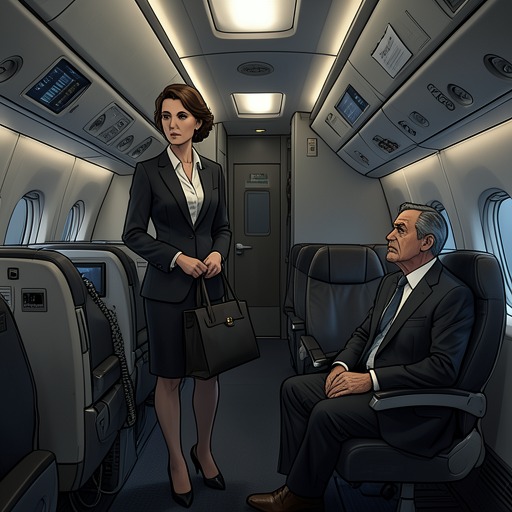
A month or two after first finding that she did not fit, West boarded a crack-of-dawn flight from New York to Seattle just before the doors closed. She was assigned the middle seat in a row with an unoccupied window seat. After offering the man beside her an apologetic smile and indicating where she would sit, she heard him make a sour remark as she put her bag overhead. She asked him to repeat it; he refused to look at her and said nothing. West insisted that he tell her what he had said, explaining to herself that speaking up was part of the work she did in public.
The disagreement hinged on a small etiquette dispute. West had not yet said excuse me because she was still putting away her bag; she understood that courtesy as appropriate when asking someone to move, which she had not yet done. Once seated, she remained uncertain what offense he believed she had committed. When the window seat remained empty after boarding, she moved into it and told him that he would not have to sit next to her. He replied that this suited him. Later, while he slept, her backpack jostled his foot as she moved it from the footwell it occupied; she then said excuse me. They ignored each other for the rest of the flight.
West did not present the encounter as proof that she could know the man’s private motives. She acknowledged that she could not be certain why he was angry. What she recognized was the way he looked at her hips rather than her face, and a familiar hostility that she had encountered in the looks directed at fat passengers. To her, his spoken complaint gave voice to a judgment that usually remained implicit: that a fat person’s body was an imposition on others. The incident felt unusual because it was openly expressed, but familiar because of that repeated subtext.
The essay and the pile-on
West wrote about the encounter in a short Jezebel essay about holiday air travel. She intended it as an account of the everyday hostility fat people face and of the self-doubt that follows subtle acts of contempt: the question of whether a slight was real or whether the person experiencing it was being oversensitive. She expected anti-fat comments, including familiar advice about eating less and exercising more, but thought readers might also respond to the person in the story and reconsider the assumptions directed at fat passengers.
Instead, commenters constructed alternative versions in which West was the aggressor. They accused her of rudeness for saying sorry rather than excuse me, of touching the man with her body while stowing her bag, and of delaying the flight by arriving late. Other accounts portrayed her as drunk, disruptive, physically violent, and intent on harassing the man. These claims contradicted details she supplied: she boarded within the permitted boarding period, and the man did not wake when her bag jostled his foot. She later explained that his foot had been in the footwell where she had placed her bag, and that she moved the bag to the empty window seat. She had left some of this context out of the original essay because she had considered it unnecessary, assuming readers would grant her ordinary good faith.
The online response exposed the double bind in which her account was received. Some commenters dismissed her as delusional or dishonest and denied that a passenger could have been hostile to her; in the same discussions, others recounted their own dislike of sitting near fat people. Within hours, a misogynistic online community was circulating invented versions of the encounter and coordinating an effort to push a hostile article about West toward the top of search results. Members also threatened to report her to the Federal Bureau of Investigation over alleged conduct on a flight. The pile-on did not simply dispute a detail of her story: it turned the act of describing hostility into fresh grounds for hostility.
Access, credibility, and the wider argument
West’s account does not claim that she can establish every stranger’s intention. Instead, it places the single confrontation beside the treatment of fat passengers she had observed more broadly, and asks readers to notice how quickly an ordinary encounter can be reorganized around suspicion of the person with the larger body. The online commenters’ competing claims—that West had imagined the hostility, while also describing fat passengers as intolerable—illustrate how denial and resentment could operate side by side.
The episode also distinguishes her position from the experiences of people with fewer resources. Elsewhere, reflecting on obtaining an abortion, West identifies her middle-class upbringing, whiteness, insurance, and Seattle location as advantages that made medical care seem routine. She observes that people who need help least may receive it most readily. That reflection is not part of the flight incident, but it sharpens the terms of her broader attention to access: her account of airline exclusion does not require treating all forms of disadvantage as identical, or all fat passengers as having the same resources.
The flight story belongs to a wider argument in the book that speech and public culture have consequences beyond the moment of speaking. In a separate debate about comedy, West rejects the claim that calling something a joke ends discussion of its effects. She also recounts a distinct episode in which a comedian brought a knife and a gun to an open mic after anticipating a confrontation. These examples do not establish that online comments caused the airplane encounter; rather, they extend the book’s concern with how hostility is normalized, denied, or carried into conduct. The airplane essay’s particular consequence is more immediate: West’s attempt to describe the routine anxiety of travel produced an online campaign that recast her as a threat, while leaving the practical question of access unresolved. She concludes that she will continue to fly for work, friendships, speaking engagements, and family, rather than rearrange her life around an industry that does not adequately accommodate every body.