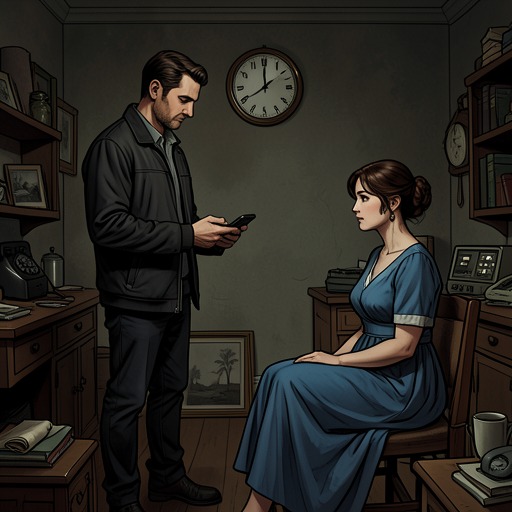
Lindy recording an interview with the troll who had harassed her
Shrill: Notes from a Loud WomanLindy West recording an interview with a troll who had harassed her becomes an encounter with the person behind an anonymous pattern of abuse—and with the limits of what understanding can repair. West reaches out after remembering that she still has his email address; their recorded conversation, made for This American Life, lasts two and a half difficult hours. The troll describes why he chose her, acknowledges the gendered hostility in his behavior, and recounts the moment his attack on her intersected with her recent bereavement. West believes his remorse and finds herself forgiving him, while insisting that the conversation does not prescribe forgiveness for anyone else.
From routine abuse to a recorded conversation
West returns to the regular flow of hateful messages and the repeated decisions they require: ignore, block, report, or engage. The options recur, but so does the memory of one troll who had apologized. She wonders whether he has really changed and what she might learn by asking him. The idea is partly investigative and partly practical: if he proves to be a jerk, she thinks, the exchange could still make a good story. The possibility of contacting him arises from a detail she has retained—his email address—not from any assumption that he deserves access to her.
West writes to him. After months of waiting, he replies that he is willing to help. Within days, she is in a recording studio speaking with him by phone for the radio program This American Life. The sequence turns private correspondence into a public interview, but does not make the exchange emotionally safe: she describes the ensuing conversation as grueling, with every second painful even as the hours pass quickly.
Why he targeted West
West begins by asking why he chose her, particularly because his earlier email had said that his harassment was not about the rape-joke controversy. He identifies her writing about being fat as a central target. He also recalls her emphatic style, especially her use of capital letters, and says that her confident public voice made him resentful. When West asks whether her gender was part of the reaction, he readily agrees. He says women’s increasingly direct writing felt threatening to him.
That admission matters to West because it makes explicit a connection often denied: a man can target a woman’s speech while insisting that his hostility has nothing to do with women as a group. She explains that she writes forcefully in part because women are not expected to do so, and because she wants other women to hear a woman speak without timidity. The interview therefore examines not only the troll’s conduct but the response to the voice he had tried to punish. His description of his motives makes the gendered dimension audible, though it does not fully explain how resentment of one woman becomes a desire to harm women more broadly.
The troll describes a period when he disliked his own body, had been left by his girlfriend, and spent his days at an unfulfilling job. He calls that life passionless and says it felt easy to direct his unhappiness at women online. West presses on the missing link: why women became easy targets, and why men’s self-directed anger so often falls on women. In retrospect, she wishes she had made that question even plainer. For all his self-awareness, he never articulates the transition from frustration with his own circumstances to generalized hostility toward women. The conversation brings his distress into view without treating it as an excuse or as a complete account of the harm.
The apology and her father’s death
The interview turns to West’s father. The troll had searched for her online, found her father’s obituary, and learned from it that her father loved his children. He tells her that after his online attack, the knowledge that she had read it would not leave his mind. Ordinarily, he says, he could post hateful material and then forget it; this time he kept thinking about how she would feel and wrote to her the next day.
West is crying as she asks what he remembers about her father and whether he understood him as a human being. When the troll says that he felt horrible and apologizes, West believes him. She says she did not mean to forgive him, but did. She also tells him that she receives abuse every day and that this was the cruelest thing anyone had done to her: the attack came while her father’s death was still fresh. The apology is significant partly because she has never heard of another troll apologizing to someone he harassed. Their exchange ends with thanks on both sides, not with a declaration that the harm has been undone.
West is unsettled by how comfortable the conversation feels and by the normality of the person on the other end of the phone. He has women coworkers who like him and a girlfriend who loves him; those ordinary relationships coexist with his history of deliberately traumatizing women online. The interview holds both facts together rather than resolving the contradiction. His capacity for connection does not erase what he did, just as the harm does not make his later remorse impossible.
Change, responsibility, and what the interview cannot promise
The troll says that he no longer harasses people and that his behavior belonged to a low point in his life. He describes taking care of his health, finding a new girlfriend, returning to school to become a teacher, and volunteering at a school. Seeing children withdraw after their peers hurt their feelings makes him think about the people whose feelings he had injured. West presents this as his explanation of change, not as proof that every harasser will change or that the injured person must participate in that process.
Her wider account of comedy and online abuse clarifies why this distinction matters. In her public debate with Jim Norton, she objects to treating jokes as detached from the forces that shape people’s lives. She describes the frustration of being made to argue that jokes have consequences when the opposing claim is simply that they are jokes. Elsewhere, she recalls that Dave brought a knife and a gun to a comedy show after fearing a confrontation with Aham over a disagreement about women’s safety. She connects that episode to the danger of treating an imagined threat as real while ignoring the threat one has oneself introduced, and to the racialized consequences of that kind of fear. These experiences give the recorded interview a wider frame: speech and online hostility are not weightless merely because they occur through comedy or behind a screen.
West is careful not to make her response a rule for others. She does not say that people who are abused owe their abusers forgiveness, or that she will always respond compassionately to those who insult her. The conversation instead changes the timbre of some later encounters. After it airs, she reports having to flag six more Twitter accounts using her father’s name and face, including one that attacked her for writing about her abortion. The abuse continues; what changes is her ability to feel pity for the people behind it, rather than only hurt or fear. Her conclusion is deliberately personal: human beings can be reached, and this conversation is her evidence—not a promise that every troll will apologize, or that understanding can substitute for accountability.