Los Angeles
Shrill: Notes from a Loud WomanLos Angeles is both a creative destination and a setting where Lindy West’s plans repeatedly meet their limits. She first went there as a college student drawn to comedy and the possibility of a writing life, then returned after an unsuccessful early attempt to find work. Years later, she moved back with a year-long lease while Ahamefule J. Oluo could commit to only a few months. The city’s place in her story is therefore not a simple tale of arrival: it holds exhilaration, professional hesitation, domestic hope, and the painful aftermath of a relationship ending.
College and the comedy audience
During college in Los Angeles, West went to comedy shows as often as she could, usually by herself because her roommates were not interested. She saw Patton Oswalt trying out new material at M Bar, Paul F. Tompkins sing Danny Boy at Largo, and Mitch Hedberg at the Improv shortly before Hedberg’s death. West remembered these outings as rapturous, and the proximity of performers to audiences made the comedy world seem unexpectedly accessible. She could find herself near Marc Maron, Greg Proops, or Maria Bamford, or seated beside Bob Odenkirk; after accidentally colliding with Bobcat Goldthwait outside a bathroom, she worried about whether he was all right.
The shows mattered not just as entertainment but as a glimpse of a possible working life. West wanted to be immersed in comedy’s creation as well as its performance, and imagined a television writers’ room as a place where people were paid to riff together and build fictional worlds. Stand-up itself was not her central ambition. Los Angeles gave her a vivid view of comedy as a social and creative community, but the closeness of that world did not yet make her feel entitled to enter it as a writer.
An uncertain start to work
West graduated in 2004 with an English degree and severe impostor syndrome. Although she loved the idea of writing, she convinced herself she did not have enough ideas to become a writer. When asked what she wanted to do, she described sentence-making as her only skill while denying that she was really a writer. That self-doubt shaped her first attempt to establish herself in the region’s working world.
With no clear alternative, she took an unpaid internship at a free parenting magazine in the Valley. The publication consisted largely of coupons and advertisements, with a small editorial staff and a much larger sales operation. West was assigned articles on parenting subjects despite feeling unqualified to advise parents. She tried to make the position useful by seeking writing clips, but it did not become the beginning of the career she had hoped to find. In retrospect, she regarded leaving the job and Los Angeles as a missed opportunity to demand better conditions; at the time, she gave up on the city and moved back home.
The return was not a final rejection of Los Angeles. West’s later account places it within a longer sequence of changes: after the move back, she would eventually return to see what the world held for her, and later begin working at Jezebel. The city thus marks an early gap between wanting a creative life and believing she could claim one, without defining the rest of her career by that first setback.
A move made on unequal timelines
In 2011, the prospect of moving to Los Angeles arose through Ahamefule J. Oluo’s place in the semifinals of NBC’s Stand Up for Diversity contest. The competition offered development deals and visibility to performers from underrepresented groups, and Los Angeles seemed to offer a chance to see whether that attention might lead somewhere. West describes the three of them as feeling ready to test their prospects there, but the practical circumstances were uneven: Ahamefule J. Oluo had two children and expected to stay only a few months, six at most, while he saw whether the opportunity developed. West, by contrast, signed a lease for a full year.
That mismatch made the move a wager rather than a settled plan. The relationship had been new, and Ahamefule J. Oluo had previously signaled that he was not ready to live together and that his recent divorce and other pressures made commitment difficult. West nevertheless believed the move could become a shared life. In the driveway, he said that they would live together as a real couple; she took the declaration as binding reassurance, even though the different lease terms and his earlier cautions remained in the background. Los Angeles became the setting where hope briefly seemed to overrule the evidence of uncertainty.
The Eagle Rock house
West rented a small yellow house in Eagle Rock for herself, Ahamefule J. Oluo, and his daughters. A large eucalyptus tree stood in the backyard, and the church that owned the house was only two doors away. The property connected their private attempt at family life to an immediate neighborhood: church members sometimes came by to invite them to activities, while the identical house next door held a family dealing with a serious illness.
The neighbor Kathy, who had early-onset Alzheimer’s, sometimes wandered into the West household confused and distressed, looking for her husband, Jeff. West and the others would try to comfort her and guide her home. On one particularly hot afternoon, West discovered that Jeff was there but unconscious under blankets. When he later came to retrieve Kathy, his usual cheer briefly gave way as he said she used to take care of everything. This episode placed the household’s efforts to make a life together beside another couple’s experience of caregiving and loss; the neighboring home was a close, unsettling counterpoint, not a distant story.
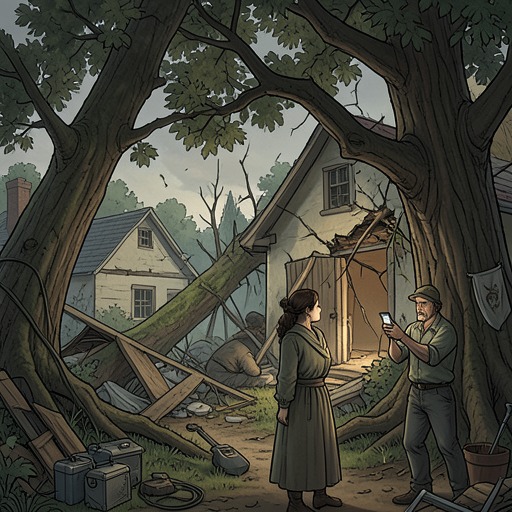
The house also became bound to the breakup. The eucalyptus tree fell onto it while West was asleep alone in the bed that had belonged to the couple. The fall came two weeks before her father died, four weeks after Ahamefule J. Oluo said he was leaving, and eight weeks after they had moved in together in a new state with ambitious plans. West later traced the drive to Los Angeles through a long list of towns and road junctions, insisting in retrospect that the move had felt wrong well before the tree fell. The house’s damage therefore coincided with a relationship and a future she was already reconsidering, rather than serving as the cause of either ending.
Return and changed circumstances
After her father’s funeral, West and Ahamefule J. Oluo returned to Los Angeles and lived in an unsettled arrangement for several months. He went on tour, while West started working at Jezebel. They were no longer a couple, but she describes them as happy in an unfamiliar way. The city held the transition between the relationship’s first attempt at shared domestic life and a renewed closeness that did not initially depend on being together romantically.
West connects this period to the changed balance of her life after her father’s death. Her grief, and later her career, occupied space that had previously been centered on the relationship. Ahamefule J. Oluo came to support her family during that period, including time at her mother’s basement, where he mixed drinks for her aunt. The account does not present Los Angeles as a place that resolved the strains surrounding the couple. Instead, the city recurs as a setting in which different versions of West’s future became imaginable: first a comedy-centered working life, then a risky shared home, and finally a more complicated closeness after separation.