Misogyny in the Comedy Industry
Shrill: Notes from a Loud WomanMisogyny in the Comedy Industry is not only a matter of offensive material; it is a set of expectations about who may speak, whose discomfort counts, and who gets to define comedy. Lindy West describes learning to accept misogynistic jokes as the price of belonging, then rejecting that bargain. Her argument is that comedy is a powerful social practice, not a sealed-off exception to ordinary accountability: it can reflect existing harm, help normalize it, or challenge it.
A Culture of Expected Endurance
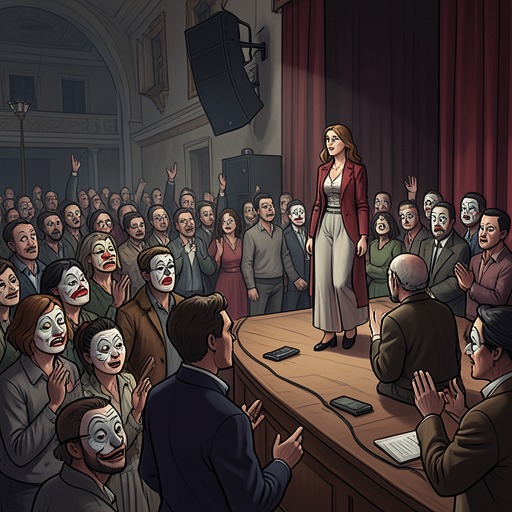
For years, West assumed that comedy shows required women to sit through jokes about beating, raping, ranking, and reducing women to stereotypes. She heard this not only at mainstream performances but at liberal alternative shows, including shows booked by friends. The repetition made the hostility seem banal. West bit back her discomfort and smiled, reasoning that this was simply how comedy worked and that even her heroes endorsed the arrangement. Membership in the scene seemed to require treating gendered hostility as ordinary entertainment.
That accommodation rested on an imagined contract. When a comedian she admired said something racist, sexist, or otherwise alarming, West assumed there must be an agreement she had never encountered, one that made the joke acceptable to the people it demeaned. At Bridgetown, she began to question who had written that contract and why its terms should bind women and other marginalized audiences. The supposed universal permission to joke, she concluded, looked more like a rule established by powerful men to protect their access to material about harms they were unlikely to experience themselves.
The industry’s canon reinforced that doubt. West considered the celebrated male comedians and the prominent alternative-comedy figures who helped shape its standards, then noticed how few women were represented among them. The familiar assertion that women were not funny could persist as conventional wisdom even while people who knew the comedy world could name many women performers. The imbalance was not merely about which names appeared on a list: it shaped whose interests and experiences were treated as central when the rules of comedy were made.
What a Joke Does
West’s criticism was not that rape or other terrible subjects must never be discussed humorously. In writing about Daniel Tosh, she distinguished between jokes that challenge rape culture and jokes that make rape victims the target. She argued that comedy works through selection: a comedian chooses words, targets, and framing. Calling a performance uncensored or equal-opportunity does not make it neutral, because people do not occupy equal positions of power. A joke aimed at a vulnerable group does not become harmless simply because its performer claims to offend everyone.
For West, this distinction mattered because comedy shapes the world in which audiences live. Speech can reflect social attitudes and help reproduce them; it can also expose their cruelty. Her standard was not a demand for censorship, but a demand to ask what a joke is doing and whom it is asking the audience to laugh at. She described comedy as a potential lever for social change: a performance can challenge a harmful assumption rather than make it easier to accept.
The stakes became especially clear to her during debate about the Steubenville rape case. In public discussion of the case, jokes and dismissive responses existed alongside attempts by adults at the school to cover up the crime and coverage that dwelled on the perpetrators’ futures. West asked viewers to consider how a woman contemplating whether to report an assault might hear an audience laughing at rape. Her concern was not abstract offense; it was the possibility that such laughter could intensify the isolation and tension surrounding people already facing violence.
Criticism, Authority, and Risk
West’s defense of Sady Doyle and Molly Knefel followed a backlash against their criticism of rape jokes and comedy culture. She argued that women who raised these concerns were treated as trespassers, while jokes about rape and gendered violence were treated as inevitable and beyond discussion. Even measured criticism could bring condescension or hostility. The asymmetry was plain: women were expected to withstand material about their own vulnerability, while comedians could respond angrily to being questioned.
On Totally Biased, West debated Jim Norton about the cultural effects of rape jokes. She objected to the circular defense that jokes were simply jokes, because it forced critics to argue as though comedy ceased to be comedy when it carried social meaning. Norton, by contrast, maintained a distinction between comic performance and real-world speech. West challenged the idea that language had no bearing on people’s lives, pointing to the broader history of comedy that once made racist assumptions seem ordinary. Their dispute exposed a conflict over authority: whether performers alone could define a joke’s meaning, or whether people affected by its assumptions had standing to contest it.
A later account of an open-mic night made the possible consequences of this conflict concrete. Dave, anticipating a confrontation with Ahamefule J. Oluo, exercised for hours and arrived with a knife and a gun. West presented the episode as a disturbing collision between comic posturing and real-world threat, not as proof that every disagreement becomes violent. She connected Dave’s fear of Ahamefule J. Oluo to the racial danger created when white men interpret disagreement as a threat to their safety. For West, the incident showed why people might remain silent, and why speaking about the culture surrounding comedy mattered.
Making the Harm Visible
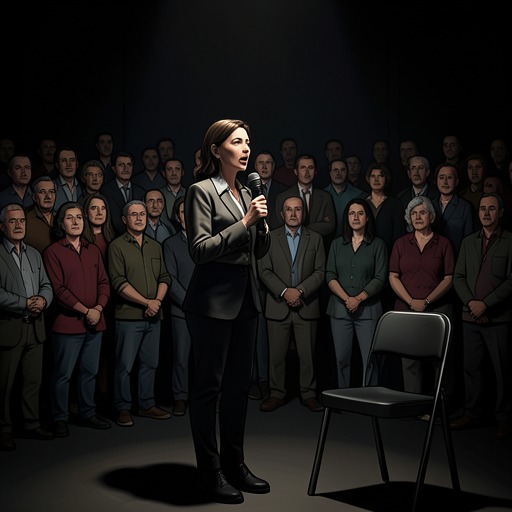
After the public debate, West collected online abuse and filmed herself reading it aloud from a large gray chair in her living room. Ahamefule J. Oluo filmed as she read in a steady, deadpan manner for nearly five minutes. The form mattered: instead of describing abuse in the abstract, the video presented her face and the words that other people had chosen to send her. By stripping away an emotional performance that could be dismissed as manipulation, the recording made the act of sending the messages harder to treat as weightless or unreal.
The response shifted. Comedians who had defended rape jokes the previous summer expressed support, and public figures, including Seattle’s mayor, voiced solidarity. Patton Oswalt also published an argument about rape jokes. West welcomed the potential effect on younger audiences, while noting the disparity between the recognition given to a prominent male comedian’s position and the abuse women had received for making related arguments. Support could help move the conversation, but it did not erase who had paid the earlier cost of raising it.
Change and Continuing Cost
West believed that the debate produced incremental change: comics became more careful when discussing rape, and audiences grew more willing to express discomfort. She took pride in those shifts, but described the outcome as a personal loss as well as a public gain. She could no longer watch stand-up without dread. Repeated hostility had damaged her sense of herself as a funny person, an identity she regarded as central to her life. Among some comedians and fans, her name became a shorthand for opposition to humor, despite her insistence that her criticism arose from love of comedy and a desire to make it accessible.
The contradiction deepened as professional opportunities arrived. West received television writing offers, invitations to write pilots, and interest in adapting her work; jokes she had written for other performers earned laughs on air. Yet reaching goals that once seemed distant did not restore her uncomplicated pleasure in comedy. The industry’s misogyny therefore appears in the account not as a single bad joke or one contentious debate, but as a structure that can reward women’s work while punishing their public criticism, and can make efforts to improve the art exact a lasting personal price.