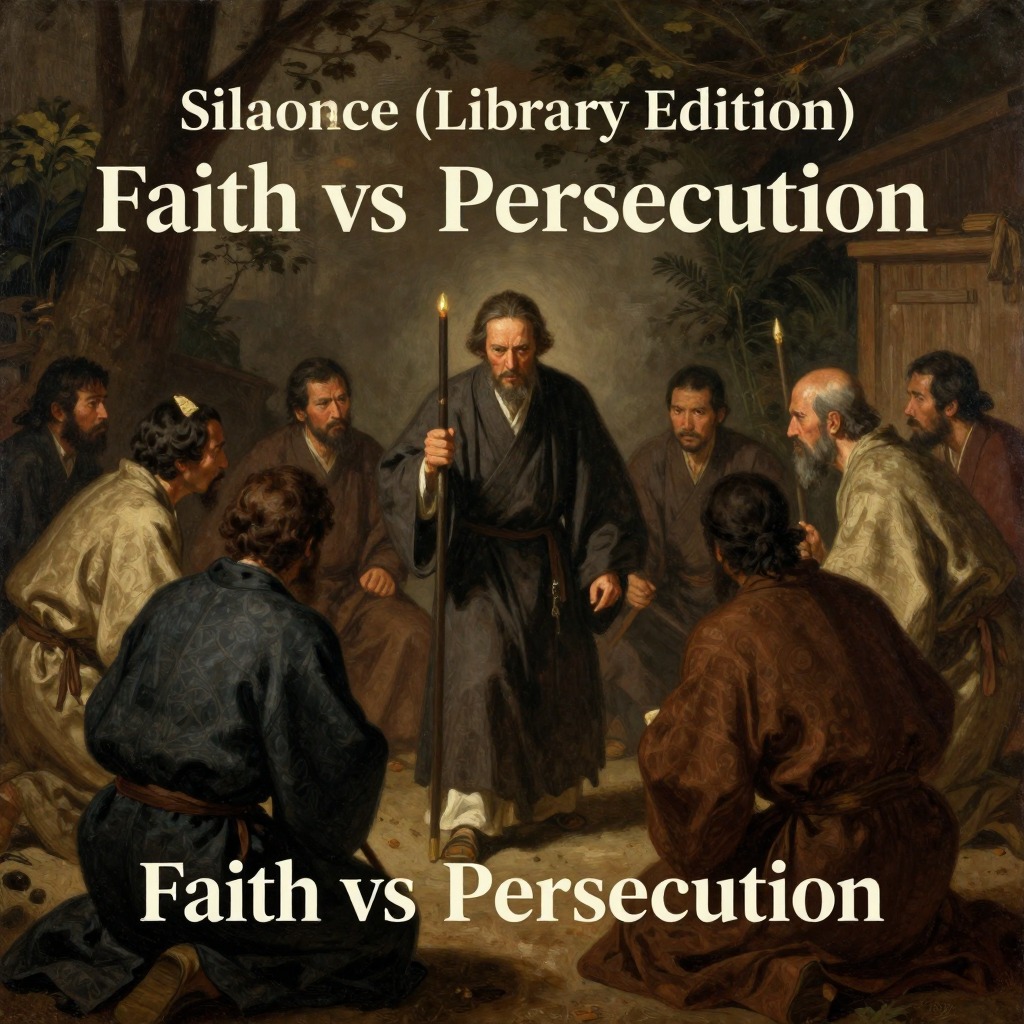
Edict of Expulsion (1614)
Silence (Library Edition)The Edict of Expulsion (1614) was the legal and political instrument by which the Tokugawa Shogunate formally criminalized Christianity in Japan, declaring the faith an 'evil law' bent on overthrowing the government and ordering all missionaries expelled. Promulgated under the first Tokugawa shogun, Ieyasu, the edict transformed what had been intermittent, locally driven persecutions into a systematic, state-sponsored campaign of eradication. It was the death blow to the 'Christian century' in Japan, a period that had seen the faith grow to an estimated 300,000 converts, supported by colleges, seminaries, hospitals, and a growing native clergy. The edict's language and the legal machinery it set in motion would define the terms of Christian persecution for the next two centuries, creating a framework of surveillance, torture, and public renunciation that the novel Silence dramatizes in its most harrowing episodes.
Background and Causes
The Edict of 1614 was not a sudden decision but the culmination of decades of growing suspicion. Christianity had arrived with Francis Xavier in 1549 and flourished during the Sengoku Period, when warring daimyos offered protection to missionaries partly for trade with Portuguese ships. The unification of Japan under Nobunaga, Hideyoshi, and Ieyasu changed this calculus. Hideyoshi's first expulsion decree in 1587, issued in a drunken rage, had quickly become a dead letter, and within four years the Christian community had grown to over 200,000 converts. But the arrival of English and Dutch traders provided the shogunate with alternative sources of European goods and information, and the Protestant rivals lost no time in warning the Japanese authorities that Catholic missionaries were the advance guard of colonial conquest. Ieyasu, the first Tokugawa shogun, grew increasingly alarmed by the unquestioning obedience of his Christian subjects to their foreign spiritual guides. The final trigger was the Shimabara Rebellion, a peasant uprising fueled by Christian faith and brutally suppressed, which convinced the Bakufu that Christianity was an inherently subversive force that could only have been sustained by foreign collusion.
The Edict's Content and Immediate Consequences
The edict itself, as recorded in historical sources and quoted in the novel's prologue, declared that 'the Kirishitan band have come to Japan…longing to disseminate an evil law, to overthrow true doctrine, so that they may change the government of the country, and obtain possession of the land. This is the germ of a great disaster, and must be crushed.' The decree ordered the expulsion of all missionaries from Japan. In October 1614, seventy priests, both Japanese and foreign, were herded together at Kibachi in Kyushu and forced onto five junks bound for Macao and Manila. The sea was grey and stormy as the ships, drenched by rain, made their way out of the harbor and disappeared beyond the horizon. Yet thirty-seven priests refused to abandon their flock and remained in hiding, among them Christovao Ferreira, the provincial of the Society of Jesus, who would continue his underground apostolate until his own capture and apostasy years later.
Enforcement and Legal Machinery
The Edict of Expulsion created a comprehensive legal and administrative apparatus for hunting down Christians. Under Ieyasu's successors, especially the neurotic Iemitsu, the persecution became systematically ruthless. The most common early form of execution was burning, but the shogunate soon realized that public martyrdoms only strengthened Christian resolve, with crowds singing hymns and canticles as the victims died. The authorities therefore shifted to torture designed to induce apostasy, most notoriously the 'ana-tsurushi' or hanging in the pit, where the victim was suspended upside down over a pit of filth, with a small incision behind the ear to let blood drip slowly. The novel records that some victims survived for more than a week in this position, and one young woman endured it for fourteen days before expiring. A reward system was established: three hundred pieces of silver for informing on a priest, two hundred for a brother, one hundred for a lay Christian. The shogunate also issued decrees forbidding fences or hedges between houses, so that neighbors could observe one another's activities and report any suspicious behavior. Every year, on January 4th, the entire population was required to participate in the fumie ceremony, trampling on an image of Christ or the Virgin to prove they were not Christians.
Consequences and Aftermath
The Edict of 1614 succeeded in its immediate goal of destroying the visible structure of the Church in Japan. Churches were torn down, seminaries closed, and the foreign clergy were either expelled, executed, or forced to apostatize. The Shimabara Rebellion of 1637-1638, in which 35,000 Christians were butchered to the last man, woman, and child, led to the final sealing of the country. Japan cut all trade relations with Portugal, and Portuguese ships were forbidden to enter Japanese harbors. Yet the edict could not eradicate the faith entirely. Thousands of crypto-Christians kept their faith in secret, passing down baptism and catechism through a clandestine organization of lay leaders—the Jiisama, Tossama, and Mideshi—that the novel describes in detail. They gave their names to Buddhist temples, complied with the order to trample the fumie, and preserved fragments of the fathers' soutanes, rosaries, and disciplines. When Japan was reopened in 1865, these hidden Christians emerged from their centuries of hiding, asking for the statue of Santa Maria and speaking of Christmas and Lent. The edict's legacy, however, was a profound transformation of Christianity itself. As the novel's Inoue tells the apostate Rodrigues, 'The Christianity you brought to Japan has changed its form and has become a strange thing…Japan is that kind of country; it can't be helped.' The God that the peasants of Goto and Ikitsuki secretly served had gradually changed so as to be no longer like the Christian God at all—a butterfly caught in a spider's web, retaining only the external form while the blood and flesh were gone.
Narrative and Thematic Significance
In Silence, the Edict of Expulsion is not merely a historical backdrop but the legal and existential condition that defines every character's fate. It is the reason Rodrigues and Garrpe must travel in secret, hide in charcoal huts, and depend on the hospitality of peasants who risk their lives to shelter them. It is the authority behind the water torture that kills Mokichi and Ichizo, the sword that beheads the one-eyed Chokichi, and the pit that breaks Ferreira. The edict creates the world in which the central theological question of the novel—the silence of God in the face of suffering—becomes inescapable. It also generates the novel's most troubling moral dilemmas: the interpreter's taunt that the missionaries' 'selfish dream' causes Japanese blood to flow, and Ferreira's claim that Christ himself would have apostatized to save the suffering peasants. The edict, in short, is the mechanism by which the 'swamp of Japan' is shown to absorb and transform Christianity, and the instrument through which the novel tests the limits of faith, love, and human endurance.