Reward for Informing on Christians
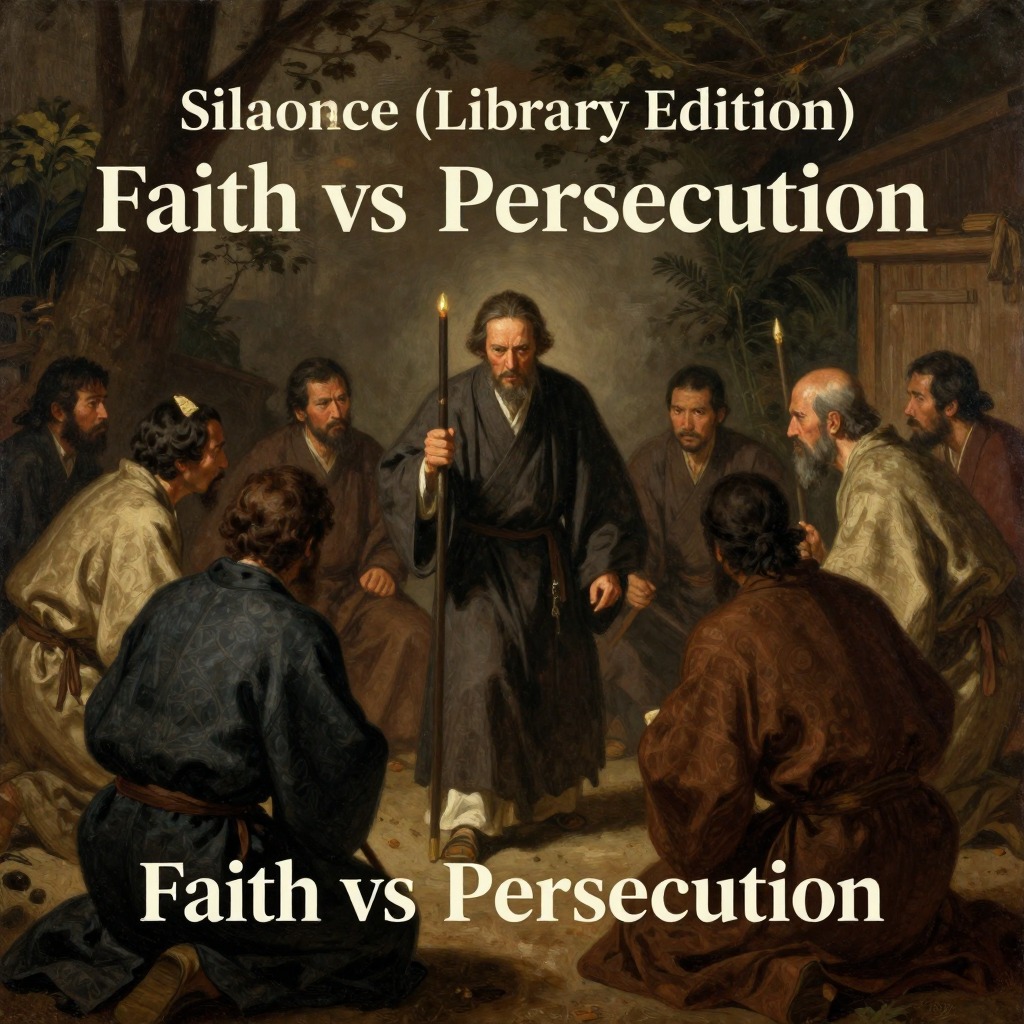
Silence (Library Edition)The Reward for Informing on Christians was a calculated instrument of the Tokugawa Shogunate's campaign to eradicate Christianity from Japan. By offering escalating sums of silver for denunciations, the authorities turned the economic desperation of the peasantry into a weapon against the faith, making every neighbor a potential informer and every priest a walking bounty. The system was designed not merely to capture individuals but to corrode the trust that sustained the underground Church, and it succeeded in doing so with devastating efficiency.
Structure and Scale of the Reward System
The reward scale was fixed and widely publicized. An informer who denounced a foreign priest received three hundred pieces of silver; a brother or a "retrovert" (an apostate who had returned to the faith) brought two hundred; a catechist or ordinary lay Christian was worth one hundred pieces. The amounts were not trivial: for the destitute farmers of villages like Tomogi, who eked out a living on potatoes and radishes and paid crushing taxes, three hundred pieces of silver represented a life-changing fortune. The system even contained a provision designed to encourage betrayal from within: if the informer himself was a catechist or lay Christian, he would still receive three hundred pieces of silver according to the status of the accused, effectively rewarding self-denunciation or the betrayal of one's own community. The announcement boards nailed to the main entrance of the Christian Residence in Edo made the terms explicit, warning that anyone who sheltered Christians and was discovered through information from others would face severe punishment for himself, his family, his relatives, and even the head of the place and the surrounding families.
Implementation and Psychological Impact
The reward system was not a theoretical threat but a daily reality. When the samurai descended on Tomogi, they offered one hundred pieces of silver to anyone who would reveal the secret adherents of the forbidden Christian sect. The peasants stood silent, but the temptation was real. Sebastian Rodrigues noted that the reward was a terrible temptation for these destitute people, and that the Christians had almost no trust in the people of other villages as a result. The system worked by atomizing communities: the prohibition of fences and hedges between houses, issued alongside the reward system, meant that every household was exposed to the view of its neighbors, and any suspicious behavior could be reported for profit. The psychological effect was profound. The Christians of Tomogi developed expressionless faces "like masks" because they could not register sorrow or joy without risk. The long years of secrecy had made them puppets, and the reward system was the mechanism that kept them so.
The Reward System in Action: Betrayal and Its Price
The reward system directly enabled the betrayals that drive the novel's plot. Kichijiro, the weak-willed fisherman who had already apostatized once, betrayed Sebastian Rodrigues to the authorities. When the guards seized the priest, they threw a number of tiny silver coins into Kichijiro's face with a gesture of contempt. Rodrigues, reflecting on his own price, noted bitterly that Judas had sold Christ for thirty pieces of silver, while he was worth ten times as much. The system thus created a direct parallel between the Gospel narrative and the Japanese persecution, but with a crucial difference: the reward was not a one-time payment but a standing offer that could be claimed again and again. The same Kichijiro who betrayed Rodrigues later returned to the prison, weeping and pleading for confession, claiming he had not betrayed the priest for money but because he was threatened by the officials. The ambiguity of his motive—was he a calculating Judas or a terrified weakling?—was itself a product of the reward system, which made it impossible to distinguish between genuine conversion and a trap set by the magistrate.
The System as a Tool of the Magistrate
The reward system was the signature method of Inoue, the Lord of Chikugo, whom Valignano had described as "cunning as a serpent." Unlike his predecessor Takenaka, who relied on brute torture, Inoue understood that the most effective way to destroy the Church was to turn the Christians against one another. The reward system was his masterstroke: it required no constant surveillance, no elaborate torture apparatus, only the corrosive power of silver. When the officials questioned the Christians of Tomogi, they did not threaten immediate death; they offered a reduction in taxation for the coming years if anyone would reveal the names of the adherents. The combination of reward and tax relief was almost irresistible, yet the peasants of Tomogi overcame the temptation. But the system had already done its work: the mere existence of the reward created suspicion, and the suspicion split the community. The officials knew that even if no one took the money immediately, the seed of distrust had been planted, and the Church would rot from within.
Legacy and Significance
The reward system outlasted the active persecution. Even decades after Rodrigues' apostasy, when he lived under the Japanese name Okada San'emon in the Christian Residence in Edo, the same reward scale was posted on the notice board at the main entrance: three hundred pieces of silver for a father, two hundred for a brother or retrovert, one hundred for a catechist or lay Christian. The system had become a permanent feature of the Japanese state's apparatus of control, a bureaucratic mechanism for maintaining religious conformity long after the last missionary had been captured or killed. The reward for informing on Christians was not merely a historical detail but a structural element of the persecution that shaped every relationship in the novel. It turned Kichijiro into a perpetual potential betrayer, made the Christians of Tomogi into masks, and forced Rodrigues to confront the terrible question of whether his own faith was worth the price that others paid for it. The system was the swamp of Japan made tangible: a mechanism that absorbed the foreign tree of Christianity and transformed it into something unrecognizable, not through theological argument but through the simple, relentless pressure of silver.