fumie test
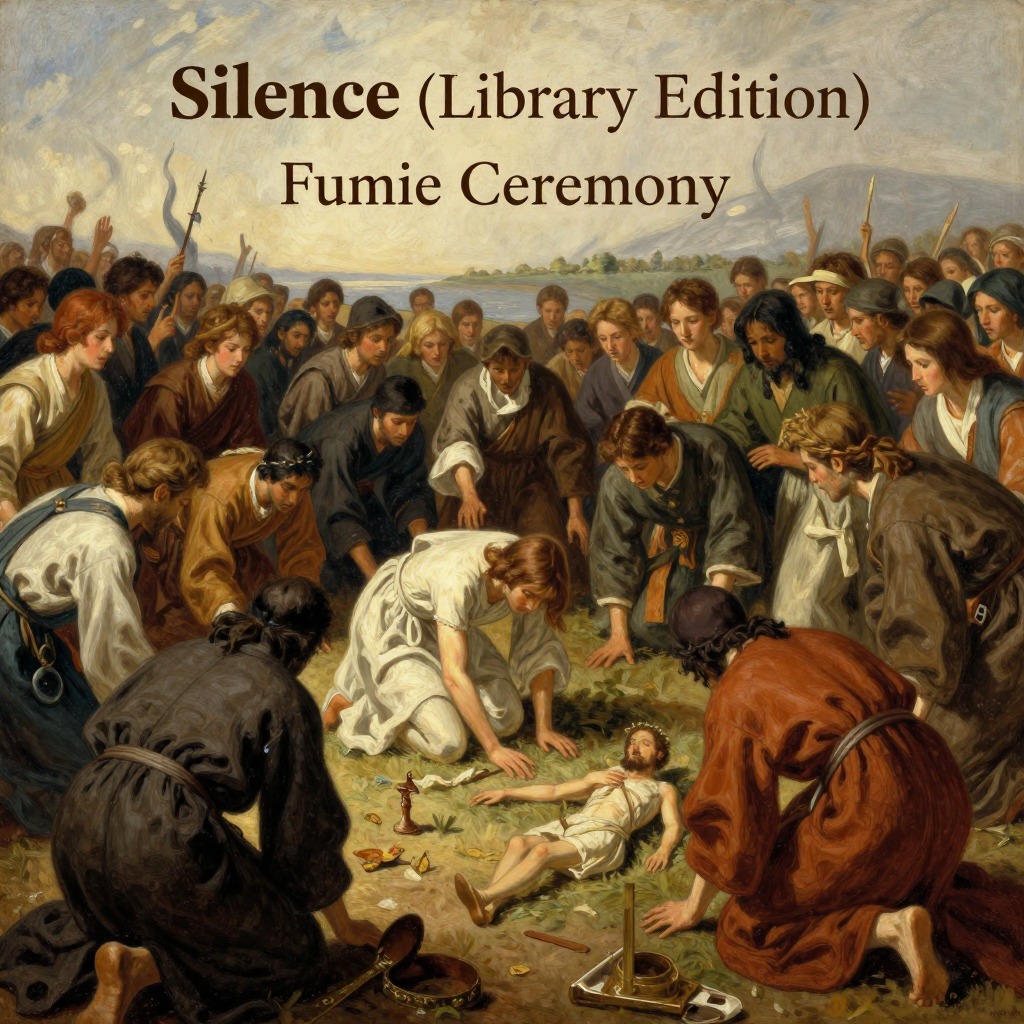
Silence (Library Edition)The fumie test was the Tokugawa Shogunate's most systematic and psychologically devastating instrument for detecting and humiliating Christians. A copper or bronze plaque bearing the image of Christ or the Virgin Mary, mounted on a wooden board, was placed before the accused; to trample on it was to declare oneself a non-Christian, while refusal meant torture, imprisonment, or death. The test was not merely a legal formality but a ritual of public degradation designed to break the will of believers and to demonstrate the state's absolute power over conscience. It became the defining ordeal for every character in the novel, the moment at which faith, fear, and love collided irreparably.
Origin and Purpose
The fumie test emerged from the systematic persecution that followed the 1614 Edict Expelling Missionaries, which declared that the Kirishitan band had come to Japan 'longing to disseminate an evil law, to overthrow true doctrine, so that they may change the government of the country, and obtain possession of the land.' The Tokugawa Bakufu, having observed that spectacular martyrdoms only strengthened Christian resolve, shifted to a strategy of forced apostasy through torture and public humiliation. The fumie was the visible symbol of this new approach: a ritual that required the believer to perform an act of desecration, thereby severing the visible bond between the individual and the forbidden faith. By the time of the novel's events, the test had become an annual civic duty: on January 4th of each year, the elders of every town went to the magistrate's office to receive the fumie plaque, and every household—from the master to the mother clasping her baby—was required to trample in the presence of officials. The sick were made to touch the plaque with their feet from their beds. The test was thus woven into the ordinary rhythm of Japanese life, a routine act of collective renunciation that the state demanded as proof of loyalty.
The Test as Moral Crisis
For the Christians of the novel, the fumie test presented an excruciating dilemma. The officials themselves acknowledged that the act was a mere formality: 'Just putting your foot on the thing won't hurt your convictions,' they insisted. But the believers understood that the formality was the point—the state demanded not belief but the public performance of denial, and to comply was to betray the Christ whose image lay beneath their feet. When the three men of Tomogi—Mokichi, Ichizo, and Kichijiro—were brought before the fumie at Sakuradai, Kichijiro was the first to place his foot on the image, following the advice of Sebastian Rodrigues. But the officials were not fooled by the mechanical act; they watched the expressions on the faces of the men, noting 'how heavy and nervous your breathing became.' The test was a trap designed to catch the conscience, not merely the body. When the officials then ordered the men to spit on the crucifix and declare the Virgin a whore—a refinement devised by Inoue, who had once been baptized himself—Mokichi and Ichizo could not comply. A white tear overflowed from Mokichi's eye and rolled down his cheek; Ichizo shook his head as though caught in the throes of pain. Both confessed openly that they were Christians. Only Kichijiro, overcome by threats, gasped out the required blasphemy and let fall on the fumie 'the insulting spittle that could never be effaced.'
The Fumie and the Face of Christ
The fumie image becomes, for Rodrigues, the most intimate and agonizing symbol of his entire spiritual journey. Throughout his captivity, he had carried in his heart the face of Christ—'the most beautiful, the most precious thing in the world'—as a source of strength and identity. When at last the fumie is placed before him in the magistrate's office, he sees not a majestic or glorious Christ but a face 'sunken and utterly exhausted,' worn concave by the constant treading of countless feet. The wood surrounding the plaque was black with the print of toes; the face itself was 'concave, worn down with the constant treading.' And this concave face looked up at him in sorrow and spoke: 'Trample! Trample! I more than anyone know of the pain in your foot. Trample! It was to be trampled on by men that I was born into this world. It was to share men's pain that I carried my cross.' Rodrigues raises his foot; he feels a dull, heavy pain. 'This is no mere formality,' he understands. 'He will now trample on what he has considered the most beautiful thing in his life, on what he has believed most pure, on what is filled with the ideals and the dreams of man.' He places his foot on the fumie. Dawn breaks. Far in the distance the cock crows.
Aftermath and Legacy
After his apostasy, Rodrigues—now known as the Apostate Paul—is himself employed by the magistrate's office to examine objects seized from suspected Christians and to determine whether they belong to the forbidden faith. He becomes a witness to the fumie test as an instrument of state, not its victim. The annual ceremony continues: on January 4th, the otona and leading citizens go to receive the fumie plaque and to check each house's observance. The first to trample is the master of the house, then his wife and the children; the mother, clasping her baby in her arms, must trample too. The plaque itself, between seven and eight inches in length and between four and six inches in breadth, bears an image of the Virgin and Child. It is the same plaque that, decades earlier, the translator's preface notes, can still be seen at Ueno Museum in Tokyo, 'rubbed flat and shining by the hundreds of feet that ached with pain while they trampled on someone whom their hearts loved.' The fumie test thus outlives the persecution it was designed to serve, surviving as a physical relic of the moment when faith and power met in the act of a single footstep.
Thematic Significance
The fumie test crystallizes the novel's central theological and existential questions. It is the point at which the silence of God becomes unbearable—the moment when the believer must act without any audible divine response. Inoue, the Lord of Chikugo, tells Rodrigues that he was not defeated by the magistrate but 'by this swamp of Japan,' and the fumie is the instrument through which the swamp operates: it demands a visible, physical act of renunciation that no inner faith can undo. Yet the novel also suggests that the fumie may be the site of a hidden revelation. The Christ of the worn plaque speaks to Rodrigues not in majesty but in solidarity: 'I understand your pain and your suffering. It is for that reason that I am here.' The test that was meant to destroy faith becomes, for Rodrigues, the occasion of a new and different love—a love that accepts weakness, betrayal, and the exhaustion of the flesh. The fumie, the instrument of apostasy, becomes the place where the silence of God is finally broken, not by a voice from heaven but by the shared pain of the trampled and the trampler.