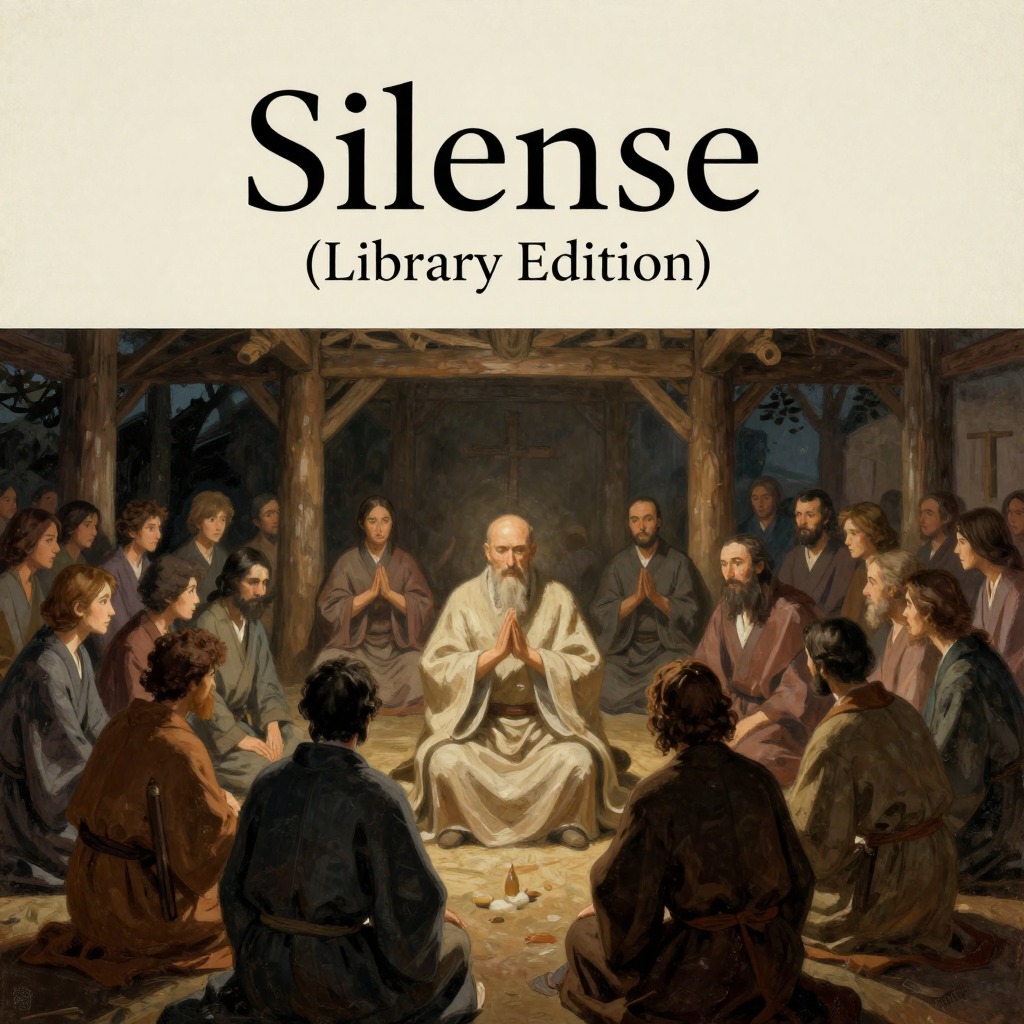
secret Christian organization
Silence (Library Edition)The secret Christian organization was the underground structure through which Japanese Catholics preserved their faith, administered sacraments, and maintained community cohesion after the Tokugawa Shogunate had driven out or killed all foreign priests. It was not a formal institution imposed from above but a grassroots adaptation born of necessity, and its existence proved that the Church could survive, at least in outward form, even when its ordained leaders were gone.
Origins and Structure
The organization arose spontaneously in villages like Tomogi after the last resident priests died or were captured. In Tomogi, the Christians had not seen a priest or brother for six years before the arrival of Sebastian Rodrigues and Francisco Garrpe. During that time, they created a hierarchy of lay offices: the Jiisama, an older man of blameless life, was entrusted with baptizing children; beneath him were the Tossama, who taught the faithful and led them in prayer; and below them were the Mideshi, helpers who assisted in the work. This system was not unique to Tomogi—Rodrigues later taught the same organizational model to Christians on the Goto Islands, instructing them to choose their own Jiisama and Tossama so that they could continue catechism and prayer without a priest. The peasants took to this method with great enthusiasm, wrangling over the posts like citizens at election time.
Daily Life and Practices
Under the constant threat of discovery, the organization operated with extreme secrecy. The Tossama compiled a calendar of all Church feasts—Christmas, Good Friday, Easter—and led the faithful in prayer before a hidden holy picture, reciting the Pater Noster and Ave Maria in Latin. Between prayers, the Christians chatted casually so that if officials burst in, they could claim they were simply holding a meeting. The prohibition of fences or hedges between houses, enforced by the authorities to allow neighbors to spy on one another, made secrecy even more precarious. Informers could receive one hundred pieces of silver for reporting a lay Christian, a sum that tempted destitute peasants. The Christians of Tomogi therefore trusted almost no one from other villages, and their faces had become expressionless masks, unable to register sorrow or joy, after years of concealment.
The Role of the Priests
When Rodrigues and Garrpe arrived, they were integrated into this existing structure. The priests hid in a charcoal hut on the mountain, and only two villagers could visit each night for Mass, confession, and instruction. The organization proved its worth when officials raided Tomogi: the Tossama hid all holy pictures and crucifixes, and the Jiisama answered questions with feigned simplicity, pretending to be fools. The wisdom of peasants, Rodrigues noted, showed itself in their ability to appear ignorant. Yet the presence of the priests also created new dangers. After the arrest and martyrdom of Mokichi and Ichizo, some villagers blamed the foreigners for bringing disaster upon them, and the community split into factions—one wanting to shelter the priests at all costs, another insisting they leave.
Transformation and Decline
The organization's faith, however, was not identical to the Christianity of Europe. The interpreter who had studied in the Jesuit seminaries of Arima and Amakusa argued that the Japanese had twisted the Christian God into something of their own making, and Inoue, the Lord of Chikugo, claimed that the God secretly worshipped by peasants in Goto and Ikitsuki had gradually changed until it was no longer the Christian God at all. Ferreira, the apostate former provincial, told Rodrigues that the Japanese had never possessed the concept of a transcendent God and that the sapling of Christianity had rotted at its roots in the swamp of Japan. The organization, in this view, preserved only the external form of the faith—like a butterfly caught in a spider's web, its wings and trunk remained but its true reality was gone.
Significance
The secret Christian organization embodied the central tension of the novel: the conflict between the universal claims of Christianity and the particular cultural soil in which it must take root. It demonstrated both the extraordinary resilience of the Japanese believers, who kept their faith alive without priests for years, and the gradual, almost imperceptible transformation of that faith into something the Church in Rome might not recognize. The organization was a testament to human devotion and a warning about the limits of cultural transplantation. When Rodrigues, after his own apostasy, was given the Japanese name Okada San'emon and confined to the Christian Residence in Edo, he became a living symbol of that transformation—a priest who had ceased to function as a priest yet still heard confessions, still loved his Lord, and still, in the eyes of the authorities, remained the last priest in Japan.