Bertilak’s Agreement to Exchange Daily Winnings
Sir Gawain and the Green KnightBertilak’s Agreement to Exchange Daily Winnings is a three-day pact between Sir Gawain and his host, Bertilak. Its simple rule—that each man must give the other whatever he wins—makes hospitality reciprocal, but also puts the events of the hunt beside Gawain’s private encounters with Lady Bertilak. The bargain’s force comes from that comparison: what can be counted and handed over in the hall is not necessarily all that has been won.
Terms and initiation
The agreement arises when Gawain is anxious about his approaching appointment at the Green Chapel. He tells Bertilak that only three days remain and that he is ready to risk death rather than fail his errand. Bertilak laughs, tells him to stay, and says he will guide him to the destination when the appointed time comes. Reassurance thus precedes the bargain: Gawain is not asked to set aside his quest, but to accept the host’s schedule and hospitality until it is time to leave.
Bertilak then proposes an additional rule. Whatever he wins in the woods will belong to Gawain, and whatever Gawain achieves will be exchanged in return. Gawain agrees, and the company seals the arrangement over a drink. The terms are deliberately broad: they do not restrict winnings to game, nor define how they must be valued. Instead, the pact makes each day’s acquisitions answerable to the other man. Its apparent simplicity supplies a measure against which actions in the castle, as well as the hunt, can be judged.
The hunt as a public measure
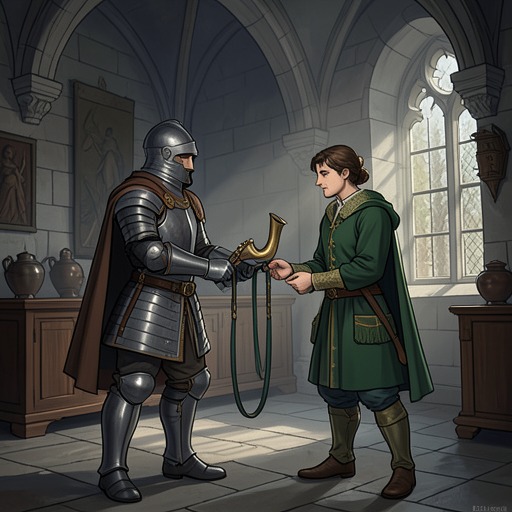
The agreement is put into motion at daybreak. Guests rise early, call their attendants, and prepare horses. Bertilak attends Mass, eats a hurried meal, and rides out with a large company. The huntsmen release the hounds and sound three blasts on their horns. These preparations give the bargain a public, orderly setting: the hunters leave together, while their quarry and the results of the chase are gathered, handled, and eventually brought back to the household.
On the first recorded hunt, Bertilak pursues Deer in the woods and heath. The hunters kill many animals; the largest are gathered, carefully opened, and examined according to the work of the hunt. When Bertilak returns, he assembles the household and has the venison brought before Gawain. He shows him the best parts, including the fat cut from the ribs, and gives him the entire take under the terms they agreed. Gawain acknowledges the gift and calls it the finest hunting yield he has seen in seven years of winter seasons. The exchange therefore begins with an abundant, visible prize, handled collectively and delivered in the hall.
The later hunt takes a different form. Bertilak and his men follow a Fox, whose flight draws the hounds and hunters through a marshy stretch and among thorns. The pursuit is narrated as a chase, with the hunters calling and urging the hounds onward. That contrast matters within the pact: the first account emphasizes the quantity, processing, and display of the quarry, while the fox episode centers on pursuit. Both nevertheless belong to the same daily cycle, in which Bertilak leaves to hunt and returns to meet Gawain.
The castle’s parallel exchange
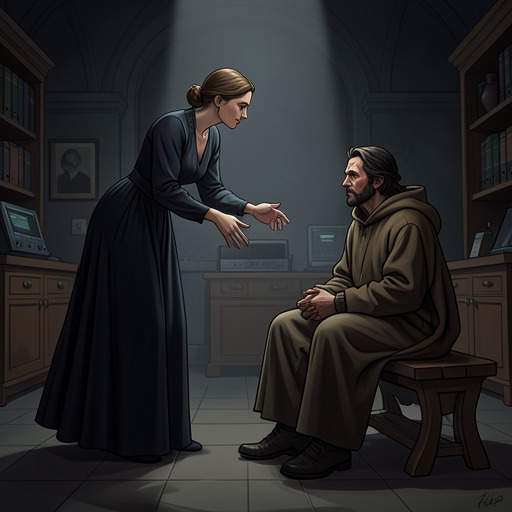
While Bertilak is out hunting, Lady Bertilak visits Gawain in his chamber. Her visits place a second kind of encounter alongside the outdoor chase. The agreement names winnings without specifying their form; meanwhile, what passes between Gawain and his host’s wife is not acquired in the public field or displayed with the venison. Her approaches make the daily bargain more than a bookkeeping device, because Gawain must decide what to receive and what to report.
The exchange becomes visible through kisses. When Bertilak returns, he embraces Gawain and kisses him; on another return he kisses him three times. Gawain accepts these gestures and returns them to Bertilak, so the host receives from him something gained in the castle rather than in the woods. At the same time, the narrative distinguishes this reciprocal, public accounting from other gifts Lady Bertilak offers. She presents Gawain with a richly worked red-gold ring topped by a bright stone. She also offers the Green Girdle, which is valued for the protection it is said to give its wearer. Those objects carry meanings and consequences beyond the straightforward presentation of venison or kisses, and expose the limits of treating every acquisition as an uncomplicated, equivalent prize.
Reckoning and significance
At an evening reckoning, Bertilak declares that the two men are even in all the covenants made since Gawain arrived. The language of balance gives their exchanges a moment of apparent closure: the host has delivered his day’s winnings, and Gawain has met him with what he can return. Yet the repeated returns to the rule keep its obligations active rather than letting it remain a single courteous gesture. Each morning begins another hunt; each evening makes the day’s account a question again.
The pact is renewed in conversation on New Year’s Eve, even as Gawain asks leave to depart the following morning. Bertilak’s men are ready with their horses before the hall gates, and the departing party sets out after the winter weather has cleared. This ending brings hospitality and obligation to a practical close: the host has received Gawain, kept him until the appointed journey, and sent him onward. The agreement’s larger narrative work, however, lies in the pressure it places on the difference between public exchange and private receipt. By making each man accountable for what he gains, it turns the ordinary forms of a hunt, a gift, and a kiss into parts of a single test of reciprocity.