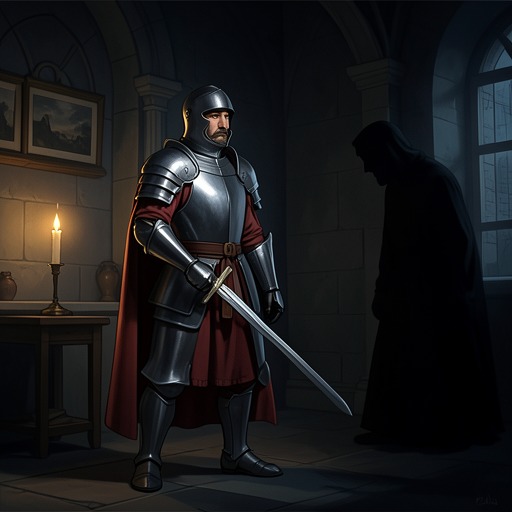
Chivalric virtue and its limits
Sir Gawain and the Green KnightChivalric virtue and its limits names the poem’s central tension between a demanding ideal and the imperfect person expected to embody it. Sir Gawain is presented as a knight of exceptional faithfulness, courtesy, purity, generosity, and fellowship; the ordeal that tests him nevertheless exposes a lapse in loyalty driven by love of life. His failure does not erase the ideal, but it makes the ideal’s human cost visible.
The Ideal and Its Setting
The poem places its adventure in a world where war, strife, wonder, joy, and mischance belong to the same broad history. Its opening reaches back to the siege and destruction of Troy before turning to Britain and the marvels associated with King Arthur. In that romance framework, virtue is not merely a private disposition: it must become visible through conduct when a knight leaves court and meets danger, uncertainty, and obligation.
The courtly setting also establishes an appetite for adventure. King Arthur is associated with a youthful desire to hear boasting, and the poem’s first feast is announced with trumpets and bright banners. Such ceremony gives the ideal a public face: reputation is made before an audience, through deeds that can be recounted and judged. Yet the narrative’s movement from court to wilderness shifts the measure of conduct from display to endurance. Sir Gawain rides into a deep forest among high hills, and the journey places the celebrated knight in circumstances where the courtly image of virtue must withstand pressure.
Fivefold Virtue and Gawain’s Reputation
The poem gives its account of Sir Gawain’s excellence a deliberate fivefold pattern. He is said to be steadfast in five and distinguished in several other groups of five. The pattern is not confined to an abstract list of moral qualities: it links capacities, religious associations, and social behavior, bringing different dimensions of the knight into a single design. The Pentangle’s Fivefold Virtues makes this ordered ideal visible, while the description of Gawain connects its pattern to the conduct for which he is known.
The account begins with an assertion that he was faultless in his five senses and did not fail in his five fingers. It then associates his faith with the five wounds. These details set bodily faculties beside religious reference: virtue is imagined as something that should hold across perception, action, and belief, not as a single isolated accomplishment. The repeated fives lend the portrait formal completeness, as though the knight’s different powers and obligations could be brought into harmony.
The poem’s social virtues make that ideal more concrete. It names generosity and fellowship above other things, and adds purity and courtesy, qualities represented as never crooked. These are not interchangeable compliments. Generosity and fellowship concern how a knight relates to others; purity and courtesy describe the integrity and discipline of his behavior. Together they explain why Gawain’s reputation is so high: his goodness is presented as a pattern extending across religious faith, personal conduct, and social life. The praise compares him to purified gold, an image of excellence made unmistakable by refinement.
Testing the Code
The formal portrait matters because the story subjects its claims to an adventure rather than leaving them as courtly praise. Gawain’s ride through a wild forest carries him away from the ceremonial security of Arthur’s court. Later, a lord laughingly tells him that he must stay until the appointed time and assures him that the Green Chapel will not trouble him further. The promise offers a measure of shelter, but it also keeps the approaching appointment in view: courtesy and hospitality do not cancel the obligation that awaits him.
The poem thereby distinguishes possessing a reputation for virtue from meeting every demand made upon it. Gawain can be celebrated for faithfulness and courtesy while still finding himself in a situation where loyalty and self-preservation pull in different directions. The test does not need to show that his earlier virtues were false. Rather, it reveals that a complete-looking emblem and a shining reputation cannot guarantee flawless action under mortal pressure.
Failure, Judgment, and Human Measure
At the encounter that brings the test to judgment, the shortcoming named is a lack of loyalty. The speaker qualifies the blame: the failure did not arise from a wicked scheme or from wooing, but from Gawain’s love of life. That distinction makes the fault specific. The narrative does not attribute his lapse to a general appetite for wrongdoing; it identifies the pull of survival as the circumstance in which his conduct fell short of the ideal.
Gawain responds with shame and condemns cowardice and covetousness as forces that destroy virtue. His self-judgment is severe, and it turns the failure into more than a minor blemish on a public reputation: he recognizes that the desire to preserve himself has implicated the virtues by which he understood himself. At the same time, the other speaker’s measured qualification resists treating the lapse as proof that Gawain is simply vicious. The poem holds blame and human vulnerability together, allowing the fault to remain real without making it the whole of the knight.
This tension gives the fivefold ideal its significance. Its completeness supplies a standard against which a lapse can be recognized; the lapse, in turn, shows why that standard is difficult to inhabit without remainder. Chivalric virtue is neither dismissed as empty ceremony nor presented as an effortless condition. It remains an aspiration with real moral force, but the narrative’s admired knight cannot embody it perfectly when loyalty comes into conflict with the fear of death.