Deer
Sir Gawain and the Green KnightDeer are the first major quarry of the hunts at the lord’s estate in Sir Gawain and the Green Knight. The poem presents them not as undifferentiated game but as animals divided by sex and kind, moving through a landscape shaped by horn calls, hounds, human rules, and pursuit. Their flight and the hunters’ handling of the kill give the hunt concrete force; its recurrence alongside the castle episodes also makes it part of the poem’s larger pattern of daily tests.
Deer in the Forest Hunt
At daybreak, the hunters gather on horseback and the keepers unleash the Hounds from the kennel. Three clear blasts on the horns announce the chase. The sound sends the wild creatures into motion: Deer stream through the valley, trying to escape toward higher ground, while the hunting party and its dogs press after them. In this opening account, the animals’ sudden flight is the event that turns the forest into a field of pursuit.
The poem distinguishes the quarry as the hunt unfolds. Harts are allowed to pass, as are broad-antlered bucks; the lord has forbidden anyone to disturb male Deer during the stated close season. Hinds, meanwhile, are held back amid cries and warnings, while does are driven noisily toward the deep valleys. As they flee through the turns in the terrain, arrows are loosed at them. These differences matter: the hunt is not described as an indiscriminate chase, but as a managed activity governed by distinctions among animals and by a restriction declared by the lord.
The scene gives Deer a particular place in the forest’s movement. Their attempts to scatter and escape are met by coordinated human and canine action: the horn signals the start, the Hounds pursue, and the hunters direct the animals’ passage. The poem’s account follows both sides of that encounter, from the startled movement of the quarry to the organized pressure of the chase. The forest is not merely scenery; its dale, slopes, and turns determine how the Deer flee and where arrows can reach them.
The Kill and Its Processing
In a later account of the lord’s hunting, Deer again form a substantial part of the quarry. He hunts in the woods and open country for barren hinds, and by the time the sun has declined he has killed a remarkable quantity of does and other animals. The narrative then shifts from pursuit to the work performed after the kill. A large group gathers around the carcasses, selects the largest, and begins the operations required to prepare them.
The processing is described in distinct stages rather than passed over as a single act. The hunters inspect the Deer, cut away the four limbs, remove the hide, and open the belly to take out the bowels. This practical sequence changes the scene’s emphasis: the hunted animal becomes a carcass handled by an assembled company, and the hunt’s success is made visible through the amount of game and the labor required to deal with it. The attention to cutting, skinning, and preparation gives the episode a material detail quite different from the rapid flight of the chase.
Rules, Recurrence, and Narrative Structure
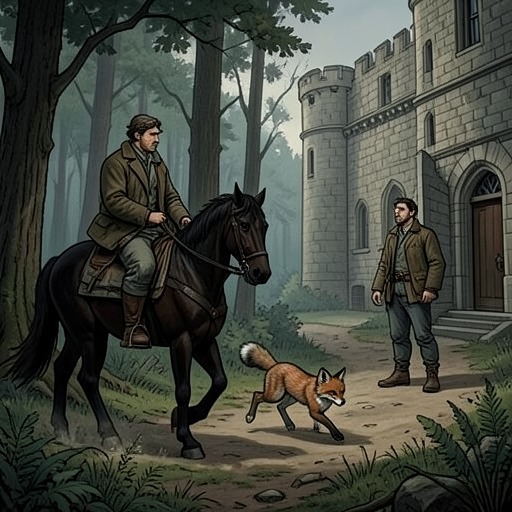
The Deer hunts recur within a sequence of hunts at the estate. The lord is still leading his games when the later pursuit of a Fox is mentioned, and the poem’s repeated returns to hunting give these episodes a patterned place in the narrative rather than treating them as incidental background. The deer scenes move from the first day’s horn-led chase to the reported kill of hinds, does, and other animals; later hunting continues the larger sequence with different quarry.
That pattern runs alongside the castle’s daily encounters with Sir Gawain and the arrangement by which the lord and his guest are to exchange their winnings. The hunts and the indoor tests occupy corresponding stretches of the narrative, so that attention alternates between animals pursued in the open and the pressures Sir Gawain faces within the household. The Deer are not themselves identified as the object of every exchange, but the hunt supplies one side of this recurring structure: the lord goes out, pursues game, and returns to a domestic setting where the day’s outcomes matter.
The contrast between the protected male Deer and the does driven toward the arrows also gives the hunt an internal order. Its violence is real, but it proceeds under a rule about which animals may be moved during the season, and the poem distinguishes the hunters’ treatment of one group from another. Together, the calls, the flight, the restriction, the kill, and the butchering make Deer central to the poem’s first sustained hunting episode and establish the hunt as both a physical action and a recurring narrative counterpart to the castle scenes.