Gawain’s Journey to the Green Chapel
Sir Gawain and the Green KnightSir Gawain’s Journey to the Green Chapel carries Sir Gawain from King Arthur’s court into the dangerous open country of Logres, where the promise made at court becomes a test of whether he can reach the appointed meeting. The route is marked by isolation, hostile creatures, winter weather, and repeated reminders that the adventure has a fixed term. Its movement from a festive court to a remote destination also prepares the poem’s reversal: the man who offers Sir Gawain shelter and directions is ultimately revealed as Bertilak, the Green Knight himself.
The Departure and Its Promise
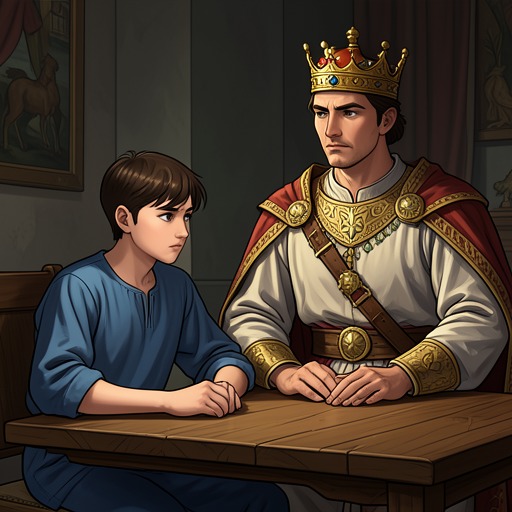
The journey begins after a feast, when Sir Gawain speaks mournfully to his uncle, King Arthur, about his passage and asks leave to go. His departure is not an open-ended quest: he is travelling to keep the appointment imposed by the Green Knight’s challenge. The courtly occasion that produced the vow now gives way to the consequences of keeping it. Sir Gawain’s request makes the departure a personal act of duty, while the presence of his uncle makes clear what he is leaving behind: the security and company of Arthur’s court.
The poem places this departure within a court already associated with adventure. Arthur, in his younger years, had eagerly sought stories of marvels and exploits; the narrative presents Sir Gawain’s journey as one such adventure, but gives it a graver charge. What begins in the world of courtly wonder is bound to a specific appointment and the prospect of bodily harm. The contrast gives the journey its tension: adventure is not merely something to hear about at a feast, but an obligation Sir Gawain must carry into the wilderness.
Equipment and Departure from Court
Before setting out, Sir Gawain is prepared for the road, takes up his lance, and bids the company farewell. His shield bears the Pentangle, the emblem explained as a sign known through learned teaching. That emblem accompanies him out of the court and makes his equipment more than practical: the journey begins under the visible sign of the virtues associated with his knightly identity. The departure thus places an ideal of constancy and virtue beside the physical dangers that will test him.
Later, as he sets out again on horseback, the practical details of travel return. He steps into the stirrup, his attendant brings him his shield, and he takes it onto his shoulder before spurring Gryngolet. The horse and shield make the movement concrete: the quest proceeds not as an abstract intention but through repeated preparations to ride onward. The return of the shield also recalls the Pentangle at the moment when Sir Gawain must continue toward the appointment rather than turn back.
Solitary Travel through Logres
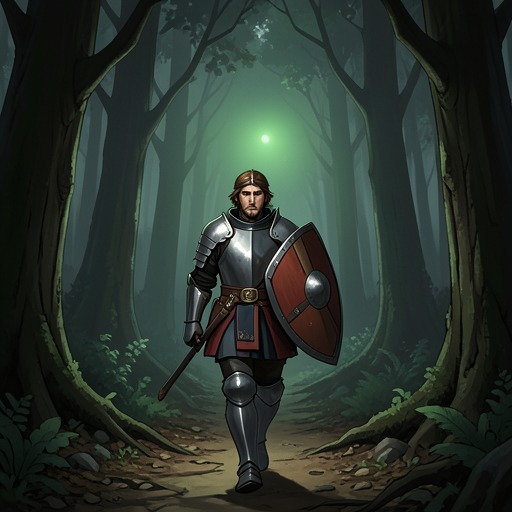
Sir Gawain rides through Logres alone, and the poem repeatedly stresses his isolation. The route is not a straightforward passage through friendly territory. He fights worms and wolves, as well as wild men, bulls, bears, and boars. The catalogue makes the wilderness feel crowded with threats even while the traveller himself remains without human company. Each encounter adds to the physical cost of reaching the Green Chapel and distinguishes this journey from the safer, communal life of the court.
The landscape intensifies that hardship. Sir Gawain travels through peril and pain until Christmas Eve, still alone. Cold water runs from a crest and hangs above him in hard icicles; the description makes winter part of the ordeal rather than a neutral background. The journey’s timing matters as well as its distance: Sir Gawain must reach the meeting at the end of the appointed period, and the winter passage presses the approaching deadline into the scene.
On a later morning he rides past a mountain and enters a deep, wild forest, with high hills on either side and woodland below. This movement into a more enclosed landscape changes the character of the route. The open realm has already exposed him to wandering dangers; the forest brings him closer to the strange place and reception that will guide him toward his destination. The poem’s romance structure carries its knight out of the familiar court and into an unfamiliar setting, but the dangers on the way prevent that transition from feeling effortless or merely ornamental.
Directions, Deadline, and Revelation
When a man asks what bold deed has driven Sir Gawain so far from the king’s court, alone, Sir Gawain explains that he has only three days left and would rather face death than fail his errand. His answer states the journey’s governing pressure plainly: he is not simply travelling until he happens to find adventure, but measuring every remaining day against a promised encounter. The prospect of death is acknowledged as part of the undertaking, not as a reason to abandon it.
The lord responds with laughter and tells Sir Gawain that he must stay; he will direct him to the Green Chapel when the appointed time comes, and assures him that the chapel need not trouble him further. This offer interrupts the solitary journey with hospitality and apparent guidance. It also changes the immediate problem: Sir Gawain no longer has to locate the destination entirely by himself, but must trust a host who seems to know where it is and when he should go.
At the journey’s far end, the encounter discloses that the host is Bertilak of Hautdesert and that Morgan le Fay’s power is involved in the events. That identity reveal recasts the assistance Sir Gawain received on the road: the guide to the Green Chapel is not a neutral stranger but the figure connected to the challenge he has travelled to meet. The journey therefore ends not simply in arrival, but in a change of understanding about the adventure’s design. The route tests Sir Gawain’s endurance, while its final revelation shows that the apparent separation between courtly hospitality and the dangerous challenge has been an illusion.