Gawain’s pentangle shield
Sir Gawain and the Green KnightSir Gawain’s pentangle shield makes an ideal of truth visible: a gold, interlaced five-pointed figure set on red. The poem explains both the device’s inherited meaning and its fit with Sir Gawain’s reputation, presenting the shield as more than armor or decoration. Its lines form an endless knot, an image of continuity that gives material shape to the knightly ideal; later, the protection associated with The Green Girdle brings that ideal into sharper contrast with bodily vulnerability.
Appearance and Use
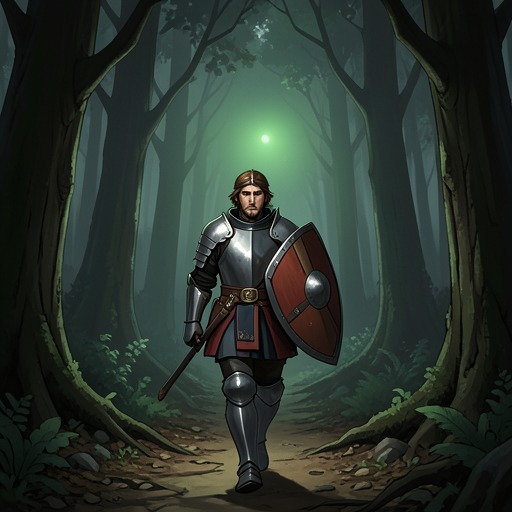
The shield is described as red, with the pentangle painted in pure gold. In the scene of Sir Gawain’s equipment, he takes it by its baldric and casts it around his neck. The account thus presents the emblem as part of the knight’s displayed armor, carried on his person rather than introduced as an abstract diagram alone. The vivid pairing of red and gold makes its design legible, while its position on the shield places the sign of truth within the equipment through which the poem presents its armed knight.
The poem stresses that the figure is made of five points, with each line looping and locking into the others. Its geometry has no loose end: wherever one follows the design, it remains connected. This is why it is also called the endless knot. The description gives the device a formal quality as well as a symbolic one: the image’s meaning is carried by the way its parts hold together, not only by the fact that it has five points.
Inherited Meaning and Sir Gawain
The poem attributes the sign to Salamon, who set it as a token of truth. That association gives the shield’s design an inherited authority within the poem. The pentangle is not explained as a private invention by Sir Gawain, but as a recognized figure whose form already bears meaning. Its interlocking lines provide a fitting image for truth understood as a quality whose parts remain joined rather than coming apart.
The narrator explicitly connects the figure to Sir Gawain and his bright armor. Sir Gawain is described as known for faithfulness in five and in many fivefold ways, and as pure as refined gold. The passage therefore aligns the device, the knight’s reputation, and the precious metal in which the design appears. It does not, in the supplied account, enumerate the fivefold qualities; the shield’s significance rests here on the stated connection between its five-part form, truth, and the knight’s acknowledged character. Gold functions both as the actual color of the painted figure and as part of the poem’s comparison of Sir Gawain to something purified.
The Endless Knot as an Ideal
The poem’s explanation lingers on continuity: each line encloses and joins another, and the design has no beginning or end, wherever the pattern starts or finishes. That description makes the pentangle more than a fixed badge of identity. Its form insists on an ideal of wholeness, one in which the parts remain bound together across every point of the design. The shield thus carries a standard against which Sir Gawain’s conduct may be read, while also showing how the poem turns an abstract moral claim into a visible, portable sign.
This emphasis on an unbroken figure also gives the shield a quiet narrative tension. The image appears whole and stable, and its meaning is stated with confidence; later episodes, however, make the knight’s vulnerability materially present. The contrast should not be mistaken for a stated change to the shield itself: the supplied passages do not describe it being damaged or revised. Rather, the emblem’s unwavering form allows the reader to distinguish the ideal it represents from the difficulties that can test a person who is associated with it.
Contrast with Later Protection
Later, the poem describes The Green Girdle as a green lace that could keep a person who wore it from being hewn down. In the closing account, Sir Gawain’s neck wound is healed, and the glittering belt is worn around him, bound at his side. These details belong to the belt, not to the shield, and the poem does not say that the pentangle causes or prevents the wound. Read beside the shield’s emblem of truth, however, they sharpen a contrast between an ideal represented as seamless and the body’s exposure to harm.
The shield’s importance therefore lies in the convergence of its physical design and the narrator’s explanation. Red and gold identify its appearance; the five interlocking points make its geometry a knot without an end; the poem links that knot to truth and to Sir Gawain’s reputation. Its later resonance depends on keeping that ideal distinct from the separate protective function of The Green Girdle. The pentangle remains the image of a virtue made whole, while the narrative’s later details remind the reader that a knight’s lived condition is not as invulnerable as an emblem might appear.