Gawain’s shame and contrition
Sir Gawain and the Green KnightGawain’s shame and contrition are the moral aftershock of his encounter with the Green Knight: Sir Gawain recognizes that, for fear of death, he concealed the Green Girdle instead of honoring his agreement to exchange winnings. He condemns the choice as a failure of the knightly virtues of generosity and loyalty, but does not simply discard its sign. Worn as a reminder of his fault and the frailty of the flesh, the girdle carries his private remorse back to court, where it becomes a shared emblem among the knights.
The fault and its exposure
The poem first presents Sir Gawain within a world that prizes adventure and chivalric reputation. King Arthur is remembered as the most courteous of Britain’s kings, and the narrative promises an extraordinary adventure from his marvel-filled court. Sir Gawain’s later self-judgment takes shape against that high ideal: the issue is not whether he can endure a marvel, but whether he can remain loyal when his life seems at stake.
The concealed girdle belongs to the temptation at Bertilak’s castle. In their exchanges, Lady Bertilak invokes the language of kissing and courtesy, while Sir Gawain answers with modesty and plays the part of her servant. When she presses him to explain why someone so young and accomplished should be present, he responds by denying that he deserves the honor she praises. These exchanges show the social skill with which he navigates her attention; they also establish the setting in which the girdle is offered and his conduct is tested. The eventual accusation is carefully limited: the Green Knight says Sir Gawain fell short in loyalty, but not through a deceitful scheme or because he yielded to the lady’s courting. He identifies the decisive cause as Sir Gawain’s love of his own life.
Confession and self-accusation
Before setting out for the Green Chapel, Sir Gawain secretly approaches a priest and asks for instruction on how his soul may be saved when he dies. He confesses his misdeeds, great and small, and seeks absolution. This private religious reckoning precedes the encounter in which the concealed fault is brought into the open; spiritual preparation does not prevent the revelation, but gives the later shame a second register, beyond the public judgment of a fellow knight.
When the Green Knight names the concealed girdle as Sir Gawain’s failing, Sir Gawain’s response is not to dispute the charge. He takes the knot and loosens it, calling the girdle a sign of his falsehood. He traces his failure to fear of the blow and to covetous self-preservation, which led him to forsake the generosity and loyalty belonging to knights. His words turn a specific concealment into an explicit account of the values he believes it violated. The shame is sharp because he can name both the choice and the code against which he measures it.
The girdle as a lasting reminder
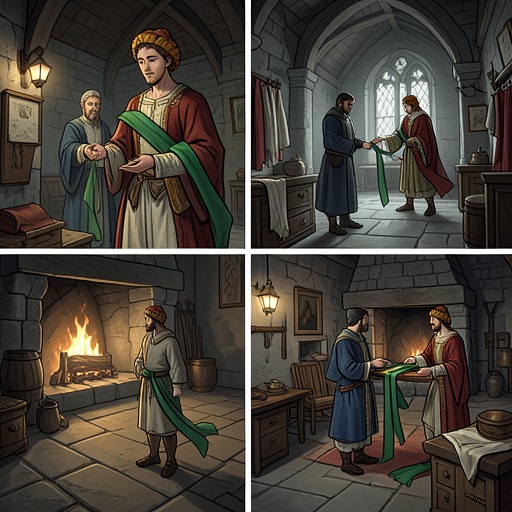
Sir Gawain does not return the girdle as though its value lay in gold, silk, decoration, or honor. He says he will keep it willingly as a sign of his wrongdoing, so that whenever he rides in renown he may remember his fault and the weakness of the flesh, easily enticed toward what is base. Its significance therefore changes: what had been concealed for protection becomes an openly acknowledged reminder. The object does not erase the lapse or turn it into a triumph; it gives the lapse a form Sir Gawain can continue to carry.
At the Green Chapel, he handles the girdle and names it the band of blame he bears around his neck, associating it with shame and loss. He also treats its attachment as enduring: once fixed to him, he says, it will not be separated from him. That insistence gives the remorse a continuing shape rather than a single moment of embarrassment. The girdle is both the evidence of a particular breach and a recurring prompt to remember how readily fear can unsettle the virtues a knight claims to uphold.
Judgment, forgiveness, and the court’s response
The Green Knight’s judgment does not collapse Sir Gawain’s whole character into this one failure. He compares him favorably with other knights, then identifies a small lack of loyalty and expressly distinguishes it from deceitful conduct or yielding to the lady. He blames Sir Gawain less because the lapse came from loving his life. That qualification does not make the concealment disappear; it places the fault within human vulnerability while preserving a real moral distinction between the lapse and more deliberate wrongdoing.
Sir Gawain’s answer remains severe. He curses cowardice and covetousness as vices that destroy virtue, and presents his own act as a betrayal of the generous loyalty proper to a knight. Yet his willingness to retain the girdle complicates the self-condemnation: he treats remembrance, not concealment or self-exoneration, as the response that should follow recognition. His shame is thus active—a means of keeping the choice in view—rather than merely a reaction to being exposed.
King Arthur comforts him, and the court laughs and agrees that each member of the brotherhood will wear a bright green baldric in his honor. This response changes the scale of the sign. Sir Gawain has described the girdle as a mark of his own fault, while the court makes its wearing a collective practice associated with him. The ending does not erase the difference between his private remorse and the court’s affectionate adoption; instead, it leaves both meanings attached to the same green band. His contrition remains personal, but its visible reminder becomes communal.