Hounds
Sir Gawain and the Green KnightThe Hounds are the active force of the poem’s hunting scenes: released from the kennel, driven by calls and horns, and sent in pursuit of game. Across the hunts they move as a coordinated pack, their baying marking the chase as it unfolds. They are not merely scenery around the hunters; their tracking and capture of the Fox bring the final pursuit to its decisive end.
The Pack and Its Work
At the opening of a hunt, the huntsmen unclose the kennel door and call the Hounds out. Three blasts sound on the bugles, and the pack answers with baying. The sequence establishes a division of labor: the huntsmen initiate and direct the pursuit, while the Hounds follow the game and give audible signs of the chase. Their first appearance is thus practical as well as ceremonial, joining an ordered human expedition with the movement and sound of the pack.
The Hounds’ work recurs in varied terrain and against different quarry. They follow the Deer during a hunt in the woods and heath; later, a huntsman calls out a quest beside a marshy area, and the Hounds converge on the trail. In each case, the pack’s activity makes pursuit legible: the hunt advances through calls, scenting, running, and renewed noise rather than through the hunters’ presence alone.
Pursuit of the Deer
In the Deer hunt, the Hounds follow the fleeing animals as the chase presses toward the water. The text emphasizes how quickly the pack closes the distance: the game is driven to the waters, and the Hounds are described as large and swift enough to seize it promptly and bring it down. Their physical strength and speed make them essential to the hunt’s outcome, while the hunters’ calls and horning keep the pursuit organized around them.
The hunt’s sound is part of its action. The Hounds bay as the chase gathers force, while horns and the hunters’ cries accompany the movement. These noises are not incidental decoration: they communicate that quarry has been found and that the pack is closing in. The Deer hunt therefore presents the Hounds both as bodies in pursuit and as the source of signals that allow the wider hunting party to follow the action.
Tracking and Collective Action
A later pursuit begins when a huntsman calls a quest from beside a marsh. He encourages the Hound that first picks up the trail, and the others hurry after it. The poem specifies that forty Hounds join the scent at once. This detail gives the pack’s work a collective scale, but also preserves a point of individual initiative: one Hound first finds the track, and the larger group takes it up.
Once gathered, the Hounds produce a clamour so strong that the surrounding rocky heights resound. The huntsmen answer the pursuit with horns and calls, coordinating their response with the pack’s progress. The scene makes tracking a shared process: the first Hound locates the trail, the pack amplifies and follows it, and the hunters use sound to stay with the chase. The group’s strength depends on this combination of a first discovery and many animals moving together.
The Fox Hunt and the Kill
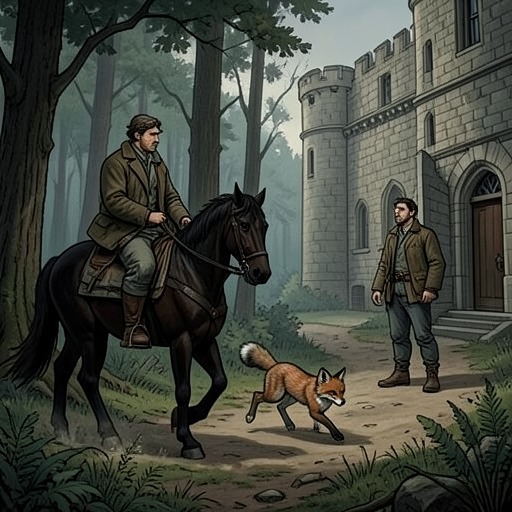
In the final hunt represented here, the lord is still leading his sport while the Fox has been pursued for a long time. As the Fox springs across a narrow gap, a Hound reaches it just before it can escape. The rest of the pack falls upon the Fox in front of the Horse’s feet and worries it to death. The capture is abrupt: the Fox’s attempted leap does not break the chase, because the Hound’s timely grip gives the others the opening to overwhelm it.
The hunters hurry to the spot with many horns sounding, continuing their calls until they see the huntsman. The Hounds’ kill thus becomes the point at which the scattered pursuit gathers into a visible scene for the hunting party. Their final action is also the pack’s clearest demonstration of collective force: one Hound intercepts the Fox, and the others complete the killing together.
Narrative Function
Across the hunts, the Hounds repeatedly convert a trail into a public, audible pursuit. Bugle blasts release them; baying and the first discovery of a scent announce progress; a mass rush closes the distance; and, in the Fox hunt, the pack’s attack ends the chase. Their activity gives the hunting episodes a recurring sequence without making every pursuit identical: the quarry changes, the terrain changes, and the Fox’s capture hinges on a last-moment interception.
The repeated attention to the pack’s coordination also makes the hunts more than a succession of kills. The Hounds depend on direction from the hunters, yet their speed, tracking, and collective attack determine whether the quarry is caught. The narrative gives those animal actions concrete consequences: the Deer are driven down, the Fox is stopped before escape, and the hunting party converges around the result. The Hounds are therefore central to the hunts’ movement and structure, not simply a background accompaniment to the human participants.